
My great grandfather, Christopher Rock, was born on 20th December 1881 in Ballyfermot and baptised a few days later at the parish church in Clondalkin. He was the fourth of the six sons of Edward and Catherine Rock. His father died on 13th September 1887.
Christopher worked as a labourer before enlisting into the Royal Regiment of Artillery (Royal Garrison Artillery) for 7 years with the Colours and 5 years in the Reserve on 11th December 1899. His older brothers Edward and Michael were already serving in the Royal Garrison Artillery. At the time of his enlistment he was serving in the Militia (“F” Company 4th Royal Dublin Fusiliers, Kit No. 586).
Christopher was able to sign his attestation papers but his handwriting was very poor. He was described as being 5 feet 7 inches tall with a fresh complexion, grey eyes, black hair and a scar on the left side of his head. Curiously he gave his age as 19 and 6 months when in fact he was just shy of 18. Possibly this is because he had lied about his aged when joining the Militia.
He joined the regiment at Seaforth on 13th December and on the 12th January was posted as 1670 Gunner to 21 Company Southern Division. Christopher was discharged as medically unfit at Portsmouth on 17th December 1900. His character during his time with the regiment was described as “good”. His handwriting had improved but he did not obtain any certificates of education. Christopher’s discharge papers give his qualifications for employment in civilian life as painter suggesting he had worked as a painter’s labourer before enlisting.
Christopher returned to live with his mother and two younger brothers in St. Lawrence, Chapelizod and got a job as a labourer in the G. S. & W. Railway Paint Shop at Inchicore. The age recorded on his employment record is incorrect as it was taken from his army discharge papers. As a labourer Christopher would have performed the grueling physical tasks required to prepare and finish railway carriages and locomotives including mixing the raw pigments, oils, and varnishes. The painting itself was done by highly skilled painters. Carriages received six coats of paint. Painting continued to be done by hand until the 1950s when it was reported as one of the most labour-intensive and time-consuming practices in the works.
On 13th March 1901 Christopher was admitted to the South Dublin workhouse infirmary with Pneumonia and Influenza. His true age was recorded. He was still in the infirmary when the census was taken on 31st March and was discharged on 10th April.
Christopher’s time at Inchicore coincided with a time of industrial unrest. In June 1901 the Amalgamated Society of Engineers (A.S.E.), which represented the highly skilled workers, demanded an extra 3s on the basic rate paid to their members. The following May the Inchicore branch of the A.S.E. served notice to the GSWR of their intention to strike over the pay dispute. The strike began on 23rd May and ended on 9th October.
Christopher enlisted in to the Irish Guards on 29th April 1902 signing up to serve 3 years with the colours and 9 with the reserve. His service number was 1308. Once again the incorrect age is recorded (22 and 7 months) presumably because his details were taken from his Dublin City Artillery papers. Christopher had grown an inch since his last enlistment which is fortunate as 5 feet 8 inches was the minimum height requirement for the guards. He stated that he was serving in the Dublin City Artillery, a part-time reserve unit of the Royal Artillery, and that he had never previously served in the Army. He joined the 1st Battalion in London on 3rd May and on the 8th was sent to the Guard’s Depot in Caterham. Christopher was re-vaccinated for Smallpox shortly after arriving. He suffered a reaction to the vaccine and spent 23rd – 26th May in hospital suffering from cowpox. The regiment’s first Colours were presented by King Edward VII to the 1st Battalion on 30 May 1902 at Horse Guards Parade.

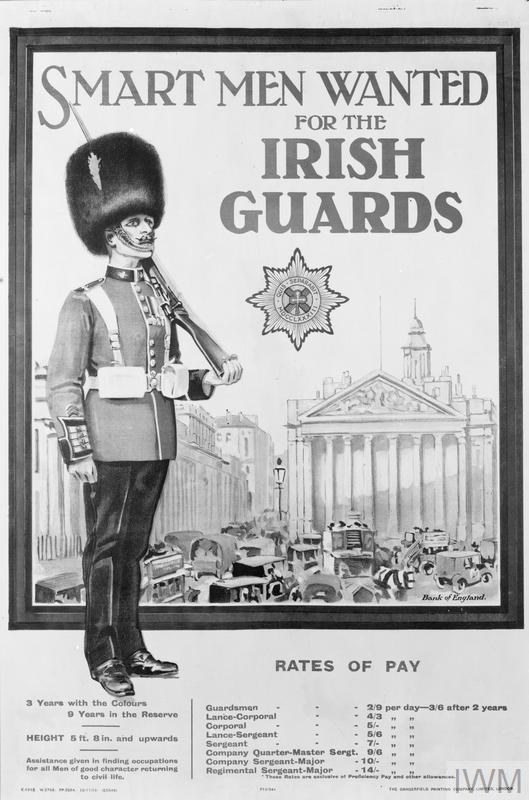
A year after enlisting Christopher’s lie about having never previously served in the army was discovered. Making a wilfully false answer on his attestation papers was a misdemeanor punishable by upto 2 years imprisonment. Christopher spent 20 days awaiting his trial and on 24th April 1903 he was sentenced by Court Martial to serve 28 days in prison.


Having completed his training at Caterham Christopher joined the battalion in Aldershot. Christopher fractured his fibula whilst off duty on 11th December 1903 and spent 32 days in splints. On 3rd July 1904 he was treated with an inunction of mercury, mist specific, to treat a possible venereal sore. In mid-September Christopher spent 8 days in detention awaiting trial for drunkenness on duty. He was tried on 20th, found guilty and sentenced to 42 days in prison and fined £1.

Late in 1904 the 1st Battalion deployed to Chelsea, London. On 9th January 1905 Christopher was transferred to Woolwich suffering with a possible venereal sore. In Woolwich he was diagnosed with soft chancre and spent 30 days in the hospital being treated with pot. nitra. and Iodoform. Just a couple of months later on 19th April he was re-admitted to the hospital suffering from Gonorrhoea. He was in hospital for 28 days where he was treated with potassium permanganate and silver nitrate irrigation. During his time in hospital his period with the colours expired. Christopher was transferred to the Army Reserve B on the 29th April 1905. During his 3 years with the colours he had spent 3 months in hospital and 3 in prison!
Whilst in the reserve Christopher was paid a weekly retainer. In 1914 this was 3s and 6d per week. He also had to attend training in the 2nd, 4th, 6th and 8th of the 9 years. In the years training was required he would have been sent a “Notice to Train” with his March payment. When the place and time of training had been agreed Christopher would then have been sent an “Order for Training” together with a passage warrant for him to get there if the place was more than 5 miles away from his home.
Christopher remained in London after his transfer to the reserves. In the autumn of 1905 he took up with Charlotte Welch, an unmarried mother with a young baby. They were married in Paddington Register Office on 4th July 1906. The Marriage Certificate shows that Christopher was working as a Railway Porter. He described his father’s profession as a blacksmith. This was an exaggeration. Edward Rock had been a blacksmith’s labourer at Inchicore. The marriage was witnessed by Robert Briffett and Sarah Grace Irons who were friends of Charlotte. At the time of their marriage the couple were living at 45 Alfred Road.
Christopher and Charlotte’s daughter, Doris Amy, was born on 22nd Aug 1906 at 1 Windsor Street. Charlotte registered the birth and Christopher’s occupation was given as carriage cleaner for G.W.R.
By June 1908 the family had moved to 398 Portobello Road where Christopher and Charlotte’s second daughter, my grandmother, Catherine Helen was born on 25th. Her birth certificate shows that Christopher was still employed as a carriage cleaner.
The marriage to Charlotte and the birth of Doris were recorded on Christopher’s army papers but the birth of his second daughter, Catherine Helen, on 19th June 1908 was not.
On Saturday 6th March 1909 a very drunk Christopher was refused service in the Porchester Arms, Paddington. He struck a screen, smashing a plate-glass window and a load of glasses, and a man who tried to stop him escaping. The Morning Advertiser of the following Tuesday (9th) reported:

Unfortunately it is not known if the fine was paid or if Christopher went to prison but it seems he may have lost his job around this time because when he was taken on as a platform conductor in Hammersmith on 19th May 1909 his previous employment was given as a doorsman for the Raymond Picture Company at the Queens Park Hall in Harrow Road. His London Transport employee record states he was 5 feet 9 ½ inches tall. Christopher’s wages were 19 shillings a week increasing to 20s on 31st January 1910. Whilst on platform duty at Latimer Road Station on Sunday 22nd May 1910 Christopher got into an altercation with two women one of whom was Charlotte. He left his duty without permission at about 10.50pm and did not show up for work again until the 25th. He was discharged the following day.


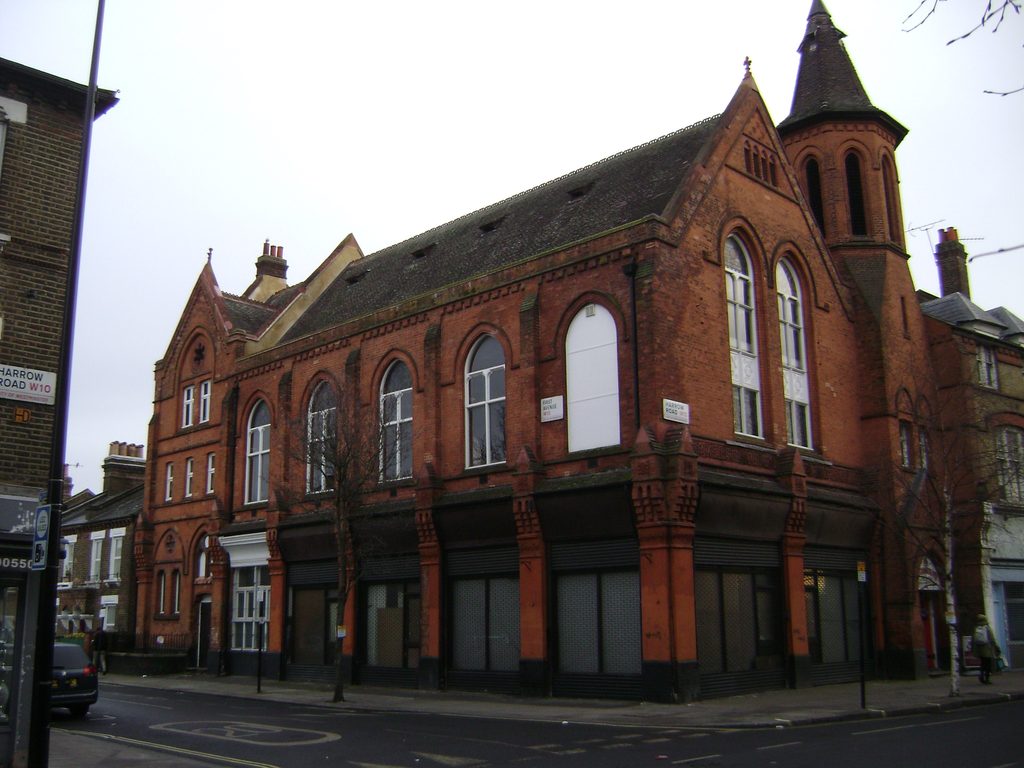
Queens Park Meeting Hall, Harrow Road. Photographs by Brian Jessop via historicengland.org.uk
In late 1911/early 1912 the family moved to a bedsit in 17 Lionel Mews. At about 10pm on Saturday 2nd March Christopher returned home to find their neighbour Sydney Tucker at the bedsit. It is possible that there was an innocent reason for him being there. If Charlotte and Sydney were having an affair it would seem that Christopher was not expected home that night until after the pubs shut – if at all.
When he came home Christopher’s violent reaction forced Charlotte to flee. To gain admittance to the workhouse or to later file for divorce she would have had to demonstrate that her husband’s actions made it impossible for her to continue living with him. On 16th March Charlotte summoned Christopher to the West London Police court to seek a separation order for constructive desertion (meaning that she had not left of her own volition but had been forced out by Christopher’s behaviour). The magistrate dismissed the summons after she admitted being found with a young man at 10pm at night.
Charlotte and Christopher never reconciled. On the 20th March 1913 Christopher petitioned for divorce naming Charlotte as Respondent and Sydney Co-respondent. By this time Christopher was working as a painter’s labourer and living at 85, Chippenham Road, Paddington. The Honourable Sir Henry Bargrave Deane heard the case on 17th November 1913 at the Royal Courts of Justice, Strand. He pronounced that Christopher had sufficiently proved the contents of the petition and that the marriage be dissolved unless sufficient cause be shown why the Decree should not be made absolute within six months. He also ruled that children of the marriage, Doris and Catherine, were to remain in the custody of Christopher. But there was cause for the marriage not to be dissolved – Christopher’s own adultery. On 17th November his mistress, Marie Lenharth, was 3 months pregnant and their daughter, Ivy, was born a week before the Decree Absolute. By not speaking out Charlotte colluded to get the marriage dissolved. The Decree Absolute was granted on May 25th 1914.
Ivy’s birth was registered with the surname of Rock even though her parents were not legally married. Christopher and Marie were married on 6th July 1914. Christopher claimed to be a widower! Christopher’s address was given as 85 Chippenham Road and Marie’s as 46 Caird Street, her parents’ home. The witnesses to the marriage were Marie’s father, Gabriel Lenarth, and sister Rose.
Christopher was discharged from the reserves on 28th April 1914. He did not re-enlist at the beginning of the war and there is nothing on his Guards record to show that he served in another regiment. Conscription was introduced on 27th January 1916. Initially Christopher would have been exempt from call-up because he was a married man and also a time-expired veteran. Changes made on 25th May 1916 removed both of these exemptions and Christopher would have been legally required to register for the draft. As a “time-expired” man who had gone back to civilian life he would have been particularly sought after by the army because the was already a fully trained soldier. Christopher would have been given a fresh medical examination and if passed as fit and conscripted, placed where needed and not necessarily back into the Irish Guards. One might have expected some note on his Guards records in this had happened but there is none. A man could appeal conscription on the grounds that he had a critical civilian job, severe family hardships, or medical issues. House painter was not a scheduled occupation but it is possible that by mid-1916 Christopher was employed in other work which was contributing to the war effort. There is no service record for him (this is not conclusive evidence as many records were lost in the Blitz); there is no medal card for him and I have not found evidence for Christopher in connection with military service tribunals in the newspaper archives or the Middlesex military service appeal tribunal records at The National Archives. It would seem he did not serve because he was unfit or was on war service at home. His three surviving brothers, Michael, Patrick and Joseph, all served.
Christopher’s second wife, Marie Lenharth, was born in London to German parents. When war broke out, as foreign nationals, Gabriel and Johannette Lenharth would have been required to register with the police. As enemy aliens they would also have faced the possibility of being interned or deported although this is unlikely to have happened to them because of their ages; their having lived in England for over 35 years and having a son serving in the British Army. (Their eldest son, William, who had anglicised his surname to Leonard, enlisted into the Royal West Surrey Regiment in 1914, lying about his age as he was too old to enlist. He later transferred to the Queen’s Regiment Labour Corps. William was killed in France on 30 October 1918.) At the very least Gabriel and Johannette would have had travel restrictions imposed on them.
One wonders how much hostility Christopher would have encountered for having German-in-laws and possibly not serving his country and whether or not he received any white feathers.
Catherine Rock senior arrived from Ireland sometime during 1913-14 (but before 14th August 1914) possibly coming over to help care for her granddaughters. Catherine lived at 566, Harrow Road. By the time Doris was admitted to the workhouse infirmary at the end of June 1916 Christopher, Marie and their daughters were living at number 583.
Joseph Rock was seriously wounded in June 1917. He gave Christopher’s address (583, Harrow Road) as his discharge address. Joseph and his wife Bridget, who joined him from Ireland, stayed with his mother until they found a home of their own.
Women over 30 gained the vote in 1918. Bizarrely, since she had never lived there and Christopher had remarried in 1914, it was Charlotte’s name not Marie’s that appeared on the electoral roll for 583 Harrow Road alongside Christopher’s. This remained the case until 1928.
At the beginning of November 1919 Christopher was fined 40s or 11 days-imprisonment for using insulting words and behaviour in the lobby of the Magistrates’ court after his brother Patrick was found guilty of Unemployment Fraud on the 3rd.

The 1921 census return for Christopher and his family, who were still residing at 583, Harrow Road, shows that Christopher was out of work. His last employers had been Simmons & Coward decorators of 3 & 6 Brown’s Court, Edgeware Road. Marie is shown as working as a metal work machinist, Doris as working as a waitress at Bradleys and Catherine and Ivy as being at school. But the Rocks lied – 14 year-old Doris was no longer living there. Doris is also recorded as a boarder at 162 Westbourne Grove along with other employees of Bradleys – The Arctic Fur Store.
Catherine and Doris had unhappy childhoods and, like Doris before her, Catherine would be forced to leave the home after she finished school. After leaving home Catherine had very little further contact with her father whom she described as a cruel man.
When the 1939 register was compiled Christopher and Marie were still living at 583 Harrow Road. Christopher was a house painter and Marie a machinist. A house painter over the age of 30 was a reserved occupation meaning Christopher would not have been accepted for service (he was in his late 50’s anyway!). There is a note against Christopher’s entry on the register stating that he had been transferred to the Reserve R.E. As part of the reserve he would have been assigned to work maintaining infrastructure in the U.K.
By the end of the war Christopher and Marie had moved to 34 Chippenham Road, Paddington. They lived there until Christopher’s death of a coronary thrombosis, in Paddington Hospital, on 2nd June 1950. Christopher left no will. On 15th September 1950 Letters of Administration were granted to Marie. The value of his estate was £373 5s 3d.