
The School Gardens at the Boscombe British School (with illustrations). By Mr. T. G. Rooper, one of Her Majesty’s Inspectors of Schools. Published in 1898 in Special Reports on Educational Subjects Volume 2.
Click on a page to enlarge it.
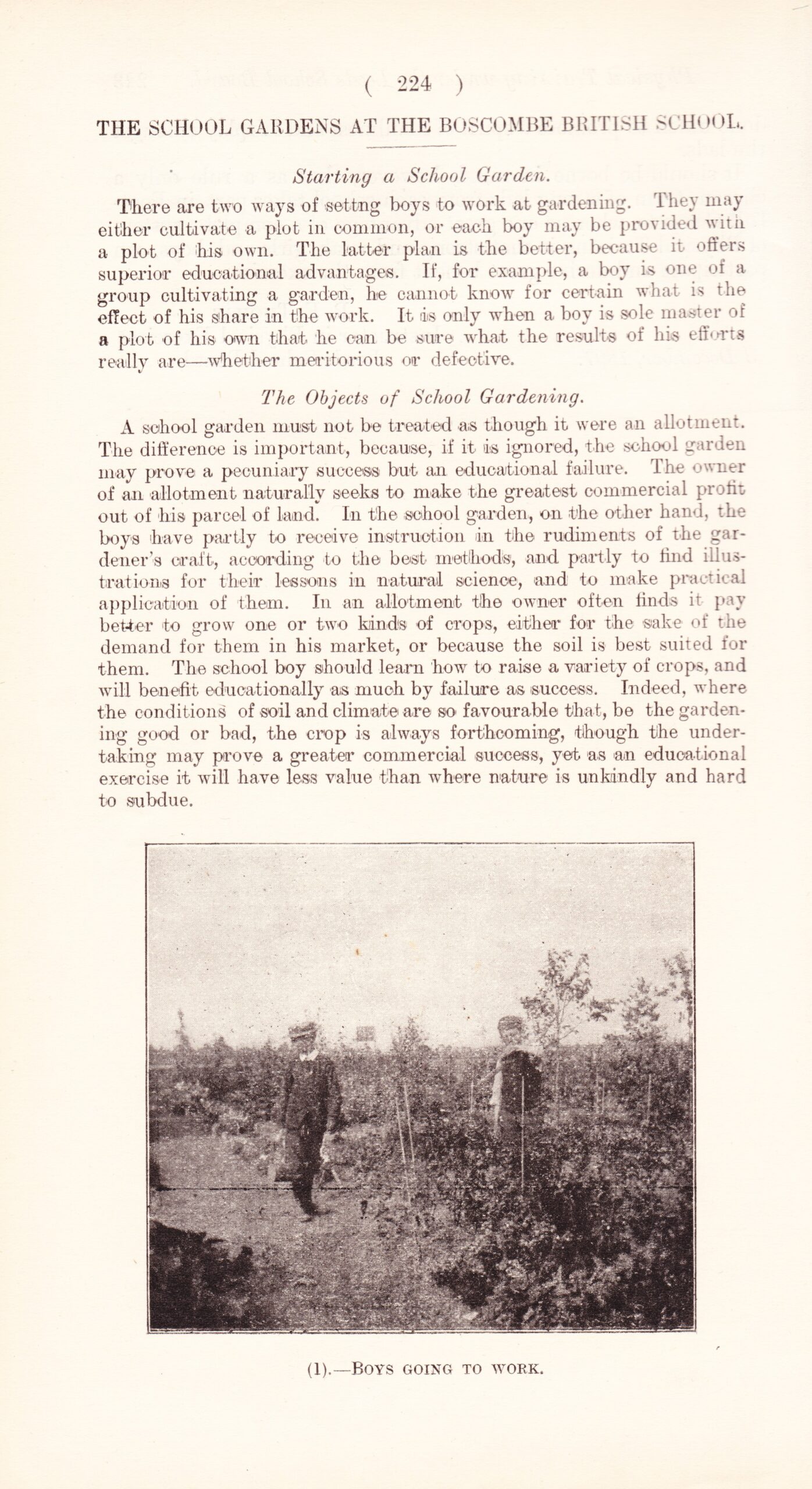
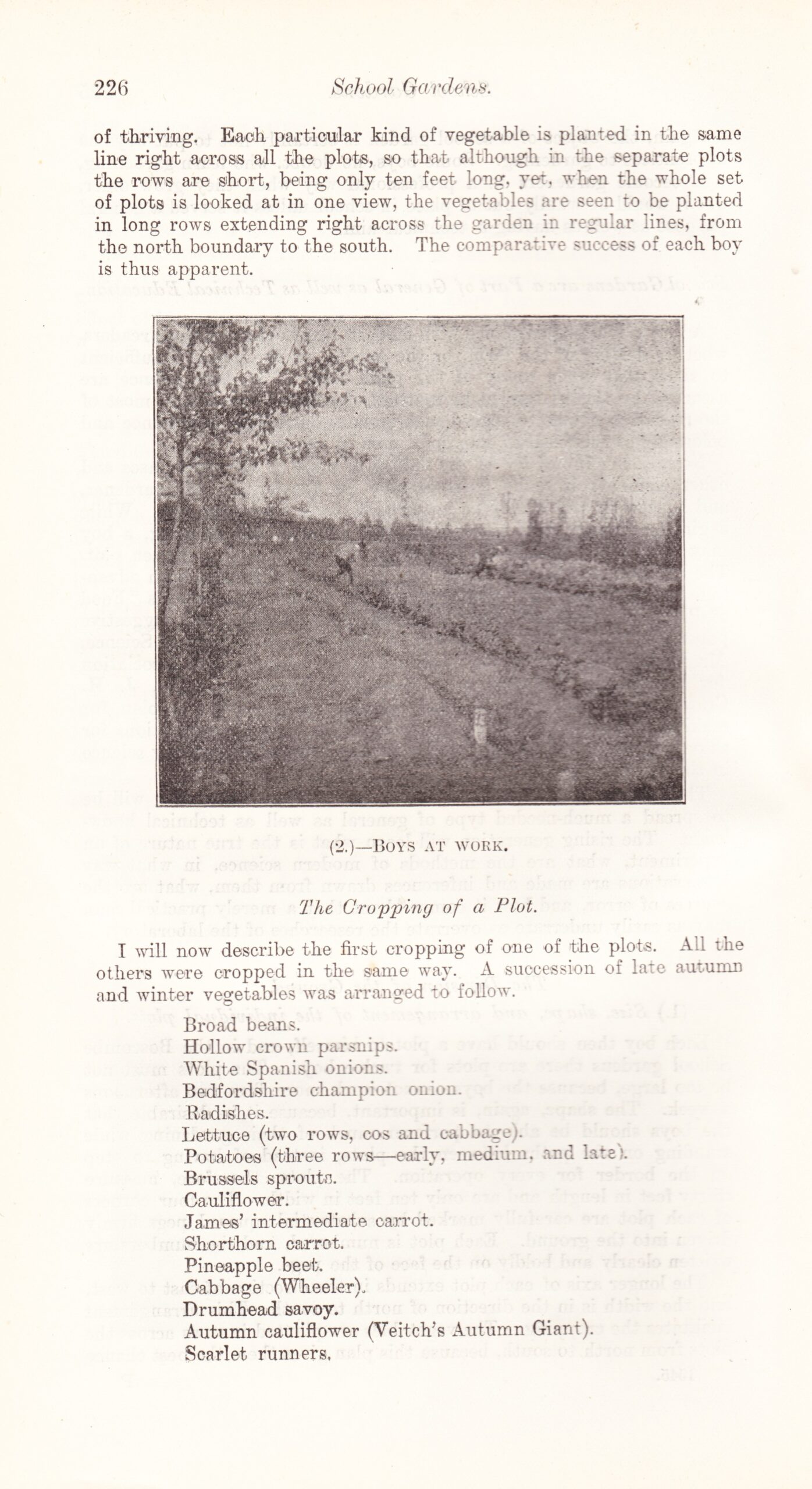
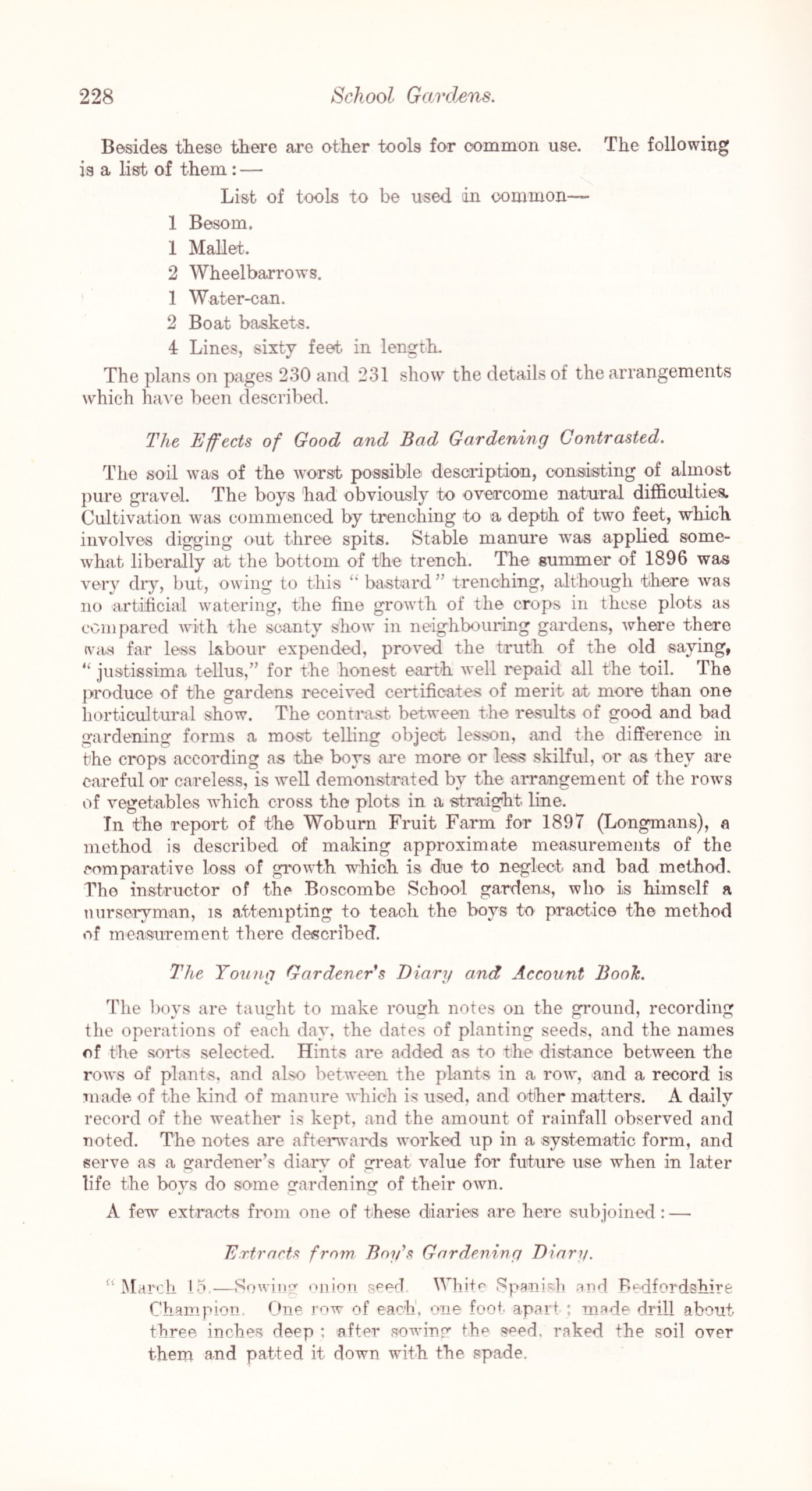
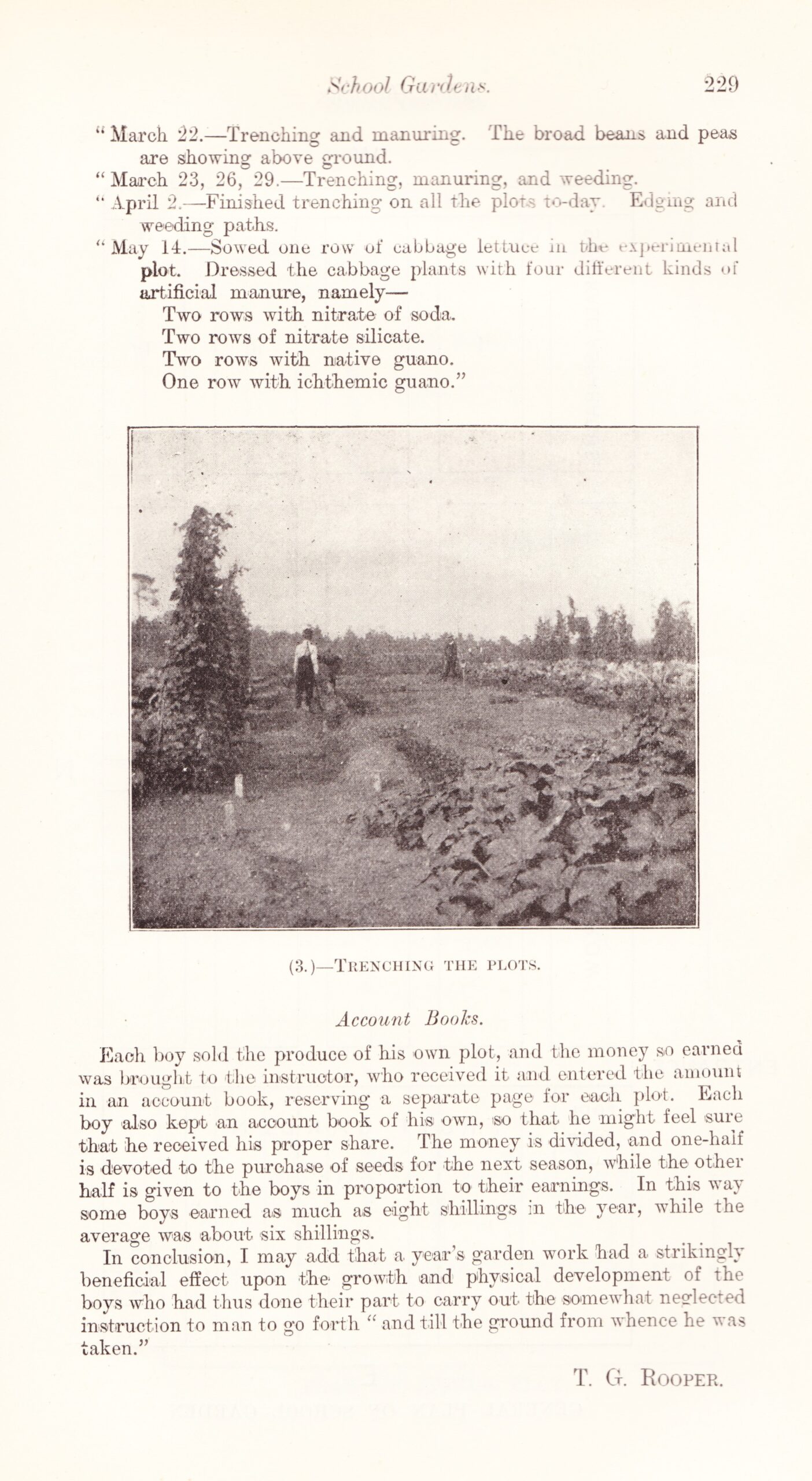
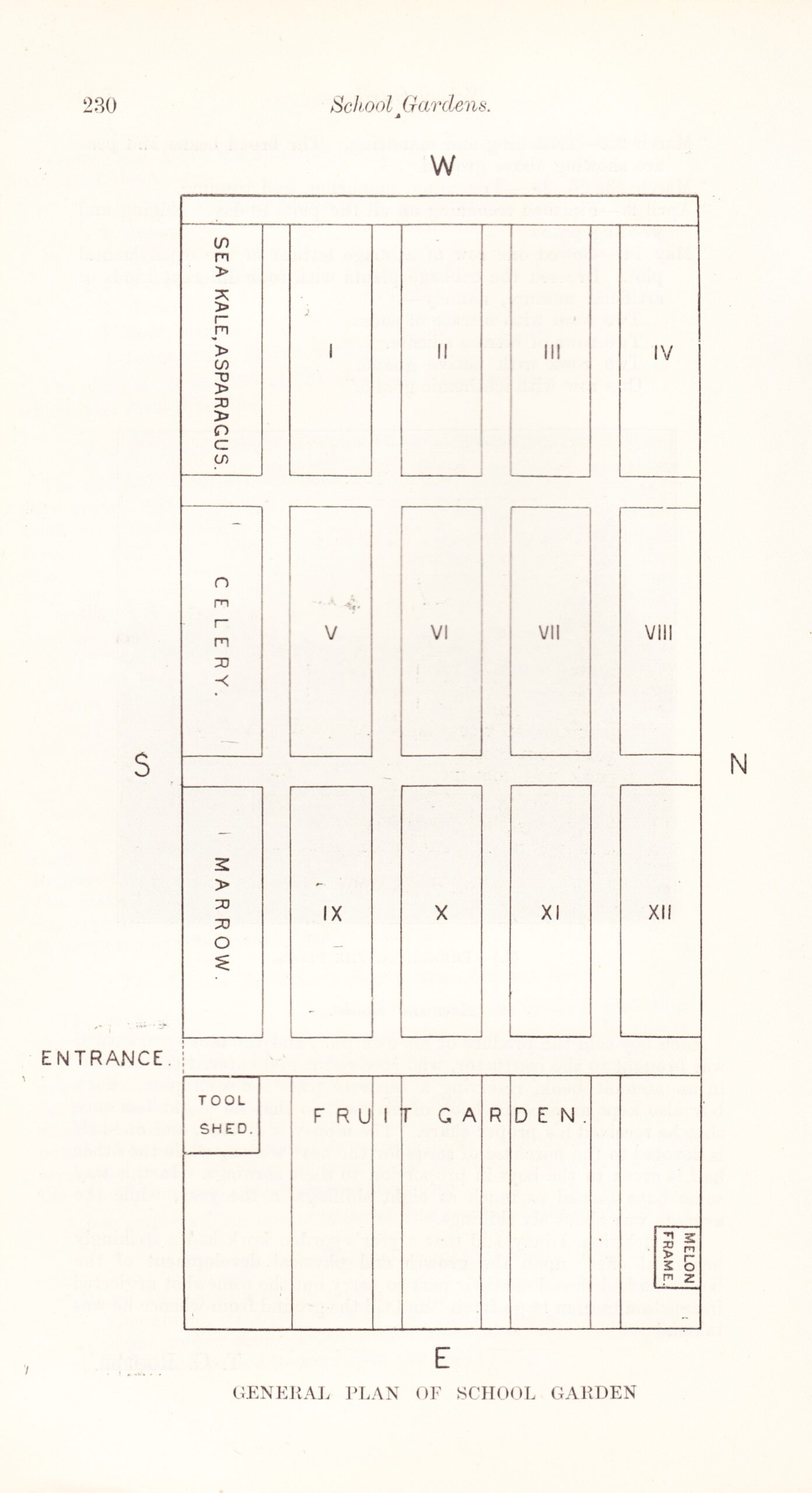
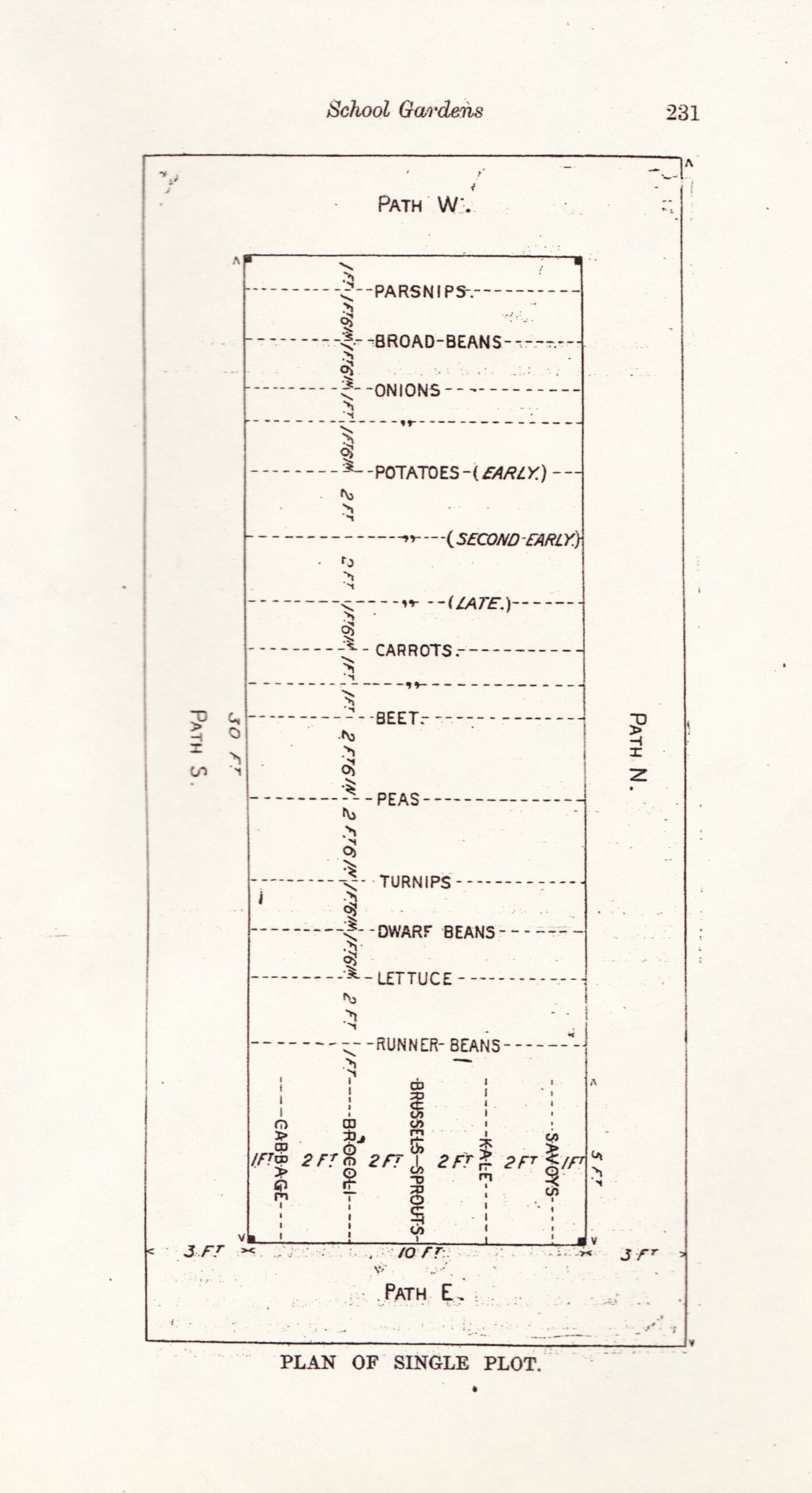
The following article about the experimental garden at the Boscombe Board School appeared in The Bournemouth Graphic of 27th July 1905. The journalist seems to have failed to fully grasp that the purpose of the school garden is not “to teach to garden” but rather “to garden to teach” (and to teach not just horticulture).
The Rooper Gardening Scheme.
The name of Rooper is widely known in Bournemouth in connection with philanthropic works and intellectual pursuits, but perhaps the one with which the name is most closely identified is that which had its origin in the fertile brain of Mr T. Godolphin Rooper, the only and much-beloved brother of those ladies who are so well known to Bournemouth residents. As is well known, Mr. Rooper, by profession and natural inclination, had a keen interest in education: in his capacity as one of H.M. Inspectors of Schools he was ever seeking opportunities of widening the mental horizon of the children with whom he came in contact, as well as to increase their interests.
It was, as has already been said, Mr. Rooper’s idea that gardening, taught in a thoroughly practical way – and not a la Squeers of Dotheboys Hall – should be adopted as a subject in the Education Code. The object of this idea was two-fold: firstly, to arouse the children’s interest in gardening as an occupation from which they could gain much pleasure; secondly – and this would seem to have been the root idea of the scheme – to lead them on to learn the possibilities of the science of horticulture, and so provide them with an opening to a healthy and reasonably paid livelihood as they grew up. Like all pioneers, Mr. Rooper received at first little or no encouragement: his scheme appeared to the Board of Education to be visionary and theoretical rather than practical: and its members were not willing to spend money in the necessary experiments until the practicability of the scheme had been tested: neither would the Board at first accede to the request that gardening should be included in the Code. Nothing daunted, however, Mr. Rooper undertook to show the practical working of the scheme at his own expense, provided the Education Department would allow the time spent in gardening to be reckoned as school attendance.
The plot of land which was chosen for the experiment was situate on the cliff as Boscombe, and the native of the soil has been described as very unpromising. In all probability it was the kind typical of Bournemouth, light, sandy, and requiring a great deal to be put into it before anything satisfactory in the way of results could be taken out. The fact that the soil was unpromising was, however, no discouragement to Mr. Rooper, rather the reverse, since he did not wish the boy gardeners to have everything made too easy for them.
It was the Boscombe British School which supplied a class of boys to work in this garden under the charge of an efficient nursery man. Each boy had an allotment of 30 feet by 10, and some larger plots were kept for the growth of such things as could not well be grown in the smaller beds. Besides this practical work, lectures on the theoretical side of gardening were given to the boys by Miss Rooper, who undertook the correction and criticism of the paper work done in connection with the lectures.
By a wise arrangement the boys were stimulated to work their best by being allowed to sell the produce of their individual plots, half of which went into their own pockets, the other half being banked for the purchase of seeds for the next season. That this was not the end of their interest in gardening is shown by the fact that in many cases, with all the enthusiasm of “new brooms,” they carried the results of their gardening lessons into practical effect in their little gardens at home. Furthermore, the boys themselves profited considerably both in body and mind.
Before very long, the success of the school garden was so well established that the Board of Education awarded it a special grant and placed Cottage Gardening on the Code as an optional subject in 1895-96. In that year no fewer than 42 schools claimed the grant, of which nine were board and the remainder voluntary schools. At the end of the school year ending 1901 the grant was claimed by 110 schools, and in 1903 by 481 boys’ schools.
Records from the various schools have shown that in many cases boys have gone straight from school to work at a nurseryman’s or market gardener’s, thereby bearing out what has been said as to the scheme giving an opening for a good and healthy livelihood. May it be hoped, too, that as the movement grows and spreads, as it surely will, that it will tend to remove the reproach that often rests upon the “jobbing gardener,” who, it must be said, is not infrequently known to make a comfortable living by his two days a week at three private gardens, without ever having been thoroughly trained in gardening, or in anything connected with the science of horticulture!
Like all work which is destined to have lasting results, this gardening scheme was worked up very quietly, and has, until late years, attracted little or no attention outside its own immediate circle. It cannot but be said that we must be proud of the fact that the scheme, which is likely to have very far-reaching effects, was originated and carried to success – in the face of considerable difficulties – in Bournemouth, by Bournemouth residents, to whom every honour is due for the splendid work done in connection with the scheme.