
Jane was born in Spetisbury in 1808 to Luke James and Jane Sibley. She was baptised on 13th March. Luke, a miller by trade, was also known as Edward, perhaps to distinguish him from his shepherd father who was also named Luke. Jane had three half-sisters: Hannah, Charlotte and Eliza from Luke’s first marriage with Hannah Coffin and two brothers: Jeremiah and Isaac.
Luke’s name appears in the 1799 militia list where he was recorded as being exempt from service because he had leprosy. The list, which was compiled around the time of Eliza’s birth, also shows him as having 2 children. It is not known when Luke died but it was probably prior to civil registration which was introduced in July 1837. Jane was shown as being a widow when she died at the beginning of June 1840.
Jane’s brother Jeremiah was a servant to George Smith of Spetisbury Manor. He married Louisa Maria Harvey in 1822. Jeremiah and Louisa had six children born in Spetisbury prior to their emigration to the United States in 1836. They arrived in New York on 6th June. At this time there was an agricultural depression in England and wages, which were already low, continued to fall. In February 1834 six men from nearby Tolpuddle were transported to Australia for 7 years. The men had been tried under an obscure law and found guilty of swearing secret oaths. They had formed a Friendly Society of Agricultural Labourers to protest against the lowering of agricultural wages which was legal but initiation into the Society had required the swearing of an oath by the new member. After a public outcry the six were pardoned in March 1836 but it was over a year before the first of them returned to England. The last man didn’t get home until August 1839! In 1838 a Union was formed in Spetisbury.

Banns were read between Jane’s brother Isaac and Lucy Sutton in May 1832 but no marriage took place. Their son Daniel Isaac James Sutton was baptised in November 1833. Isaac has not been positively identified in the records after this date.
It is likely that Jane was in service. There was a Jane James living with her illegitimate son, Samuel, in Furze Hill when the 1841 census was taken which may possibly be her. On June 21st 1846 Jane married James Downton at the church of St John, Clerkenwell after the reading of banns. It is not known why they were in Clerkenwell. They were staying at the house of the clockmaker Adam Inglis and Adam was one of the witnesses to their marriage. Adam was married to Elizabeth Pearce from Poole. The Downton, James and Pearce families were well acquainted. Sally [Sarah] Pearce is shown living with James’s sisters in Spetisbury when the 1841 census was taken while an Elizabeth James was staying with Elizabeth’s parents John and Elizabeth in Ashley, Ringwood. James is said to be a farmer. A James Downton, yeoman, shown on the jury list for Lytchett Minster in September 1846 could be him. A couple of years after their wedding James deserted Jane and she went into service to support herself.
In the 1851 census Jane is shown as a servant in the household of the widow Sarah Way at Woodlands in East Howe, Kinson (her name is erroneously recorded as Dowden). Jane is recorded as being married. Sarah Way was a farmer of 70 acres employing four labourers. Two male servants were also employed in the household – John Pain from Kingston and Charles Talbot from Langton Matravers. John Way’s sister Sarah lived in Langton Matravers with her husband the Rev. David Davies.

Sarah Way had lived with her husband John at Howe Lodge in Brook Lane. John Way died in 1846 and by the time the 1851 census was taken Sarah was living next door in Woodland’s Cottage. Whether or not Jane started working for Sarah Way before the move she certainly would have known the house. This advertisment from 1861 describes the accomodation provided by both Howe Lodge and Woodland’s Cottage.

The Way, Downton and Spinney families were well acquainted. Generations of the Spinney family had been blacksmiths in the Tarrant valley/Stourpaine/Blandford area. The Ways were blacksmiths in the Winterborne/Puddletown/Tincleton area. My great x5 grandfather, the shepherd John Downton, was living in the tything of Ilsington when the Militia List of 1758 was compiled. Also on the list were Thomas Way a blacksmith in Tincleton and William and John Way who were blacksmiths in Puddletown. John Way was the father of Joseph Way the father of John Way of Howe Lodge. Joseph Way was also a blacksmith in Puddletown but by 1787, when he was made gamekeeper to the Lord of the Manor of Anderson, he was a yeoman in Anderson. Joseph died in 1796 and his wife Mary Blake continued at Tomson Farm until her death in 1815. John Downton’s daughter Sarah was a servant of the widow Mary Way and a witness to her will. Betsy, the other sister of John Way of Howe Lodge, was married to John House of Anderson House.
In 1851 James was living with his mother and stepfather in Blandford St Mary.
At this time a married woman didn’t even own the clothes on her own back. Whatever a woman who had been abandoned by her husband managed to save or acquire could be claimed by him. A clause in the Matrimonial Causes Act of 1857 enabled a wife who had been deserted for more than 1 year to protect her earnings from any claim by her husband. Reporting on the Petty Sessions held in Wimborne 8th September The Salisbury and Winchester Journal and General Advertiser of Saturday 17th September 1859 records:
“Mr. Freeman made an application for an order for protection under the Divorce Act on behalf of Mrs Jane Downton, of Kinson, whose husband resided at Charlton, near Blandford, and who left her when on a bed of sickness about eleven years ago. She was now living by her own industry, and had saved a little money, for which she sought the protection provided by the Act in question. Granted.”
In 1861 Jane was still in the employ of Sarah Way with her occupation given as ‘cook etc’. James was a lodger in Rope Close, Pimperene, employed as a Brewers carter and now recorded as being married.
Sarah Way died at Woodland’s Cottage in 1869. She had not spent all her final years there as evidenced by advertisments to let the property in 1859 and 1861 and her living in Rugby where her will was drawn up and signed in 1867. Whether or not Jane remained in Sarah’s employ during these years is unknown.
By the time of the 1871 census Jane was living next door to Thomas Hicks‘ household in Kinson Village. She had taken in a boarder, Sophia Baker from Christchurch. Sophia was the daughter of John Baker of Christchurch, a boot maker. After her father’s death Sophia moved to Kinson, living off an annuity and lodging for many years with Emily Rodwell. Emily was the daughter of the farmer Edward Elliott of Cudnell. She married John Rodwell, son of a neighbouring farmer in St. Mary’s Islington on 2 Jan 1831. Coincidentally John’s address was given as St James, Clerkenwell! The witnesses to the marriage were John’s sister Jane and her husband the Clerkenwell watchmaker John Hux. Emily and John had 4 children before John was convicted of Breach of the Peace on 11 Feb 1837. Breach of the peace was a legal mechanism to prevent violence or threats of violence which included threatening or insulting behaviour and engaging in violent behaviour. There are no details of the case in the newspapers suggesting John pleaded guilty. It must have been a serious incident or series of incidents as the magistrate threw the book at John sentencing him to 12 calendar months in prison. John was discharged after serving 3 months. Unfortunately the record is damaged so the terms are unclear but they did involve his mother Mary. Perhaps she agreed to provide surity. It is possible that Emily suffered domestic abuse at the hands of her husband because whatever happened seems to have marked the end of them living together. They had no more children; when the 1841 census was taken Emily and her daughter Emily were living with Edward Elliott whilst her sons were living with their father; and when young Emily died in June 1850 it was her mother who placed the notification of death in the newspaper. John Rodwell died of consumption in October 1850 just a few days after son Thomas was involved in a shooting accident which resulted in the death of Richard Legg. There was no newspaper notification of his death and no will or administration that I have been able to trace. Mary Rodwell had been declared bankrupt in 1845 and it is possible that he had no assets at the time of his death. Emily herself died in October 1869 and in her will bequeathed £5 to Sophia Baker.
In 1871 James Downton was living in the household of his widowed sister Elizabeth along with stepfather John and sister Jane in Albert Street, Blandford Forum.
In the three census returns Jane appears in her date and place of birth are consistent – born in 1816 in Spetisbury. It is unclear why she lied about her age. In all three censuses she is recorded as being married. James Downton died on 22nd January 1873 and there is no mention of Jane in his will. Jane died on 10th September 1875. My great great grandmother, Fanny Troke, was present at the death which was the result of morbus cordis, mitral disease and exhaustion. Fanny registered the death and gave Jane’s age as a more accurate 70.
Remarkably for a woman in her situation Jane left a will. At this time most adults died with very little or were in debt. Wills were not commonplace. In 1850 only 15% of adults left a will. Jane must have been prudent and financially astute. At probate her estate was valued at below £200. The estate of Thomas Hicks Thatcher who died two years previously was valued at less than £100.
This is the last Will and Testament
of me
Jane Downton of Kinson in the County of Dorset I direct the payment of my just debts funeral and testamentary expenses I give and bequeath to Charlotte Scovell of Witchampton the sum of Five pounds, To Mary Weyman of Colhill [sic] near Wimborne the sum of Five pounds To Elizabeth Garland of Ensbury All my Silver Spoons and a Cheffioneer [sic]. To Mr John Arney of Swanage the sum of Five pounds and my bureau To Martha Cutler of East Howe the sum of Ten pounds To William Weyman of Colhill [sic] near Wimborne my Freehold Cottage at West Howe together with the garden now in the occupation of Alfred Thorne To Fanny Troke of Kinson All my wearing apparel and articles of Household furniture except as hereinbefore bequeathed together with any monies I may be possessed of at the time of my decease after payment of the legacies before mentioned And I appoint George Curtis of the Town and County of Poole Auctioneer sole Executor of this my Will In witness whereof I have hereunto set my hand this twenty second day of November One thousand eight hundred and seventy four
Jane Downton
Signed by the said Testatrix as her last Will and Testament in the presence of us present at the same time who at her request in her presence and in the presence of each other have subscribed our names as Witnesses’
J.C.Austin
John Randle Poole
A correct copy
Francis [illegible]
Dist. Reg.
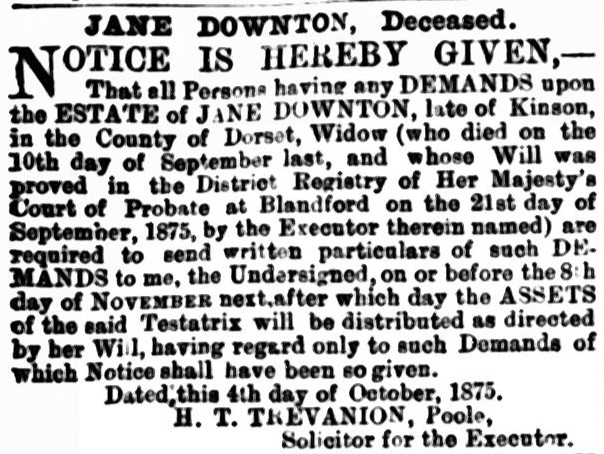
Proved at Blandford on 21st day of September 1875 by the Oath of George Curtis the sole Executor to whom administration was granted. The Testatrix Jane Downton was late of Kinson in the County of Dorset Widow and died on the tenth day of September 1875 at Kinson aforesaid.
Under £200 W.H.T. Trevanion Sole P[illegible]
Beneficiaries named in and the Executor of Jane’s Will
Charlotte Scovell and Mary Weyman were sisters and the daughters of Samuel and Mary Crouter. Other siblings were Eliza born 1803, Joseph born 1805 and Charles born 1814.
Charlotte Crouter born in 1800 in Long Crichel; married Isaac Scorell, a shepherd, in Moor Crichel in 1824.
Mary Crouter born in 1811 in Long Crichel; married William Wayman, a journeyman miller, in Wimborne in 1835.
Elizabeth Garland was born in Hampreston in 1847. In 1871 Elizabeth was a servant in the Ensbury Vicarage, Kinson. By 1881 the incumbant had changed but Elizabeth was still employed at the vicarage (as the cook). Elizabeth died in 1885.
John Arney born to John Arney and Susannah Curtis in Langton Matravers in 1798. John was a labourer in Swanage. He was married to Harriett Pain, sister of John Pain who was employed by John and Sarah Way. John Arney died in 1878.
Martha Cutler, born 1849, the daughter of Charles of East Howe Farm.
William Weyman (also Wayman), the husband of Mary Crouter. Born in Ireland 24 July 1811, baptised 7 Aug 1811 St Peter’s Church of Ireland, Drogheda. The son of Joseph and Susanna Wayman.
William worked as a journeyman miller. He died on 11 Jan 1892 and his effects were valued at £17 12s. 4d.
Living in the Wimborne area was William’s elder brother John, also born in Ireland, an agricultural labourer who married Ann Soper in 1835 and his sister Eliza who married the bricklayer and plasterer John Hayward in Wimborne on 25 Dec 1839. Eliza was born in Ireland 1 Apr 1814, baptised 24 Apr 1814 St Peter’s Church of Ireland, Drogheda.
The 1841 and 1851 censuses show that William’s mother Susanna was living locally too. Susanna, base born daughter of Ann Lodge, was baptised 22 Oct 1775 in Holy Trinity, Shaftesbury. Ann Lodge married Jacob Wilmot the following year. Bizarrely, Susanna married Joseph Wayman in St James Shaftesbury 21 Feb 1815 suggesting they were not ‘properly’ married when they were in Ireland or that Joseph had a previous wife also called Susanna. Grace Wilmot was one of the witnesses to the marriage. Living in Colehill with Susanna in 1841 was a Mary Wilmot. Susanna, recorded as a pauper living in Little Lonnen, Pilford Bottom, in the 1851 census died in 1859 and was buried in Hampreston on 24 Apr.
William’s father Joseph was serving in the 2nd Garrison Battalion in Ireland when William was born. The battalion was formed 25th Feb 1805 and served in Ireland from Feb 1807. It was disbanded Dublin 5 Dec 1814. It is probable that Joseph was the son of William and Susanna, baptised in Kinson on 14 May 1769 and that he returned to the area after his battalion was disbanded. Joseph does not appear in the 1841 census and there is no entry for him in the register of deaths suggesting that he died before 1837. Dorset Memorial Inscriptions records a memorial to a Joseph Wayman in Wimborne Cemetery but no dates are given for him.
There had been Waymans living in Greater Canford for hundreds of years.
The nuncupative will of Hugh Wayman of Poole proved 28 May 1635 by his widow Dorothy bequeathed £20 to his son Robert and 40s to his sister Webster with the residue going to his wife and sole Executrix, Dorothy. The witnesses were Suzanna Bramble and his sister Joane Webster.
Nuncupative wills were verbal wills often dictated by very sick people on their deathbeds, who had not had time to call a lawyer to draft a legal will. They were then written down and signed by witnesses who had heard the testator’s words.
In 1644 Robert Wayman, the son of Hugh a cook, from Poole was apprenticed to Edward Woodward of the Vintners’ Company, London.
An inscription in St Andrew’s Church, Kinson reads: “In memory of Joanna the wife of Joseph Wayman who died in November 1757 aged 38 years.” Joanna was the daughter of Joseph Luther, Basket Maker and aunt of Joanna Luther who married Robert Hicks and was the aunt of Thomas Hicks.
Alfred Thorne (the name should be Tharme. probably a copy error) was living near the Wesleyan Chapel in West Howe in 1871 and 1881.
Fanny Troke the daughter of Charles Troke and Fanny Downton. Related to Jane by marriage and the author’s great, great grandmother.
George Curtis was born in Poole in 1823 to bricklayer William and his wife Mary Ann Curtis. In the 1871 census his occupation is given as Auctioneer, Builder (employing 14 men and 4 boys) and local Wesleyan Preacher.
As of July 2023 the British pound has lost 99.323% of its value since 1875. £5 in 1875 would be worth £738.14 in 2023.