
John Warren was the third of seven children and the only son of Joseph Warren (1830-1868) and Jane Thorne (1833-1910). He was born in Sep 1859 in Holwell, Dorset and baptised on 4 Dec 1859 in Tyneham.

On 7 Apr 1861 the Warren family were living in Sea Barn, Lulworth Castle, East Lulworth. Sea Barn was to the north of Arish Mell on the Purbeck Coast, an area now within the army ranges. John’s uncle, William John Thorne, lived in Lulworth in the early 1860s too. He married the East Lulworth born Roman Catholic Martina Edwards in St Mary’s Chapel at the Castle on 2 January 1865.


Joseph Warren died in 1868 and Jane returned to her home village of Buckland Newton with the children. Before her marriage Jane had been a button maker but the Dorset button making industry had been wiped out by mechanisation. Unable to return to buttoning Jane and her eldest daughters Mary and Caroline made gloves to support the family. The 1871 census records Jane and the children in Buckland Newton, Dorchester. Mary died later in the year and was buried on 15 September. After school John trained and worked as a blacksmith until he joined the army when he was 20.
In 1872 Secretary of War Edward Cardwell’s Localisation Committee created “Sub-district Brigade Depots”. With effect from 1 April 1873, 141 regular army battalions were paired at 68 numbered permanent depots. One partner in a pair of battalions served overseas while the other battalion remained at the depot to recruit and train and send drafts to the overseas battalion. The 75th (Stirlingshire) Regiment had already lost Highland status and dress in 1809 and in 1873 they were paired with the 39th (Dorsetshire) and assigned to sub-district 39 with its Dorchester Barracks Depot.
When John Warren attested at Dorchester on 29 Jan 1880 he attested for General Service rather than for a named regiment and was appointed to the 39th Brigade (75th Regiment) with Service No.: 1883. John was 20 years and 4 months of age at the time and had previously served in the Dorsetshire Militia. He had a fresh complexion, blue eyes and light brown hair, was 5 feet 6 3/8 inches tall with a 34 inch chest and a small birth mark on his back. John served at the Depot in Dorchester until he went to Malta with the 75th in 1881.
The 75th Regiment embarked at Chatham, Portsmouth on 11th March and disembarked at Malta on 20th. While stationed at Floriana Barracks many of the regiment, mostly younger soldiers, suffered greatly from fever.
Further reforms to the Regimental structure occurred in 1881 (Childers Reforms) whilst the regiment was in Malta. W.e.f. 1st July the 75th were amalgamated with the 92nd (Gordon Highlanders) to form the Gordon Highlanders with a Depot in Aberdeen. The 75th became the 1st Battalion Gordon Highlanders and the 92nd the 2nd. An annotation on John Warren’s Army record records that John consented to liability and service in 1st Battalion Gordon Highlanders. On the 18th of June 1882 he paraded in full Highland uniform for the first time.
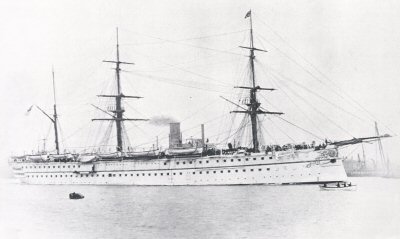
On 2nd August 1881 the 1st Battalion of the Gordon Highlanders departed Malta for Egypt on H.M.S. Euphrates. The Battalion arrived at Alexandria on the 7th and occupied the Gabati Railway Station. On the 19th the Battalion moved to Ramleh where it joined with 1st Bn. Black Watch, 2nd Bn Highland Light Infantry and 1st Bn Queen’s Own Cameron Highlanders to form the Highland Brigade. On 31st August the Highland Brigade sailed from Alexandria via Port Said and the Suez Canal to Ismailia arriving the following evening. The Brigade remained on H.M.S. Euphrates until the 9th Sept when it disembarked and began its march to El Magfa.

“With cavalry on one flank and artillery on the other, the Gordons led the march, followed by the Camerons, Highland Light Infantry (HLI) and then the Black Watch. During the first day men sank to their ankles, sometimes their knees, in soft sand, struggling through the dust to cover 6 miles by sunset. The camp site, as recalled by the Camerons’ Quartermaster John Ainslie, had ‘nothing to be seen to the front, right or left but a sea of sand. Behind us the tall masts of the transports rose like a forest out of gathering gloom.’ …
The brigade continued to suffer from the lack of food and shelter during the next two days.”
The Victorian Soldier in Africa by Edward M. Spiers
Early on the 10th the Brigade set out for Kassassin. They rested during the heat of the day, sheltering from the sun under blankets hung from their rifles, and resumed their march in the evening. The Brigade reached Kassassin on the following day (11th). It was decided to surprise the rebels with a pre-dawn attack on Tel el-Kebir on the 13th necessitating a night march. After dark on 12th camp was struck, the troops formed in order of battle and bivouacked. Total silence was observed and no fires or smoking were allowed to avoid alerting the enemy. Several halts were made during the night the final being at 3am.
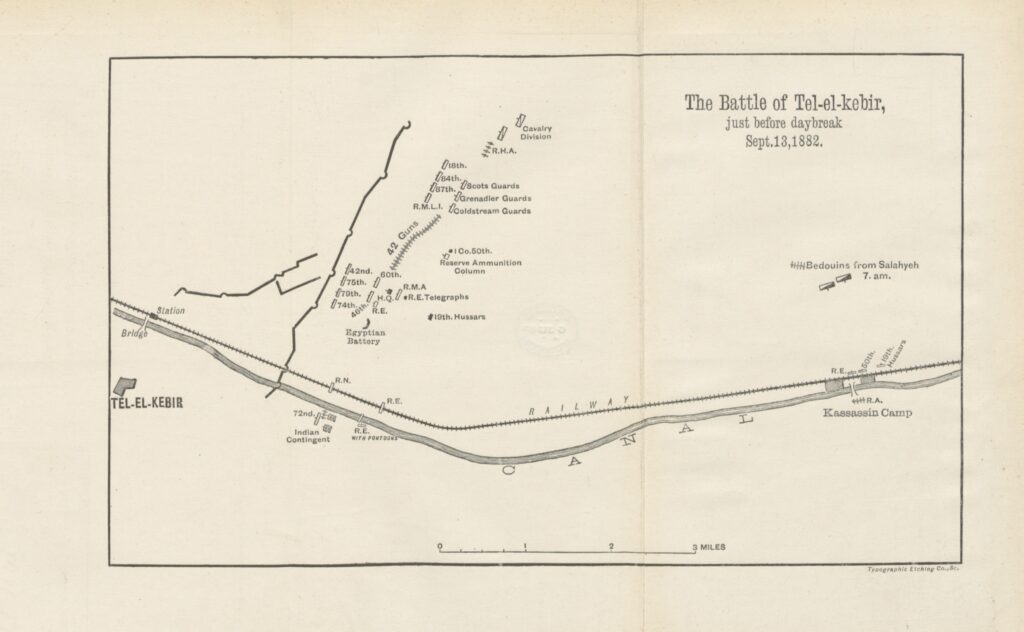
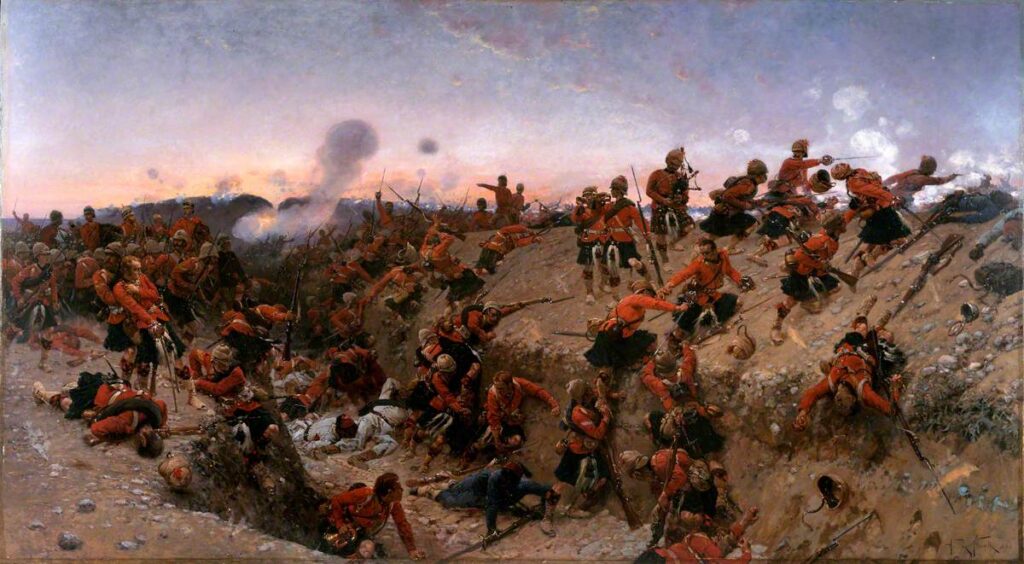
About 4am the final advance began. The Highland Brigade, with the Gordons between the Black Watch and the Cameron Highlanders, was centre front in the order of battle and were the first to reach the enemy trenches where they had to cross a deep ditch and climb over a high redoubt. The first phase of the attack was made with the bayonet only. Shots were not fired until the soldiers were among the enemy lines.
“As for the Highlanders, who were unsupported for the first 10–15 minutes, they had the experience of plunging into the 5-foot-deep ditch with perpendicular sides and then scrambling up a parapet on the other side. Private Donald Cameron (Cameron Highlanders) was the first man up and the second killed as the Camerons and Gordons were the first into the enemy’s trenches. ‘We were mixed up’, recorded Seton-Karr in his diary, ‘75th and 79th in inextricable confusion, but keep advancing after the flying masses, while those in the rear drive their bayonets through those the front men have shot down.’” The Victorian soldier in Africa by Edward M. Spiers
In a telegram sent from Cairo on Sept 17th the Principal Medical Officer stated: “The Highland Brigade is so scattered that I cannot send a complete return in yet of all the casualties.” The eventual figures for the Gordon Highlanders were 6 killed, 30 wounded and 4 missing.
The wounded included John Warren who sustained a gunshot wound to his right forearm. A supplement to The London Gazette published on 6th October described him as only slightly wounded. John’s army record does not record the treatment that he received or how he returned home but we can piece together what probably happened to him from press reports and journals that were published at the time or soon after.
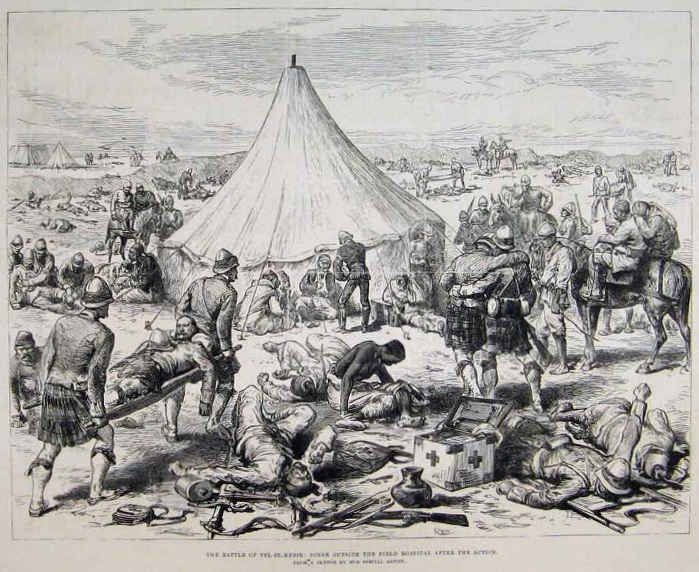
After initial treatment by the Corps Medical Officer and the Bearer Company John was taken to the dressing-station which had been set up by the canal. The dressing-station utilised two tents that had been abandoned by the Egyptians together with another 25 tents that had been brought up along the canal. Although technically a dressing-station it had most of the qualities of a field-hospital and had all that was necessary to treat and feed the wounded. Wounded started to be brought in at around 7:30am and all the British wounded had been picked up and brought to the dressing-station by 9am.
From the dressing-station John was transported in a boat towed along the Fresh Water Canal to the field-hospital at Kassassin. 9 boats made 2 trips during the day of 13th transporting around 200 wounded. The first boat left at 9am and the last at 9pm.
“The lightest cases were, as a rule, most quickly disposed of, the more serious needing longer time and greater attention; and in the first trips of the boats the majority of the wounded conveyed were but slightly hurt. The two horse-boats alone took down no less than fifty seven. After this the number in each boat was decreased to about nine severe and six mild cases.”…
“The embarking and landing of these sufferers was very distressing, the steep muddy banks of the canal rendering the operation most painful in spite of every care.” Report of the from British Naval and Military Operations in Egypt, 1882
On 14th and 15th the wounded were moved from Kassassin to the base hospital at Ismailia. The most seriously wounded were taken by water down the canal directly to the side of the hospital ship Carthage. The depth of water in the canal at Kassassin was only 14 inches at this time. The rest of the wounded, including John, travelled to Ismailia by train.
“But the greatest service rendered to the Army was the conveyance of stores and provisions along the Fresh Water Canal, and the greatest energy was displayed in bringing back the wounded from Tel-el-Kebir to Ismailia, which has been gratefully recognized by Sir Garnet. It sounds as if a canal and a railway were extraordinary aids for transport; but it must be remembered that the Canal was a narrow, shallow ditch, meant to convey water, not to carry traffic, and that the single line of railway was broken up for miles.” Earl Granville reported in Hansard 26 October 1882
“The railway company under Major Wallace, RE, had had to repair 230 yards of track from Ismailia to Magfar and bring engines from Suez to Ismailia (as they could not be unloaded at Ismailia) before they could send even one engine along the line. By 31 August they sent a train to Kassassin, and increased the number of trains to 2 per day from 1 September, increasing to 4 per day from 7 September.” The Victorian soldier in Africa Edward M. Spiers
John’s records show that he left Egypt on 1st October. The journey from Egypt to Britain took 12 days by steamer but some ships made a stop at Malta (3-4 days out from Egypt) to transfer the severely wounded to Fort Chambray Hospital. The Statement of Services of John Warren was checked and signed off by the Paymaster of 75 Regional District on 5th October. This being 4 days after John departed Egypt it probably occurred in Malta and represents John’s transfer from the 1st Battalion to the Regimental Depot. Hospital transports arrived back in Britain on the south coast (Plymouth, Portsmouth or Netley) and soldiers who didn’t require hospitalisation were sent to their Regimental Depot which for John was now the Castlehill Barracks in Aberdeen.
On 22nd March 1883 John was discharged in consequence of his having been found medically unfit for further service. It was recorded that the grip and usefulness of his right hand was slightly impaired as a result of the gunshot wound he received at Tel-el-Kebir (which would be a handicap for a blacksmith).
The 22nd was also the date on which the gratuity for the Egyptian campaign of 1882 was issued. The amount given to privates was £2. John was awarded the Egyptian Medal and Tel-el-Kebir clasp. As recipient of the Egyptian Medal John would also have been entitled to the Khedive’s Star (1882). John was finally discharged in Aberdeen on 10th April 1883.
By 1881 William and Martina Thorne were living in Globe Lane in Poole. Globe Lane was near the Quay where Harriet’s sister Mary and her husband William Medley were running the Hand and Heart Inn. It seems likely that John met Harriet Troke whilst on a visit to his Aunt and Uncle. John and Harriet married on 27 Oct 1883 in Kinson, Dorset.
Mary’s husband William died in 1881 and she married John Coakes, a fisherman, at the end of 1883. Their daughter Florence was born 18 Feb 1885. Tragically, Mary died 14th May 1886 and John and Harriet took in the young Florence and raised her as their own daughter.
The Electoral Roll lists John Warren as an Occupation Voter living in Highmoor, Kinson, Dorset in 1888 and 1889 but the 1891 census finds John, Harriet and Florence living in Milford where John was employed as a blacksmith. Living with them was their 17 year-old nephew Henry Troke, another blacksmith. John, Harriet and Florence returned to Highmoor in the early 1890s and John established his own business there. The census taken on 31 Mar 1901 records John’s mother Jane, his sister Louisa and her daughter Caroline, Harriet’s father Charles Troke, John’s nephew John Pinson (the 4 year-old son of his sister Elizabeth) and the blacksmith John West living all living with them and Florence. Harriet ran a laundry although no occupation is recorded for her in the census.

In 1911 John was a Shoeing and General Smith employing others. Living with the Warrens when the census was taken on 2 Apr were a servant, Dorothy Frampton, and three boarders (laundry maids Ellen Beavis and Elsie Williams and blacksmith Herbert Alford). Ten years later John and Harriet were living on their own although John was still running the smithy.
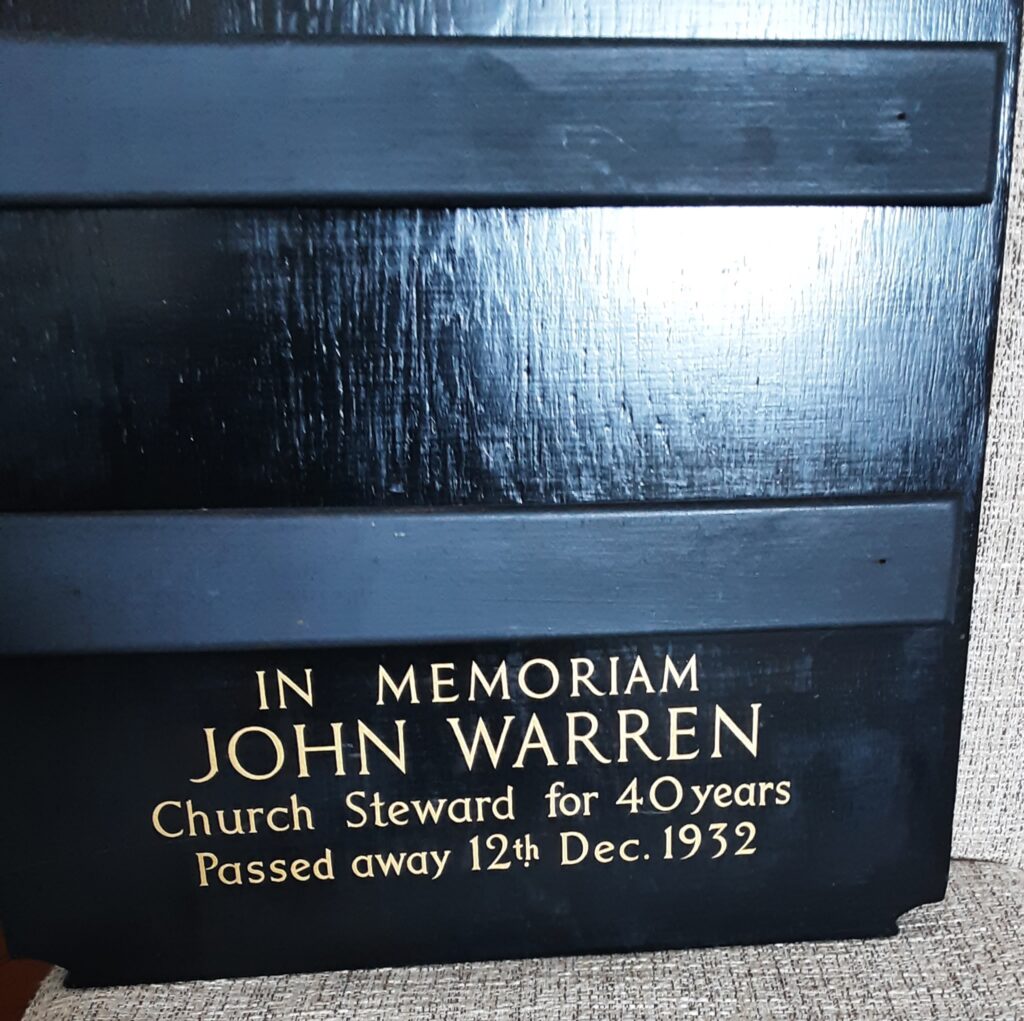
John Warren died on 12 Dec 1932. John had been a Church Steward at the Wesleyan Methodist Church in Wallisdown for 40 years. After his death a hymn board was given to the chapel in his memory. Initially installed in the chapel which had been built in 1873 it was moved to the new church building when that opened in 1955. The hymn board was given to John’s great niece Hazel Wright when the church was deconsecrated.
Harriet Troke, daughter of Charles Troke (1822-1906) and Fanny Luther (1835-1899), was born 19th August 1861 in Kinson and baptised on 11 Oct 1861. Harriet remarried after John’s death. Q2 1934 she married Sidney Benjafield a retired plasterer. In 1939 they were living in Canford Road, Highmoor. Sidney died in 1941 and Harriet 16th May 1943.