
Michael was born in Ballyfermot on either 3rd (according to Baptismal Register) or 4th (according to Register of Births) December 1879 and baptised in Clondalkin on the 7th. He was the third son of Edward and Catherine Rock and the first born after their return to Ireland. Michael was just 7 when his father died.
Michael was serving in the 4th Royal Dublin Fusiliers F Company, Kit No. 561, when on 1st July 1897 he attested into the Royal Artillery in Dublin to serve 7 years followed by 5 years in the reserve. He was allocated Service Number 20915. When he enlisted he was 5 feet 7 inches tall but he was still growing (in 1906 he was recorded as being 5 feet 11 ½ inches tall) and was described as having a fresh complexion, grey eyes and brown hair.
By 6th July Michael was at Woolwich Depot. He was posted gunner to 84 Company a month later and to 39 Company in the Southern Division on 2nd December. On the 9th October 1899 he was posted to 13 Company which became 94 Company on 1st January 1902. Michael went to Malta with 13 Company on 23 December 1899 and, as 94 Company, to India on 23 October 1902. In India 94 Company served in Allahabad, Delhi and Roorkee. Michael returned to England and 4 Depot (Great Yarmouth) on 15th December 1904. He transferred to the reserves on 10th January 1905 being discharged on 30th June 1909 with 7 years and 194 days towards a pension.
Back in Chapelizod Michael turned to drink. His appearances at the Petty Sessions reveal just how serious his drinking problem was. The punishment for being Drunk and Disorderly was a fine which increased as the number of convictions within a 12 month period went up. Not paying the fine resulted in a period of imprisonment in Kilmainham Gaol. Michael didn’t pay his fines and spent a considerable amount of time in Kilmainham Gaol some of it with Hard Labour.
In November 1905 whilst in Police custody Michael attempted to choke himself with his shirt and threatened to commit suicide. He was bound to keep the peace for 2 years. Twelve months later Michael assaulted a Police Officer resulting in him being imprisoned for 6 months with hard labour at the end of which he was required to find sureties to guarantee him keeping the peace or face an additional one month in prison.
On 8th June 1909 Michael appeared before the Hon. Mr. Justice Dodd at the County Dublin Commission charged with being a Habitual Drunkard within the meaning of the Inebriates Act. He pleaded “Not Guilty” but was convicted the following day and sentenced to be sent to and detained in St Patrick’s Inebriate Home at Waterford for the period of 3 years. He was removed to Waterford by Royal Irish Constabulary escort on 14th June. A year later Michael assaulted a fellow patient at St Patrick’s for which he received 3 months in Waterford Jail.
When the 1911 census was taken Michael was lodging with Anne Maher in Chapelizod. Either he did not return to St Patrick’s Home at the end of his sentence in Waterford or he was out on license.
On 9th March 1914 Michael was once again in court on charges of being Drunk and Disorderly and assaulting his brother Patrick. The case was adjourned for 6 months (in what appears to be a suspended sentence) and he was fined 6d with 4/6 costs. Before the 6 months were up Britain was at war and Michael was back in the army.
Michael re-enlisted into R.G.A.(Special Reserve) as 417 on a one year Short Service (renumbered to 275417 in 1917) on 17th August in Dublin and joined at The Citadel, Plymouth (3 Depot) on 19th. His trade was described as labourer.
In late August Michael was posted as Gunner to 109 Heavy Battery (H.B.). He was awarded 14 days detention by his C.O. on 7th September. At the end of his detention Michael was posted to 112 H.B. on 21st September; to 113 H.B. on 24th September; and to 120 H.B. on 15th October. These four Heavy Batteries (109, 112, 113 and 120) had all been formed early in the war.
Michael was with 120 H.B. in Sunderland when he was awarded Field Punishment #2 for 7 days for “not being on the alert” whilst on Sentry duty on 24th November 1914. This was a harsh punishment designed to humiliate the man although given Michael’s history he probably found it a walk in the park.

On 19th December Michael disobeyed Brigade Orders and was out of his billet after 9pm (until 10.30pm). This led to him being confined to barracks for 10 days. A few days after completing this punishment drink got Michael into trouble again. On 2nd January he was drunk on active service and he left his guard without orders from his superior officer. He received an admonishment for being drunk but leaving his guard was a more serious offence and he was court-martialled and given 84 days detention. 14 days of the sentence were remitted and he returned to duty on 18th March 1915.
On 7th May 1915 Michael was posted to 20 H.B. in Woolwich. He was awarded 168 hours detention and forfeited 2 days pay for being absent for 2 days on 1st June. At the end of the same month he went absent for 3 days. He was awarded another 168 hours detention and forfeited 7 days pay in addition to 3 days pay for the days he was absent (10 days pay in total).
On 10th July he was drunk and created a disturbance in the hutments for which he was confined to barracks for 7 days, forfeited 7 days pay and fined 2/6. Then on the first of August he again went absent for 2 days for which he was deprived of 2 days pay plus an additional 14 days pay.
20 H.B. left for France on 6th August and three days later joined X Corps in the Somme Sector. Between 13th and 31st of August the battery was assigned to 51st Division (Highland) which was known as Harper’s Duds. 20 H.B. then joined VII Corps (part of III Army with H.Q. in Marieux) and between 5th and 30th September was in “Buckles Group”. From 1st October to 7th November it was in 21 Heavy Artillery Brigade (H.A.G.).
On 8th November 1915 the battery moved to Marseilles with 22 Division to embark for Macedonia. It departed Marseilles on 28th November and arrived in Salonika on 5th December where 22 Division joined XII Corps. 20 H.B. joined 37 Heavy Brigade No. 2 Group XII Corps Artillery on 24th February 1916. Fighting on the Salonika front generally took place between April and June and in September and October because of the extremes of the climate although the Heavy Batteries were in action year-round. Winter temperatures routinely plunged to below freezing, regularly dropping to between -5°C and -20°C. Summers in Salonika brought temperatures of over 44°C in the shade. During the hottest parts of the day in summer the men would remain in the shade and try not to do any work. Fatigues and training were undertaken in mornings and evenings. The summer also brought swarms of insects that made men’s life a misery and spread diseases. Chief among these were malaria carrying mosquitoes.

“The occupation of areas in advance of the entrenched camp and the Struma Valley in the summer of 1916 at short notice prevented measures being taken in these intensely malarial areas in time to avoid malaria. A severe and widespread outbreak consequently occurred in July. The only rapid means of prevention was the provision of mosquito nets for use in bivouacs and dugouts. Bell-shaped nets were tried but had only a limited usefulness, and were not obtainable in sufficiently large numbers for immediate distribution.” W.G. Macpherson and T.J. Mitchell in Medical Services General History Vol. IV
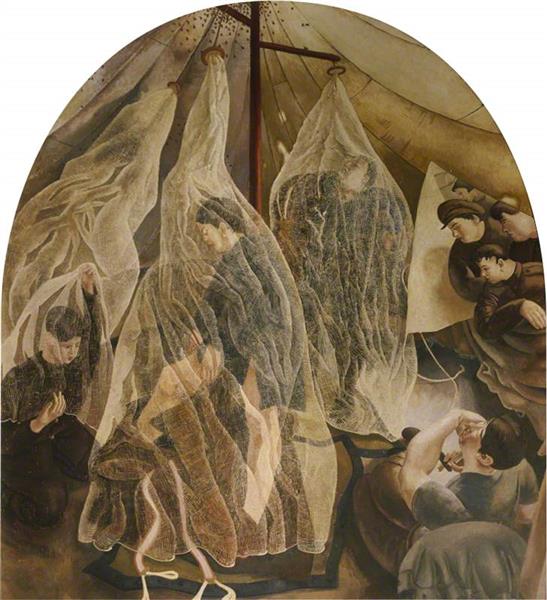
The artist Stanley Spencer was with 68th Field Ambulance in 22 Division. He painted this picture, titled Reveille, for the Sandham Memorial Chapel. It shows men beneath bell-shaped nets. Note the mosquitoes in the roof of the tent.
On 8th June 18 and 20 H.B. of XXXVII H.A.G. were placed at the disposal of XVI Corps located between Tumba (present day Toumba) and Aivatli (present day Lete) within the entrenched camp nicknamed the “Birdcage”.

20 H.B. was transferred to LXI H.A.G. on 1st September. A few days later LXI H.A.G. (13, 18 and 20 H.B.s) was assigned to XII Corps on the Struma front. On 13th September LXI H.A.G. was near Kalinova (present day Soultogianneika) and providing counter-battery fire as part of the action of Machukovo (Present day Evznoi).
20 H.B. was assigned to “Molesworths” Group at the end of September. Major H.F. Molesworth was commander of 3rd Mountain Artillery Brigade which provided highly adaptable artillery support. It relied heavily on mules to transport disassembled artillery pieces across steep, treacherous mountain tracks where traditional wheeled transport failed. 3rd Mountain Artillery Brigade supported infantry lines in key sectors including entrenched areas near Lake Doiran and along the Struma Valley.
Another artist, Henry Lamb, was a medical officer with the 5th Royal Inniskilling Fusiliers in the Struma Valley. One of his daily tasks was to hold parades and dispense doses of quinine and the ointment Paraquit to be smeared on the hands and face. After the war Lamb produced this painting of men with malaria being treated at an Advanced Dressing Station in the Struma.

“Any stranger seeing a soldier dressed up in anti-mosquito garb would for the the first time imagine himself face to face with a scarecrow. The face and arms are thoroughly smeared with an anti-mosquito preparation called ‘parakit’, an excellent thing whilst it lasts; but its tendency is, of course, to get absorbed into the skin after an hour or two, and one often had to smear on a second coating. The mosquitoes didn’t like it though, and always kept very clear of a ‘parakit’ face… After this shorts were turned down and tucked into the top of the puttees, thus safeguarding the knee. Thick gloves were worn, attached by a piece of tape running through the arms and under the tunic over the back. Over the tin hat was worn a mosquito net veil, which, like that apparatus worn by a bee-keeper, rendered the face and neck immune from danger.” Second Lieutenant Richard Skilbeck-Smith, 1st Leinster Regiment.

During the 1916 Malaria outbreak convoys from Salonika took between 718 and 2587 patients each week to Malta where the number of hospital beds was increased by the use of tents. In November 1916 Michael was one of these patients. He had been taken to a Base Hospital in Salonika and from there he was transferred to Floriana Hospital, Malta on the Hospital Ship ‘Valdivia’ on 6th November. His mother was informed of his sickness on 1st December. It is not recorded how long he was in the hospital in Malta or when he returned to Macedonia.

20 H.B transferred to 75 H.A.G. on 21st January 1917. In April 1917, the British 22nd, 26th, and 60th Divisions launched attacks on Bulgarian defences around Lake Doiran and on the River Vardar creating a diversion to the Franco-Serb offensive taking place simultaneously to the west. The attacks began on the night of April 24/25 following a four-day artillery barrage in which 20 H.B. participated. Some of the outer Bulgarian strong-points were destroyed by the British guns, but incessant counter-battery fire and machine gun fire held up the attacks. By the 27th the Bulgarians had thrown the British back. The British attacked again on May 8th, but the assault was finally called off the following day. The British lost some 12,000 killed, captured or wounded at Doiran in April 1917, of whom more than 2,250 were buried by the Bulgarians.

On 16th September 1917 20 H.B. transferred to 82 H.A.G. In late May 1918, 20 H.B. and 1 section of 190 H.B crossed to the right bank of the Vardar and were placed under the tactical command of the French for the attack on the Skra salient at the end of the month. The successful attack was made on the 30th of May and a few days later 20 H.B. returned to the left bank.
The men in Salonika had had no home leave since their arrival. This was raised in Parliament several times in 1918. A scheme was finally put in place at the end of July 1918. The journey home included an uncomfortable 8 day train journey in covered box trucks from Taranto, Italy to Cherbourg, France. Back home the men were granted 21 days leave.
A major Allied offensive began in July 1918. Michael left Salonika for home leave on 10th August. On 17th September a Serbian-Franco force dislodged the Bulgarians from Dobrog Polja. Kaiser Wilhelm declared “Disgraceful. 62,000 Serbs decided the war.” His prediction would prove correct because the subsequent breakout brought World War I to an end. The Allies pressed the attack surging north liberating Serbia, Albania and Montenegro and crossing into southern Hungary. Bulgaria requested an armistice on 24th September and agreed terms on 29th. On 29th the German Supreme Army Command informed Wilhelm and the German Chancellor that Germany’s military situation was hopeless.
Some of the Salonika War Diaries of 20 H.B. have survived and are held in The National Archives. Transcriptions of those for the period Michael was in Salonika can be accessed here.
On 17th September at the end of his period of leave Michael was posted to the R.G.A. Clearing Office and from there, on 31st October, to 3rd Reserve H.B. (Winchester). He was discharged as unfit (myalgia aggravated by service) on 21st of the following month with a weekly pension of 8/3 (representing a 30% disability) from the 22nd November 1918. His pension entitlement was to be reviewed in 52 weeks. The outcome of the review is unknown but no reduction is recorded on the pension index card. After discharge he lived at 3 Goldney Road as did his brother Joseph and his family. Michael was awarded a Silver War Badge (No. B42232) on discharge and the British War Medal, Victory Medal and 1915 Star after the war had ended.
Michael married Mary Fox in Paddington Q1 1920 becoming step-father to her three children Doris born 1910, Phyllis born 1913 and Charles born 1916. Mary had been born at Rockfield Hall, Kells in County Meath. She moved to London to work as a housemaid and by 1901 was a cook in the household of Frederick Hatton in Holland Road, Kensington. Her daughter Doris was born on 22nd April 1910. The 1911 census shows Mary was working as a barmaid in Princes Square with her baby being left in the care of Edward and Eliza Lewis who lived in one room at 33 Clarendon Street. In late 1916 solicitors in Kells were placing advertisements in the press asking Mary to contact them to learn something to her advantage. The birth of Michael and Mary’s daughter Mary Eileen (known as Eileen) was registered Q1 1920.
On 15th May 1920 Michael asked for consideration for a service pension. He had 7 years and 194 days towards his pension from his first period of service and 3 years and 338 days towards his pension from his second period of service. As this totalled more than ten years he could have been eligible for a pension. The outcome is unknown but papers were forwarded to Chelsea on 18th December suggesting he may have been successful.
When the 1921 census was taken Michael, Mary and the four children were occupying 2 rooms in the Goldney Road house. Michael was employed as a road labourer by the City of Westminster. A second daughter, Catherine Helen, was born on 25th August 1923.
Michael died in Goldney Road on 3rd October 1931. His cause of death was I Angina Pectoris and II Chronic Nephritis. No post mortem was performed. His brother Joseph registered the death. Chronic Nephritis can result from Malaria as too can the symptoms of Myalgia.
Sadly Michael’s daughter Eileen died aged just 14 on 11 March 1934. Her cause of death was Ia Syncope Ib Chronic Myocarditis II general Oedema. No post mortem was carried out.