
John, known to his family as Jack, was the seventh of eight children born to John and Julia Williams and the second of that name. Their first child, born in 1876, had been named John but sadly only survived for a few weeks. Another son, Charles, also died in infancy and John was to grow up the only boy among 5 girls.
John was born in the General Lying-in Hospital in York Road, Lambeth on December 9th 1891. The General was a charitable maternity hospital for “Relief of those Child-bearing Women who are the Wives of poor industrious Tradesmen or distressed House-keepers and who either from unavoidable misfortunes or the Expences of maintaining large Families are reduced to real Want.” At the time of his birth the family were living at 1 Carpenter Street, Westminster. John was baptised John Joseph Vincent Williams at St Mary’s Roman Catholic Chapel on Horseferry Road on 3rd January the following year. His eldest sister, Julia, was named as his godparent.
John’s father was a working cutler and the family moved around a lot. When the census was taken in 1901 they were all lodging in Tormoham, Torquay with the exception of John’s sister Julia who had married and was living in Boscombe (then part of Christchurch now part of Bournemouth). His sister Ellen died in Christchurch the following year aged 15. Then in 1907 his sister Mary, who had married Coastguard boatman George Ogles and was living on the Isle of Wight, died.

After school John worked as a page (male servant) and shop assistant. He joined the Royal Navy as an Officers’ Cook Third Class on 17th August 1908. Although John was old enough to join the Navy as a boy he claimed to be 18 (giving his date of birth as 9th August 1890) to receive a better rate of pay. His record says that John was 5 feet 3 inches tall with a chest of 30 ½ inches. He had a fresh complexion, brown hair, grey eyes and a ‘V’ and a dot tattooed on his left forearm. His Official Number was L568. The number range L1 to L15000 being issued to Stewards/Domestics between 1908 and 1923.
John served on HMS Majestic. Majestic was a pre-dreadnought battleship in the 3rd Division of the Home Fleet stationed at Devonport. The 3rd Division was not fully operational and Majestic only had a nucleus crew. As an Officers’ Cook John wore the “fore-and-after rig” Class III uniform without badges. A month after he joined a 10s gratuity was paid to the man who recruited him. In 1910 the annual pay for an Officers’ Cook Third Class was £22 16s 2d.

The Captain of the Majestic during John’s time aboard was Ernest Frederick Augustus Gaunt. He was transferred on 2nd January 1910 and John was discharged the following day. Gaunt, an Australian, was made a Rear-Admiral on 24th October 1914 and he was second-in-command of the 1st Battle Squadron of the Grand Fleet at Jutland (commanding the 5th Division).
John was discharged to shore on 3rd January 1910. His father, who died at the beginning of 1911, was probably already suffering with the cancer that killed him. John, his mother and younger sister, are missing from the 1911 census. It is probable that they were heeding the call of the Suffragettes to boycott it. His sister, Julia, died towards the end of 1911.
On 23rd October 1912 John, who had been working as a waiter, engaged to serve 5 years in the Royal Navy followed by 7 years in the Fleet Reserve. His service number was SS4132. He spent the next few weeks at HMS Victory, the barracks and training centre at Portsmouth, before being posted to H.M.S. Venerable on 8th December. Venerable was a London Class Battleship in the commissioned reserve. She had a nucleus crew and was part of the 5th Battle Squadron, Second Home Fleet anchored at the Nore (Thames Estuary). John’s pay as an Ordinary Seaman was 1s 3d per day. On the 18th December 1913 John was made an Able Seaman with daily rate of pay of 1s 8d.

John transferred to the destroyer H.M.S. Acasta, depot ship H.M.S. Hecla, on 19th January 1914. Destroyers were painted black (not actually a good idea) rather than battleship grey. As a result the ships and the men who sailed them were known as ‘the black navy’. Life aboard a destroyer was arduous and the men serving on them were paid ‘hard-lying money’ to compensate them for the cramped conditions and a lack of amenities. As an Able Seaman John received an extra 6d a day.
More about H.M.S. Acasta during the time John served on her.
John was awarded a Good Conduct Badge on 23rd October 1915 (with badge pay of 1d per day) and was made an Acting Seaman Torpedoman (S.T.) on 1st February the following year. Acting Seaman Torpedoman was a non-substantive rank awarded at sea by his commanding officer. John would have received training aboard the ship and been examined by the ship’s Torpedo Lieutenant or Torpedo Gunner. He would not have received an increase in his wages but he would have been paid 3d a day for performing the role if there was a vacancy for a S.T. in the ship’s complement.
John served on H.M.S. Acasta at the Battle of Jutland and the experience had a lasting effect on him – he was to “suffer with his nerves” for the rest of his life. John also totally rejected the Catholic Church. Whether this was a Damascene moment after the battle or the result of the cumulative effects of the war is unknown.
Acasta needed significant repairs and her crew were assigned to other ships. Acting S.T.’s were, on paying off, supposed to be sent to torpedo school but there is no record of this happening in John’s case. Perhaps this was because the Navy had lost so many men in the battle. On 1st July John was transferred to HMS Nizam, an M class destroyer that had been completed on 29th June 1916. Nizam (depot ship Greenwich) joined the new 14th Destroyer Flotilla at Scapa. Her first captain was Commander Barron. A few weeks later Nizam and the destroyer Ophelia transported delegates visiting England at the invitation of the Empire Parliamentary Association from Scrabster Wharf near Thurso north for an exhibition of gunnery on Orion and Monarch.
On 13 January 1917 Nizam was damaged when she struck the bottom at Invergordon.
In response to the U-boat campaign against merchant ships convoys were introduced during 1917. Each convoy was escorted by armed trawlers or cruisers for most of the journey with destroyers taking over in the U-boat hunting ground of the Western Approaches. Four destroyers from the 14th flotilla were sent to Buncrana, County Donegal and five or six more occupied a zone to the west of the North Isles (with anchorage at Swarbacks Minn). The ships on escort duties were regularly relieved. When not on escort duty Nizam would have been on patrol or screening duties. Nizam DID NOT take part in the large-scale operation involving 30 cruisers and 54 destroyers that took place on 15th October (see list of ships involved here).
At the end of 1917 the basic rate of pay was increased and a new payment of an additional 3d a day for Able Seamen with 3 years service was introduced. John’s basic rate of pay increased to 2s 1d. With add-ons of 1d for his good conduct badge and 6d hard-lying money for serving on a destroyer he would have been earning 2s 8d per day with an extra 3d per day when acting as a S.T.
In April 1918 the main base of the Grand Fleet was moved from Scapa to Rosyth. John was transferred from Nizam to HMS Sparrowhawk, another destroyer in the 14th Flotilla, on 30th September.
John was present at the mightiest gathering of warships in one place on one day to ever occur when Sparrowhawk was among the ships that escorted 70 ships of the German High Seas Fleet into the Firth of Forth on 21st November 1918. The previous morning (20th) H.M. The King had inspected the destroyer ships’ companies at Port Edgar after which the destroyers sailed to anchor to the east of Inchkeith. Very early on the 21st 120 destroyers left their anchorage and departed for the rendezvous with the German fleet in the middle of the North Sea. The destroyers formed a screen 50 miles ahead of the main British fleet. The destroyers met the German ships at 08.00 and forming two columns passed down either side of the German line which stretched for 19 miles. At the end of the line the British destroyers turned to surround the 49 German destroyers. Sparrowhawk in the 14th Flotilla was on one of the flanks but her precise position is not known. The crews were at ‘action stations’ to be ready for any ‘funny business’ but there was none. On the night of the 21st the destroyers anchored off May Island with the British destroyers surrounding the German ones. The German ships were escorted to internment at Scapa over the following days.
In March 1919 Sparrowhawk was transferred into the 7th Destroyer Flotilla but remained based at Rosyth. John was demobilised to shore 3 May 1919. The following day he joined the Royal Fleet Reserve with service number PoB9774.
After his discharge John obtained his Merchant Seaman’s ticket (ID certificate no.: 414437). His CR10 record card doesn’t list any voyages indicating that he was employed on home trade voyages (around the British Isles, including the Irish Sea, or to a port on the West European coast between Hamburg and Brest). His Continuous Certificate of Discharge (more commonly known as his discharge book) would have recorded all the ships he worked on including sign on and sign off together with the ports of engagement and discharge. The discharge book also recorded his character and ability and the type of voyage i.e. Home Trade [HT] or Foreign Going [FG]. His Discharge A number was: 998989 but the actual discharge book has not been located.
In 1920 the British Government gifted a light cruiser (Aurora) and two destroyers (Patriot and Patrician) to the Canadian Government. The Canadian Navy did not have the resources to fully man these ships and so recruited 50 Royal Navy ratings on a 2 year short service. John was engaged on 22 October 1920 for two years as a Seaman Torpedoman on H.M.C.S. Patrician. This would imply that John had completed his torpedoman training. John’s service number was 61574. The three ships were commissioned into the Royal Canadian Navy (RCN) at Devonport on 1st November and set sail for Canada on 1st December. The ships travelled via the Azores (6th) and Bermuda (15 – 18th) and arrived in Halifax on the 21st.
John’s time in the Canadian Navy took him all around the coasts of northern and central America and twice through the Panama Canal.
The first 6 months of 1921 saw the squadron cruise from Halifax to Esquimalt and back. It left Halifax on 8th January calling at Bermuda (11th – 15th); Port of Spain, Trinidad (20th – 2nd February). Panama (7th); Nicaragua (11th); Manzanillo, Mexico (24th – 25th) and San Diego, California (2nd – 5th March). On the 1st of March John was made the Patrician’s Ward Room Officers Servant. The squadron arrived in Esquimalt on 9th March. It remained in British Columbia for three months visiting Vancouver, Comox, Nanaimo and Ganges Harbour during that time. When the census was taken on 1 June 1921 John was aboard Patrician in Esquimalt. The census records that he had no weeks unemployed in the previous year and his earnings for the year were $834.
The Patrician left Esquimalt on 3rd June for Oregon where, from 8th – 10th June, it took part in the annual Portland Rose Festival. On 11th Patrician resumed its voyage southward visiting San Pedro, California (14th – 16th); Magdalena Bay, Mexico (22nd – 25th); Acapulco, Mexico (26th – 29th) and Punta Arenas, Costa Rica (6th July). It passed through the Panama Canal to Colon (11th) from where it returned to Halifax via Jamaica (14th; – 18th) and Bermuda (22nd – 27th;).
The Patrician spent the next four months on the eastern seaboard of Canada. Visits were made to Sydney, Cape Breton (August 10th – 15th); Charlottetown, Prince Edward Island (16th); Montreal (1st September); Quebec City (9th) and Saint John, New Brunswick (20th).
On December 10th the squadron left Halifax for Bermuda. En route it encountered a severe hurricane and had to run before the storm. Sub-Lieutenant (later Rear-Admiral) R.E.S. Bidwell who was in the Aurora reminisced in the May 1961 edition of The Crowsnest:
“We did one fine West Indies cruise in this squadron, during which we encountered the only full-scale hurricane I have ever been through at sea, and several times the good ship rolled to beyond what the constructors ominously call the “vanishing angle”. Luckily all that vanished was the upper-deck ship’s office, together with the service certificates of most of the ship’s company, and all the pay records. The author, who was keeping the first watch when all this started, was unable to get aft and he, the captain and several other key officers were compelled to stay for’ard on the bridge until well on in the forenoon watch next day.”
First watch is from 20:00 to 00:00 and forenoon watch 08:00 to 12:00 so the ordeal lasted a good 10 hours or more. The Deputy Minister, Department of the Naval Service reported:
“During the passage of the squadron to Bermuda a severe hurricane was encountered. The sea was so violent that the ships were obliged to run before the gale. They came through in excellent condition and demonstrated most completely their seagoing qualities.”
The Deputy Minister made no mention of the impact of the hurricane on the crew! 30 – 40% of victims exposed to hurricanes develop PSTD. The figure is probably higher for those caught in a hurricane at sea. Storms can worsen condition of those with existing disorders. For John who was already “suffering with his nerves” after his experience at Jutland it must have been a traumatic voyage.
The squadron reached Bermuda on December 14th. John left Patrician while she was in Bermuda. His record card shows that he “did remain absent over leave 24 hours 40 minutes”. He was deprived of his good conduct badge and had 9 days pay and 9 days leave stopped. This was the only recorded misdemeanour during his time with both the RN and RCN and was totally out of character.
The squadron left Bermuda on 27th December visiting Roseau, Dominica (4 January 1922); Barbados (7th); Grenada (17th); Trinidad (19th) and Georgetown, British Guiana for exercises with the Imperial Light Cruiser Squadron (22nd).
The Canadian elections held in December 1921 had returned a new government which slashed the Navy’s budget for 1922. The squadron’s cruise was cut short and the ships left Port of Spain on 30th March. Calling at Bermuda 4th – 8th April and reaching Halifax on 11th. John was paid off on 23rd June 1922. His good conduct badge was restored on the same day. John was allowed 11 days passage time and his service formally ended on 4th July. He received a $122 gratuity on discharge. Upon his return to the England John returned to the merchant service.

On 23rd April 1928 John married Catherine Ellen Rock. Since John had completely rejected the Catholic faith they were married by license in the Register Office, Southampton. John gave his address as Sailors’ Home, Oxford Street, Southampton. The Sailors’ Home provided a temporary home for merchant seamen. John and Catherine had three children. John Percival born Q1 1929; Kathleen Mary born 16th April 1930 and Sheila Doris born 31st December 1932.
In late 1929 John entered the Southern Daily Echo’s “True Stories of the War competition”. He won second prize (10/-) and his story was published in the Echo of Tuesday 12 November 1929.
TRUE STORIES OF THE WAR.
More Readers Relate Their Adventures.
THE PRIZE WINNERS.
2nd (10/-) – John Williams, formerly Able Seaman, H.M. Destroyer “Acasta”
BEARING THE BRUNT.
TWO destroyers, Shark and Acasta (attached 3rd Battle Cruiser Squadron). The enemy just visible – grey line two points off our port bow!
The Admiral had signalled prior to opening fire ordering destroyer commanders “full discretionary powers,” and some of us wondered why we kept our exposed position on the engaged bow of the flag ship. We soon knew.
Suddenly altering course, the little Shark led us full-speed for the enemy’s line, and my greatest thrill had come. As we raced nearer, two destroyers against a line of ships, the inferno became indescribable. The roar of explosion, the awful concussion, the scream of tearing, twisting metal – and worse…
The Shark was the first to be knocked out – we never saw her again.
We were on fire fore and aft, had lost our steering-gear, main steampipe, dynamo, oil tanks, and many important ratings. Yet our appearance saved us, for, leaving us to Davy Jones, the fight moved on.
Little remains. We were days struggling to port, and thankful to be alive. But, ah! if we had only known that we spoiled the enemy’s torpedo attack on our big ships.
We received many decorations, but best of all was the V.C. given to the gallant little Shark. – JOHN WILLIAMS, Able Seaman, H.M. Destroyer Acasta, 4th Flotilla, Grand Fleet.
John struggled to find employment during the 1930s. He would walk to the docks each day to join the queue of men hoping to pick up a day or two’s work. Catherine took on whatever work she could get but life was very hard for the family. Work became easier to find as the threat of war loomed and by the time the 1939 Register was compiled John was working as a ship’s painter. In September 1939 the family were living at 22 Vine Road, Southampton.
In anticipation of German bombing of the south coast of England John’s eldest two children were evacuated. John went to stay at a farm in Sixpenny Handley but he returned home a few weeks later. Kathleen was evacuated to West Moors, Dorset where she remained for over a year. Sheila remained at home with her parents. Southampton was heavily bombed during the war. The town centre experienced a higher density of bombing than any London Borough and the port was severely damaged. The worst bombing-raids were on 30th November and 1st December 1940 when at least 712 bombs were dropped on the city. Some of these bombs fell close to the family’s Vine Road home.
During the war years John and Catherine’s marriage broke down and Catherine walked out in March 1944. Their son John had left school and was fairly independent by this time, Kathleen remained living with John while Sheila went to live with Catherine.

After leaving school Kathleen moved to Bournemouth where she trained as a nurse. She married Fred Vincent in March 1954. Sheila married Fred Melin in Southampton in January the following year. After their marriage Sheila and Fred lived with John in a council flat above a shop at 30 Hollyoak Road, Aldermoor, Southampton.
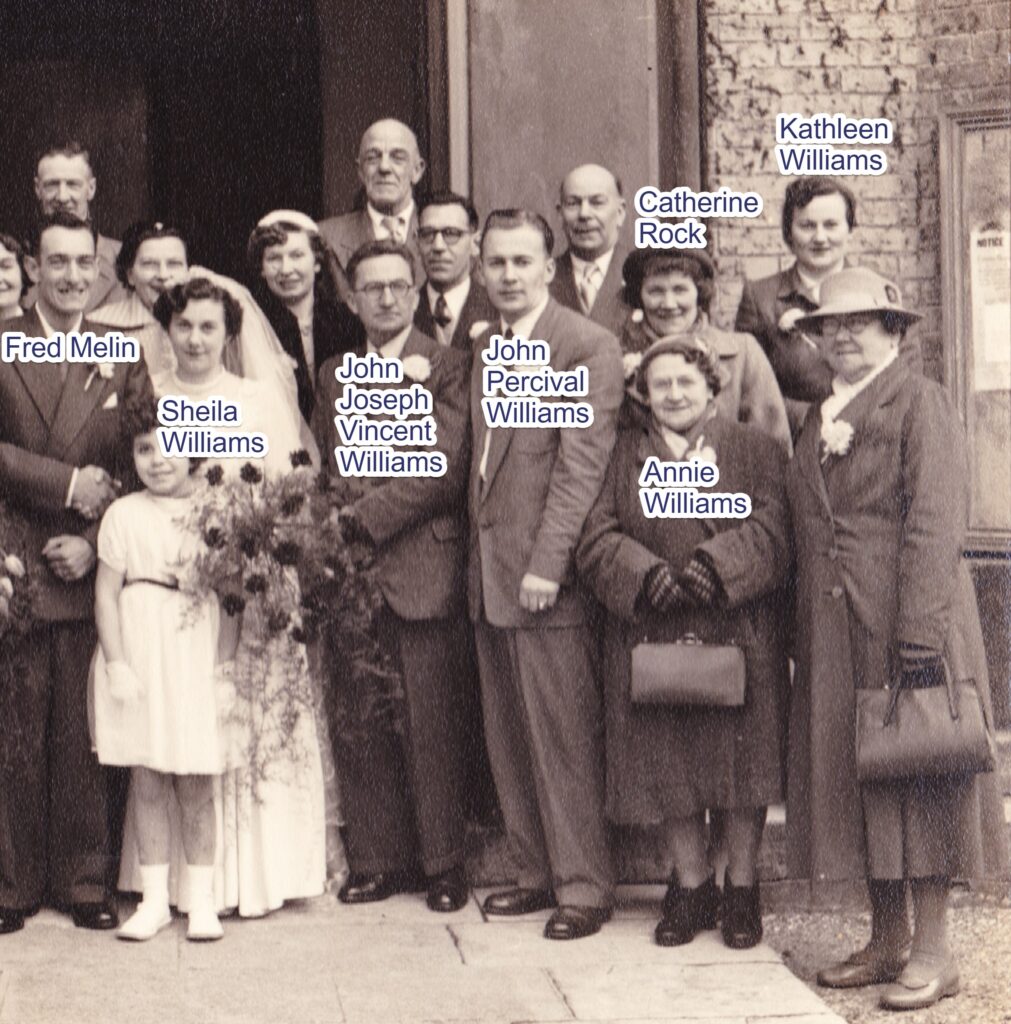
In the summer of 1954 John had been involved in a road accident which left him unable to work and suffering from headaches and sleeplessness. He was due an insurance payout for this accident. On Wednesday 27th July 1955 John deposited all his money into his daughter Sheila’s bank account. The following day Sheila and her husband went to stay with another relative.
Sheila called to see her father on the Saturday evening and that was the last time he was seen alive. When she called again the following morning she found a sign at the top of the stairs which said “Gas. Keep out. Get a policeman”. John had locked the kitchen door and closed the windows before placing a wooden armchair in front of the oven, opening the oven door and turning the oven gas full on. He died from carbon monoxide poisoning and the inquest returned a verdict of “Asphyxia due to coal gas poison. That he did kill himself. Balance of mind disturbed at time.” John left a note which read:
Dear Sheila
I don't know what to say.
I've been ill – very ill for a long time – nerves The doctor has done all he could so don't blame him.
Get me out of the way quick no funeral, no flowers, no nothing.
I only wish I could have been with you and Fred for the rest of my life – I should have been happy – Anyway get that insurance through and share it out – My head has been bad for some time but its worse tonight – Dad
J. Williams
In her witness statement Catherine Williams stated that “John was always of a quiet disposition and suffered from nerves” and that John’s nerves had been bad since the First World War.
John died intestate. His estate was valued at £450 and Catherine, whom he had never divorced, was granted Letters of Administration as his “lawful widow and relict and only person now entitled to the estate of the said intestate.” on 3rd December 1955.
In John’s possession at the time of his death was a well-worn copy of The Ragged-Trousered Philanthropists. It was the abridged version which had been given a depressing ending with the hero, Owen, contemplating killing his family and his own suicide. Ironically the unabridged version with a more upbeat ending was first published in the year John died. In 1955 suicide was still illegal in Britain. To be judged to have committed suicide while of sound mind was more of a heinous crime than being of an unsound mind. Had he failed in his attempt John could have been prosecuted and even sent to jail. There was considerable social and criminal stigma attached to suicide. The Catholic Church would have refused him burial while the Church of England would have allowed him burial but with no Christian service. John was cremated. His daughter Kathleen retained his ashes until her death in 2024. His casket was placed into her coffin and they were laid to rest together in St. Mark’s churchyard, Talbot Village.