
Patrick Joseph Rock, the fifth son of Edward and Catherine Rock, was born in Ballyfermot on 28th February 1884 and baptised in Lower Palmerstown (date unknown). Patrick was 5 feet 9 inches tall with brown hair, blue eyes and a fresh complexion. He also had a cast in both eyes. Patrick learned to read but was unable to write, not even his name. He found work as a labourer.
Patrick was no stranger to the inside of Kilmainham and Mountjoy prisons. Typically he was committed for failure to pay fines imposed at the Petty Sessions or for assault (mostly, but not exclusively, of policemen and usually alcohol related). Twice he was jailed for assaulting his mother and in one of these assaults he struck her with a stone. More seriously he was charged with manslaughter in July 1903.


On the night of 26/27 February 1903 an extratropical cyclone (ex-hurricane) passed over Ireland bringing with it some of the strongest winds ever experienced in the British Isles. James Joyce referred to the storm in his novel Ulysses which led to it being known as Storm Ulysses. A quarter of properties in Dublin sustained damage that night and nearly 3,000 trees were thrown over in the Phoenix Park. 400 men from the 21st Lancers took two days just to clear the road behind the Viceregal Demesne in the park. Clearing the damaged timber from the whole park took months. Patrick was one of the labourers working on the tidy up.
Patrick, James Farrell and William Sheridan were felling wood near the Magazine Fort on 9th July when they came across the 65 year-old Nathaniel Browne indecently assaulting a young girl called Sarah Noud. James Farrell pushed Browne away from the girl. Thomas Farrell and Luke Messitt were working nearby and saw the altercation between the men. James Farrell explained to them that they had caught Browne behaving improperly and Thomas went for a constable. Before the policeman arrived Patrick struck Browne in the face. Browne fell amongst some wood, got up, reeled and fell again. He did not get up. When Constable O’Reilly arrived he thought Browne was shamming injury. Browne was taken on a handcart to Chapelizod police station on the charge of indecently assaulting the little girl. From the police station he was taken to the hospital where a member of the police force remained with him at all times.
In the Northern Police Court on the 15th Patrick was charged with assaulting Browne with the result that Browne was in Steeven’s Hospital suffering from appoplexy produced by a rupture of a blood vessel in the brain. He was also charged with resisting arrest. Patrick was fined 10s, or seven days’ imprisonment. He was remanded.
Nathaniel Browne never regained consciousness and died the following day. At the inquest on the 17th the Coroner said that Nathaniel Browne was suffering from senile decay and disease of the arteries and that a burst blood vessel had caused a brain haemorrhage. The Coroner’s jury found “that the deceased died from the rupture of a blood vessel in the brain, caused by a blow given by Patrick Rock, in the Phoenix Park, on 9th July”. The verdict was not unanimous. Patrick and James were charged with manslaughter and released on bail of £10.
The charge of manslaughter against James Farrell of 8 New row and Patrick Rock of 33 New row was considered by the Grand Jury at the Commission for the County and City of Dublin on 5th August. His Lordship Mr Justice Wright outlined the case concluding “The blow did not appear to have been a violent one, and the men were not actuated by any motive or ill-feeling against the old man. Shortly afterwards the old man died, and the suggestion on behalf of the Crown was that, having regard to the state of his physical health at the time of the blow, the violence of the shock led to his death within few days of the occurrence. There appeared to be a considerable amount of doubt on the medical evidence as to whether there was any immediate connection between the blow, or blows, inflicted by these men and his death. They [the Grand Jury] would have to satisfy in their minds before they found a bill for manslaughter against these two men as to whether or not the death of the old man, which ensued within a week or so of the occurrence, was caused or accelerated by the blows. If it was sensibly accelerated by the blow or blows inflicted by the two men then they might find a bill for manslaughter; but if when they had examined the depositions and the medical evidence in the case they were satisfied that the two things were disconnected then, of course, they would be bound to say “ no bill.” ”
After a long deliberation the County Grand Jury found “no bill” against James and Patrick.
Nathaniel Browne was a farmer and small land proprietor from Templetuohy, County Tipperary. The cousin who identified his body stated that he had last seen him in June which would suggest that Nathaniel had been in Dublin for about a month when the incident occurred. It is not known why he was there. In Dublin Nathaniel Browne had taken lodgings with the young widow Emily Noud and her two children, James and Sarah, at 1a Bow Lane West, Dublin. Sarah was only 7 when Nathaniel assaulted her in The Phoenix Park. Since Nathaniel was never brought to justice we cannot know how many times he may have assaulted poor Sarah over the course of that month.
In October 1890 Browne had been accused of indecently assaulting Catherine O’Brien, a girl under the age of 13. He was released on bail to appear at the March 1891 Assizes for the North Riding of Tipperary. I have been unable to find the outcome of the trial but he was back in Templetuohy in March 1896 when he licenced his dog. The local Petty Sessions registers reveal that in the late 1890s Browne and his daughter Ellen were not on good terms with their neighbours! Nathaniel Browne’s body was not returned to Templetouhy for burial. He was buried in Mount Jerome Cemetery, Dublin. Ellen Browne quietly disappeared from Templetuohy. Sarah Noud may not have been his first victim but she would be his last.
The similarities between the case and a central theme in James Joyce’s novel Finnegans Wake are uncanny – a crime committed near the Magazine Fort, the perpetrator caught in the act by three men and being assaulted by one of them, followed by a period of unconsciousness before death, the alleged crime not named in the Patrick’s trial – and it is tempting to speculate that it may have provided Joyce with a source of inspiration.
Patrick twice received indoor relief in the Dublin Union infirmary. Firstly from April 19 to 21 May 1901 and again 2 Dec – 18th Dec 1908. I have been unable to decipher the cause of admittance for either occasion.
During the Great War Patrick managed to enlist 3 times! Only the records from his first period of service have survived. He attested into the Royal Dublin Fusiliers, Service No. 11887, on the 17th August 1914 in Naas. He was recommended for discharge from the service as medically unfit by an eye specialist because he had Trachoma and he was discharged on 4th October.
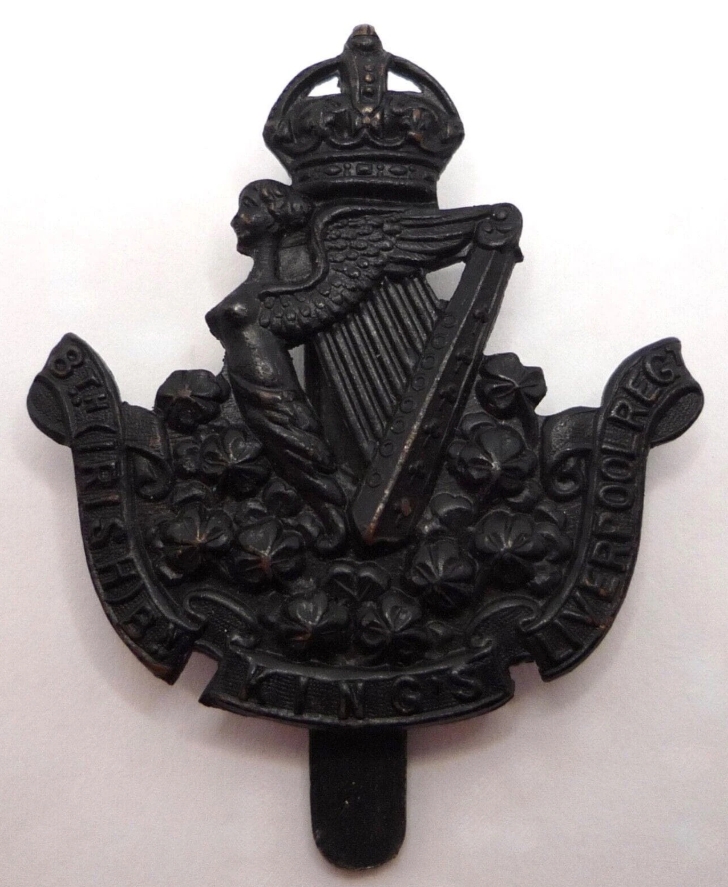
On 21st May 1915 he enlisted into the 2/8th (Irish) Battalion; The King’s Liverpool Regiment, Service No. 4319 (renumbered to 306816 in early 1917). Patrick was court-martialled in Canterbury on 19th June 1916 on one count of assaulting a sergeant and two counts of insubordination. He was sentenced to 9 months detention. As he was stationed in Canterbury this would have been served in Aldershot Detention Barracks. His detention period expired mid-March 1917, around the time that the 2/8th shipped to France but it is unlikely that Patrick went to France with them as he had been transferred into the Liverpool Regiment’s 25th Infantry Labour Company. Men were transferred to Labour Companies because they were medically unfit for frontline service although some men were transferred because they were difficult or unwanted. In Patrick’s case it was probably both! In April 1917 the Infantry Labour Companies were absorbed into the newly formed Labour Corps. The 25th Liverpool became the 90th Labour Company under Labour Corps Western Command and Patrick was given a new service number – 53788. Patrick did serve abroad as evidenced by his receipt of both Victory and British War Medals. There is scant information about the 90th Labour Company in France but from III Corps diary we know that on 5th May it was in Catelat to the S.E. of Doingt and on 8th August it was at Le Catelet (11 miles north of Saint-Quentin). Patrick was discharged as unfit (sickness) with a pension and a Silver War Badge (No. 289591) on 27th November 1917. He was awarded a pension of 27/6 from 28th November until 25th December and thereafter 13/9 to 26th November 1918. 27/6 represented 100% disablement so whatever his sickness it was totally debilitating but his condition was expected to improve to 50% disablement within a few weeks.

Patrick’s condition and pension entitlement would have been re-assessed in November 1918 had he not re-enlisted as a pioneer in Royal Engineers Inland Waterways and Docks, Service Number WR338646 on 22nd July 1918. The I.W. & D companies were formed in 1915 originally operating barges in the Middle East and France, later they operated cross channel barges from Richborough in Kent carrying arms and ammunition as well as construction materials and the heavy stuff the BEF needed. He was discharged once again as no longer fit (sickness) on 22nd October 1918. It would seem that physical labour aggravated his condition. Patrick was granted a pension of 24s 9d to 21st January 1919 and another Silver War Badge (number B/327661). 24/9 represented a 90% disablement. He would have been re-assessed in January 1919 but the result of the assessment is unknown.

On 6th January 1919 Patrick married Bridget Bowe, known as Delia, in the Church of Our Lady Immaculate, Paddington. Delia was the daughter of Michael Bowe, British Army pensioner and postman, and his wife Mary Lynam of Drumcullen. Bridget Bowe was born in the workhouse in Tullamore on 18th March 1883 while her father was serving in England. He went to Egypt the following month. As a child Delia lived abroad with her parents. Her brothers John and Michael were born in Gibraltar and Malta respectively.
At the time of his marriage Patrick was living at 3 Goldney Road with his brother Joseph and his family.
On 3rd November 1919 Patrick was found guilty of Unemployment Fraud for obtaining £7 out-of-work donation while in employment at Hampstead. He was sentenced to 6 weeks’ imprisonment without hard labour.
By February 1920 Patrick and Delia were living at 27 The Avenue, Brondesbury. A daughter, Eileen Mary, was born on 24 February 1920 at Cedar Lawn, a Maternity Home for the benefit of the wives and children of servicemen, in North End Road.
In December 1920 Patrick was back living in Goldney Road. He tried to sell furniture that was on the hire-purchase system to a policeman who prosecuted him for fraud. Patrick pleaded guilty and, it being his second offence for fraud. he was sentenced to 4 months with hard labour.
Delia went to Ireland some time after April 1920 taking baby Eileen with her. If he was planning to join her there this may explain why Patrick was trying to sell their furniture. Delia was pregnant when she left and their daughter Delia Margaret, known as Rita, was born in the Rotunda Hospital in Dublin on 31st January 1921. The birth certificate gives Patrick’s address as Thomastown, Birr but Patrick was not there – he was doing time back in England. Young Eileen would have been left with Delia’s parents, or brother, or a friend whilst Delia was in the Rotunda. I doubt that Patrick ever met Delia Margaret or saw Eileen again.
In early March 1921 The Southern Ireland Ministry of Pensions Regional Office tried to locate Patrick sending a trace request to the King’s Liverpool Regiment. In early July the office in Dublin recorded that Patrick was resident in the London Region and his files were transferred there. This was unfortunate as that Regions files were not retained. On the Irish index card Delia’s address is given as the N.S.P.C.C.’s office and “Children’s Shelter” in Molesworth Street, Dublin. The shelter was where at risk children were cared for while cases of abuse or neglect were investigated. It is likely that Delia was also there as Rita was a newborn. What the problem may have been we can only guess at but it seems that the “The Cruelty Man” was trying to locate Patrick. It is interesting that Delia either would not or could not provide details as to Patrick’s whereabouts.
On April 9th 1921 Patrick was admitted to the workhouse in Northumberland Street, Marylebone as destitute but was discharged at his own request the same day. He had probably just been discharged from prison.
How much disability pension Patrick was receiving post January 1919 is unknown but he was struggling for money and not in work. When the census was taken in June 1921 he was at Guardians’ Institution, Faversham, Kent (the workhouse).
In Ireland, Eileen and Rita were removed from their mother. The 1926 Irish Free State Census shows Eileen living with her grandparents in Dovehill, Drumcullen and Rita lodging with the Tully family in Arnott Street, Wood Quay, Dublin. Neither Patrick or Delia were in Ireland in 1926.
Nothing is known about the final decade of Patrick’s life. He has not been found in any electoral roll. On 24th February 1931 he died of Erysipelas of the face and pulmonary tuberculosis in Paddington Infirmary, Harrow Road. Prior to his death he had been living back at 3 Goldney Road with his brother Joseph and it was Joseph who registered his death.
Delia never remarried and she died in Hastings on 11th November 1950. Eileen and Delia Margaret both eventually came to England and both became nurses.