
Joseph, the youngest son of Edward and Catherine Rock, was born in Ballyfermott Lane on 3rd March 1888. His father had died 6 months earlier and he was baptised Joseph Edward in Clondalkin Roman Catholic church. Joseph lived with his mother and brothers in a small cottage near the bottom of what is now Chapelizod Hill Road close to the southern end of Chapelizod Bridge (now Anna Livia Bridge).
After school Joseph worked as a groom at the racing stable of the merchant and Nationalist M.P. Denis Cogan. Joseph enlisted in the local militia, The Royal Dublin Fusiliers (102nd Foot), on 11th August 1905 for a period of 6 years. He went on 49 days drill and officially joined the R.D.F. on 7th November (Service No. 3994).
By the time of the 1911 census Joseph was serving as a gunner in the Royal Garrison Artillery on Portland. Unfortunately Joseph’s R.G.A. service record has not survived but he would have been in either 28 or 30 Company both of which were stationed at various times at Nothe Fort, Weymouth and Verne Citadel, Portland. There is a good chance that Joseph may have crossed paths with John Williams who was serving in the Royal Navy and was with H.M.S. Acasta at Portland from January 1914.
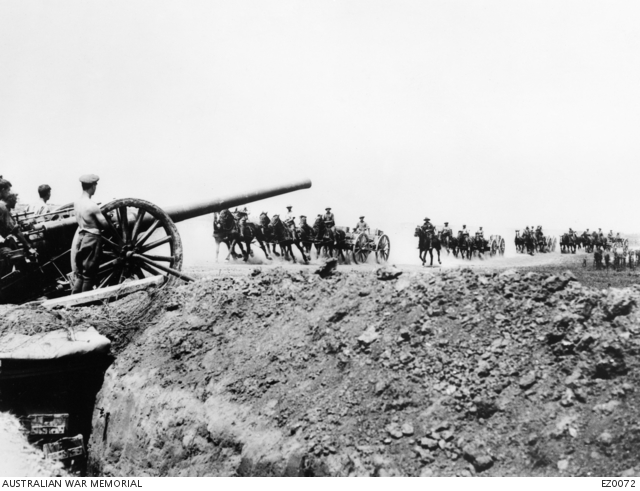
W.W.I. medal records show that Joseph served in 118 Heavy Battery (H.B.) during the war and, from war diaries that have survived, it is possible to piece together where the battery was. 118 H.B. went to France with the 8th Heavy Brigade, the first Heavy Brigade to arrive in France. The battery’s armament consisted of 4 x 4.7” Mk IV guns with Mk I carriages.

The 8th Heavy Brigade, consisting of H.Q., 118 H.B., 119 H.B., and Brigade Ammunition Column, was formed in Woolwich on 3rd October. On the 14th it travelled to Hursley Park, Winchester to join the 8th Division. 118 H.B. left Hursley Park at midnight on 5th November. It marched to Southampton to embark “S.S. Cymzic”. “S.S. Cymzic” sailed at 6.30pm and arrived at Le Havre at 10am on 7th. The ship proved to be unsuitable for Heavy Artillery. There was difficulty loading and unloading the equipment and 5 of the battery’s general service wagons were damaged. From Le Harve the battery travelled by train to Berguette. It then marched to Merville and to it’s billets at Riez Bailleul, La Gorgue.
On Christmas Day 1914 there was a sharp frost. The brigade’s diary reports: “Perfect quiet all day. Apparently a tacit understanding that neither side should provoke hostilities. Extreme vigilance was however ordered to be maintained in view of possible hostile attacks.” Joseph received a Christmas card from HM The King and Queen and Princess Mary’s present of an embossed brass box containing tobacco and cigarettes, a pipe and a card or substitutes.”
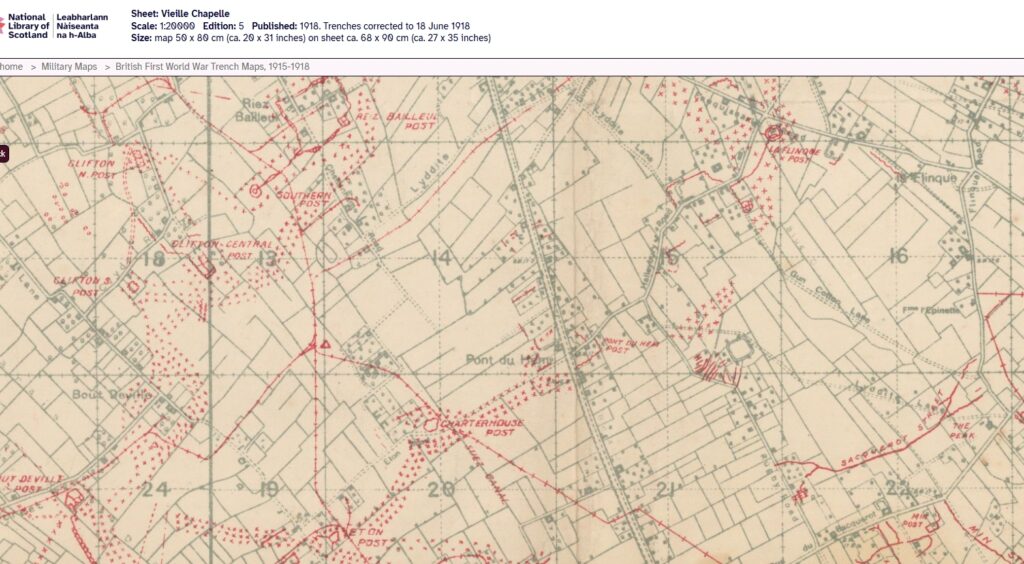
At the beginning of 1915 118 H.B. was positioned at Bout Deville. Between 10 and12th March it was allotted a special role in the bombardment of and subsequent advance on Neuve Chapelle and the Bois du Biez. When the battery arrived at it’s billets at 5 a.m. on the 11th a red flare was lit by the inmates of the farm. Another flare was lit the following evening when an infantry detachment arrived. The women on the farm said they lit the flares to amuse the babies. Major Twiss, O.C. 118 H.B., arrested them and handed them over to the police. On the 11th 118 H.B. moved, one section at a time, to a position near Min. The battery was badly blocked by the traffic in Rue de Bacquerot. One gun collided with a wagon on the Pont du Hem road and ended up in a ditch. The section finally arrived at its new position at 3am on 12th. In the action of 12th 2 men of the battery were killed, 2 died of their wounds and 3 were wounded. The battery was so heavily shelled on the 14th that it moved to a position near La Flinque. At an inspection a couple of days later all the guns of the battery were condemned but they would have to wait for replacements.
On 26th June, 8th Brigade was assigned to the northern part of Indian Corps area under command of the Lahore Division. There was a lot of reorganisation of the heavy batteries over the following days. On July 1st 118 H.B. was detached from 8th brigade and came under control of Lahore Division. Then on 3 July 118 H.B. transferred to 4th Heavy Artillery Brigade.
With 4th Heavy Artillery Group (HAG):

5 August 1915  4th H.A.G. took on the guns of 4th Brigade (Heavy Batteries number 109, 110, 118 and Highland) under Lt. Col. Logan and 8th Brigade (Heavy Batteries  number 119, West Riding, Warwick and Canadian) under Col. Phillips.

21 August 8th Brigade left with Col. Phillips. 109, 110, 118, Warwick and Canadian Batteries remained with 4th HAG. This necessitated re-organisation of the batteries. Lt. Col Logan of 4th Brigade remained in command of the Indian Corps Subgroup which consisted of 110, which moved to the position which had previously been occupied by the Highland H.B., and 118 and 119 which remained where they were. Bt. Lt. Col. Loring of 110 Battery was placed in command of the 3rd Corps subgroup which replaced 8th Brigade. This consisted of the Warwick and Canadian batteries which remained in their current position. This Brigade had no “official” number and was subsequently referred to as Loring's Brigade or Group.

29 August 118 H.B. shifted to the position which had previously been occupied by West Riding i.e. with Loring's Brigade. It was detached with Loring's Brigade until 10 November.

I have been unable to find out what the battery was doing over the next few months but the Warwick H.B. War Diary mentions 118 H.B. on 6, 10, 12 and 20 Feb. 1916. At this time Warwick was firing at targets in Ennetieres and Escobeques so the battery hadn't moved far, if at all.
The following poem appeared in Grays & Tilbury Gazette of 5th February 1916. It was sent in by E. Ducie, 118th Heavy Battery (R.G.A.) who said it had been composed by a friend.
AN INVITATION.
When I'm sitting in my shelter and have got my dixie out,
And am busy with a meal of beef and bread,
Then my thoughts go back in pity
To those fellows in the city
Who for all they know my pretty soon be dead
For the dangers that beset them very naturally fret them-
When the taxis and the lorries dog their steps;
They get hustled by the “cusses”
Of the drivers of the buses,
And at night-time they are worried by the Zeps.
Still I do admire the fellow who has pluck to leave his pillow,
To prowl across the pavements in the dark;
And the man who lit two matches
Should be mentioned in dispatches,
As Grays' hero who smoked fags within the Park!
“You won't stand it; you'll go balmy!-take my tip and join the Army;
You will find a dug-out ready when you come.
Life's too precious; pray don't risk it,
Take your shilling, then the biscuit,
Then the bully-beef and last-not least-the rum.

SOMEONE IN FRANCE.
On 5 May 1916 118 H.B. transferred to 42nd Heavy Artillery Group. At the end of the month Joseph had home leave. He married Bridget Flanagan in the Roman Catholic Church in Chapelizod on 30th May. This was a little over a month after the Easter Uprising and parts of Dublin were as much in ruins as the towns back in France!
With 42nd Heavy Artillery Group (HAG):

5th June 118 H.B. fired on a train in La Basse station. It was reported that the train left hurriedly.

6th June one section of the battery left its position.

8th June 118 H.B. fired on a train and set fire to it.

12th June second section left its position.
On 14 June 1916 118 H.B. transferred to 18th Heavy Artillery Group. Unfortunately the June diary of 18th HAG has been lost and the precise position of 118 H.B. is unknown.

With 18th H.A.G.

July HAG HQ was at Billon Copse, Bray-sur-Somme. Start of Battle of the Somme.

3 July during the morning 118 H.B. was involved in a special bombardment on Mametz Wood. In evening the battery moved to 600' NE of Carnoy.

10 July 118 H.B. destroyed a British BE2 Plane that had been downed and fell to east of Mametz Wood.

11 Jul The day was spent mainly in counter-battery work; “the usual difficulty attended this, viz. ignorance of the exact whereabouts of our infantry.”

16 July 118 H.B. Ordered to move to a valley south of Mametz Wood about 1 mile behind the old German front line.

17 & 18 July Heavy counter-battery work. High Wood area.

19 July HQ moved from Billon Copse to Fritz Trench as communication with forward batteries becoming difficult to maintain.

26 & 27 July Gas! “During the night of these two days the enemy kept up a fairly steady fire with gas-shell of small calibre mostly in the valley (full of batteries) immediately in front of Hq, The gas was of a new kind, non-asphyxiating and non-irritant, and not unpleasant to the smell. When strong it caused collapse by seriously affecting the circulation.”
On 20th August 1916 Joseph’s name appeared on the Wounded List. Because of the usual delay in reporting his wounding could have occurred up to several weeks earlier. His name does not appear on any surviving field ambulance/hospital records etc. and it is unlikely that it was a “blighty” wound. 18th H.A.G. diary records one man slightly wounded on 31st July and this may well have been Joseph there being no other wounded reported around this time. Appearing on the Wounded List would have entitled Joseph to wear a Wound Stripe on the left sleeve of his uniform.
[To complete 118 H.B.'s story...

3 September more than 3300 rounds fired by 10 x 60 pounders and 7 x 4.7 guns of the group 18th H.A.G.

On 2 December 1916 118 H.B. transferred to 62 HAG which moved to Ginchy and took over 1/1 Kent H.B., 1 /2 Lanc H.B., 26 H.B., 116 H.B. and 118 H.B from 18 HAG.

3rd December 1916 118 H.B. left for rest. returned 18th.

24 December 118 H.B. left for rest. Returned 12 Jan 1917.

2nd January 1917 Major Arthur Francis Balington Fishe, Battery Commander 118 H.B. awarded D.S.O.

12 January 118 H.B. takes new position at Ginchy.

On 28 January 1917 118 H.B. transferred to 73 HAG

On 6 February 1917 118 H.B. transferred to 23 HAG

On 12 February 1917 118 Heavy Battery was broken up. 1 section went to 1/2nd Lancs H.B. and 1 section to 1/1 Kent H.B. (2 guns in each section). Sergeants Frederick Gordon Powell 25947 and Ernest Crick 24028 of 118 H.B. were awarded the Military Medal.]
It is unknown which Heavy Battery Joseph was transferred to but Acting Sergeant Joseph Rock was discharged unfit on 15 Sep 1917 from 3 Res Battery, 1st Heavy Artillery Reserve Brigade. Winchester. The 3 Res Battery was a Depot Battalion for holding wounded men awaiting discharge. He was awarded a Silver War Badge. Joseph’s name does not appear in any Wounded List. There was a gap in the published lists from April to late July 1917 and so his wounding would have occured sometime between March and the beginning of July. Searching through the surviving Diaries for the Heavy Artillery Groups to which 1/1 Kent and 1/2 Lancs were allocated there is one entry which is probably describing the action where Joseph was injured. The diary for 99 Heavy Artillery Group records:
Neuve Eglise, 6th June 1917
The Batteries of the Group carried out their usual programme during the night except 1/2 Lancs H.B. which taken off its programme objective and put temporarily on another. At 10 a.m. and again at about 1 p.m. the 1/2 Lancs H.B. was shelled by hostile 4.2 1 Officer and 13 other ranks wounded. 1 Gunner killed. 1 gun damaged.
The man killed was Gunner 308117 Harry Gobie. 4 of the wounded later died of their wounds. They were Gunner 308391 John Clarke, died 9th June; Gunner 308291 J.T. Caine, died 14th June (his pension index card states he died of multiple cordite burns); Gunner 168897 William Boyd, died 15th June (previously of 118 H.B.); and Bombadier 308509 Charles Cashin, died 17th June. Charles Cashin’s sister Margaret Jane was the wife of Harry Gobie.
Joseph’s pension index card survives and shows he received 26/- p.w. from 16.9.17 to 17.9.18. This represents an 80% rate for a disability pension for a Class III NCO/Sgt under the 1917 Royal Warrant. Injuries corresponding to 80% disablement included amputation of leg at hip or left arm (for the right handed) at shoulder joint, severe facial disfigurement, total loss of speech.
The pension index card shows that he applied for an Alternative Pension Disability (APD). The card also has a clipped top right corner indicating the disability claim had ended. At the time he was wounded Joseph had over 10 years service which entitled him to an army service pension and he was described as an army pensioner by the time daughter May was born in 1921. Joseph was awarded the 1914 Star with clasp, and the Victory and British War Medals.
At discharge Joseph gave the address of his brother Christopher at 583, Harrow Road, Paddington. He and Bridget then lived for a short time with his mother at 566 Harrow Road before finally settling at 3, Goldney Road. These addresses were what would now be called Homes of Multiple Occupation. The 1921 census shows Joseph, Bridget and two children were occupying 3 rooms of the house so his pension was enough for them to live relatively comfortably. Brother Michael, his wife Mary and 4 children were living in 2 rooms in the same house.
Joseph and Bridget had four children:
Kathleen born 1918
May born 1921
Edward born 1923
Joseph born 1925
Joseph’s mother Catherine, who had come to England sometime after Patrick‘s conviction in 1913 and before the start of the war, died on 17th January 1920. Joseph was present at the death and registered it a couple of days later. Joseph was also present at and registered the deaths of his brothers Patrick and Michael who both died in 1931.
Circa 1937 Joseph and his family moved to Ruislip. They lived for many years at 139 Victoria Road but by the mid 1950s were living at 123 Park Avenue. Joseph was very active in the local British Legion first at Ruislip (South) and then, after the move to Park Avenue, at Ruislip (North). He was chairman of the South Ruislip Branch of the British Legion and, during the second World War, Secretary of the Ruislip South Home and Overseas Comforts Fund. During the war he served as a Warden for the Council. Later Joseph was the Pension Officer of Ruislip (North) British Legion and at the end of 1955 took over as its President.
Joseph took jobs to supplement his pension. In 1959, although he was over 70, he was working as a cleaner at London Telephone Region’s Norwood exchange.
Joseph died in St Kevin’s Hospital, Dublin on 2nd September 1959. His cause of death was Mesenteric Thrombosis (Venous), Coronary Insufficiency, Nephric sclerosis. It was noted that Joseph had had a previous heart attack. He was buried in plot A040-00608 Mount Jerome Cemetery, Harold’s Cross, County Dublin.