
Frederick Troke, son of Charles Troke (1822-1906) and Fanny Luther (1835-1899), was born in 1868 in Kinson, Dorset. His birth was registered in Q4. When the census was taken on 2 April 1871 2-year old Fred and his family were living with his mother’s uncle, the thatcher Thomas Hicks, in Kinson. Ten years later Fred was a scholar living with his family in Kinson near to the West Howe Wesleyan Chapel. The family were Wesleyan Methodists.
After purchasing a discharge from the 3rd Dorset Regiment (Militia) Frederick joined the Dorsetshire Regiment on 19 February 1886 in Dorchester (Service number: 2191). Previously he worked as a labourer. He attested for a Short Service and was described as being 5 feet 7 1/4 inches tall with a swarthy complexion, grey eyes and dark brown hair. Fred weighed 134 lbs and had a 34 1/4 inch chest. He had acne spots on his face and a scar on the left front of his sternum. He lied about his age, claiming to be 18 years and 10 months old when in fact he was about 17 ½.
At the time he signed up Fred’s level of literacy had been poor. He continued his education after enlisting and achieved the following Army Certificates of Education:
4th Class 16 Mar 1887 The minimum standard.
3rd Class 14 Jun 1887 The standard required for promotion to Corporal.
2nd Class 13 Mar 1889 The standard required for promotion to Sergeant.
Fred was “at home” for the whole 6-year period of this short service. At first he was based at the Regimental Depot in Dorchester then from 7 Jan 1887 he was based in Portsmouth and from 24 Sep 1889 in Devonport. When the census was taken on 5 April 1891 Corporal Fred Troke was in Plymouth with the Dorsetshire Regiment. Fred trained as a cook in September 1891.
He transferred back to the Regimental Depot in Dorchester on 21 Jul 1892. In Dorchester Fred received a wound to the forehead when he fell off a bicycle whilst off duty. This resulted in a Court of Enquiry but no action seems to have been taken against him and he was said to suffer no after effects.
On 28 Nov Fred was permitted to extend his service to serve 12 years with the colours and was promoted to Sergeant on 1 Dec.
Fred transferred to the First Battalion of the Dorsets on 27 Jan 1893 travelling on the storeship HMS Tyne to join the Battalion in Egypt and arriving in Cairo on 10 Feb.
Fred was tried by Court Martial two months later and found guilty of conduct to the prejudice of good order and discipline. He was demoted to the rank of Corporal and forfeited 1 penny good conduct pay. This offence may well have been drink related as during April Fred was treated in hospital for alcoholism. At the beginning of October Fred was promoted to Lance-Sergeant but he would not regain his Sergeant’s rank until 21 Aug 1897. (Lance-Sergeant was an appointment given to a corporal so that they could fill a post usually held by a sergeant. The appointment of Lance-Sergeant could be removed by the soldier’s commanding officer, unlike a full sergeant, who could only be demoted by court martial.)

The 1st Battalion embarked from Egypt for India on the troopship HMS Malabar on 29 Sep 1893. The Malabar could transport a full battalion of infantry with its married families (about 1,200 people). The Battalion landed in India 11 Oct and was stationed in the south of India until the autumn of 1897 spending 15 months in Wellington, 9 months at Malappuram and nearly 2 years at Bangalore. In Wellington Fred obtained a Qualification in Military Subjects and was given training in transport. Towards the end of the Battalion’s time in Bangalore Fred re-engaged to complete 21 years service with the regiment and was promoted to Sergeant.
On 3rd Sep 1897 orders were given for the assembly of a force for the invasion of Tirah, NW Frontier. Two days later the regiment left Bangalore for Peshawar which was over 1700 miles to the north. En route to Peshawar Fred attended the School of Musketry in Bellary.
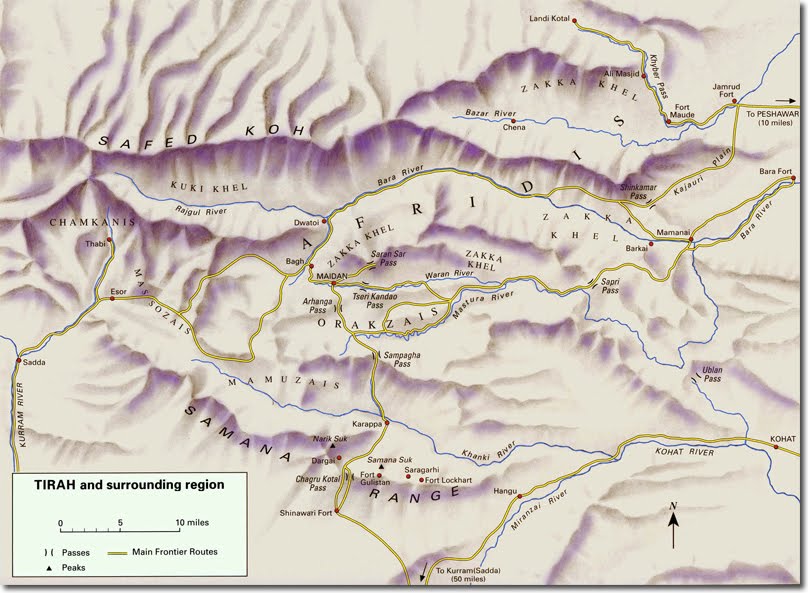
It was later decided to use Kohat-Kushalghar as the base for the campaign in preference to Peshawar. Kohat was only 30 miles from the advanced base at Shinawari and had a better road on which carts could be used. Beyond Shinawari it was not possible to use carts only pack animals. Troops that had been using Peshawar as a base marched to Kohat on 10, 11 and 12th Oct. On 14th Oct the Dorsets, under the command of Colonel Piercy, advanced to the front from Kohat via Shinawari. The Regiment participated in the assault on the Dargai Heights on 20 October 1897.

The Dorsets wore light weight khaki service dress with quilted helmet curtains over their cloth covered cork helmets to protect the back of the neck. They had Slade-Wallace equipment (a leather harness) with square water bottles and haversacks for food and were armed with Lee-Metford rifles all of which can be seen in this contemporary photograph.

The Battle of Dargai

The regimental history of the Dorsetshire Regiment, by Atkinson (Vol. II), describes the action on 20th October:
‘The second attack found the tribesmen in greatly increased numbers and the position much strengthened. Many Afridis had served in the British Indian Army and had learnt how to use modern rifles the majority of them carried. It was therefore an extremely formidable task which awaited General Kempster’s men when at 0430 on 20 October they started the next advance. The 2nd Gurkhas led, with the Dorsets, less ‘G’ and ‘H’ Companies escorting the two Mountain Batteries, in support. On reaching the top of the Chagru Kotal the enemy were found In force at Dargai and the Gurkhas were sent forward, the Dorsets following. The only line of approach was little better than a bad goat path up a water course, so the men could only advance very slowly, though they were in dead ground and consequently escaped exposure to fire.
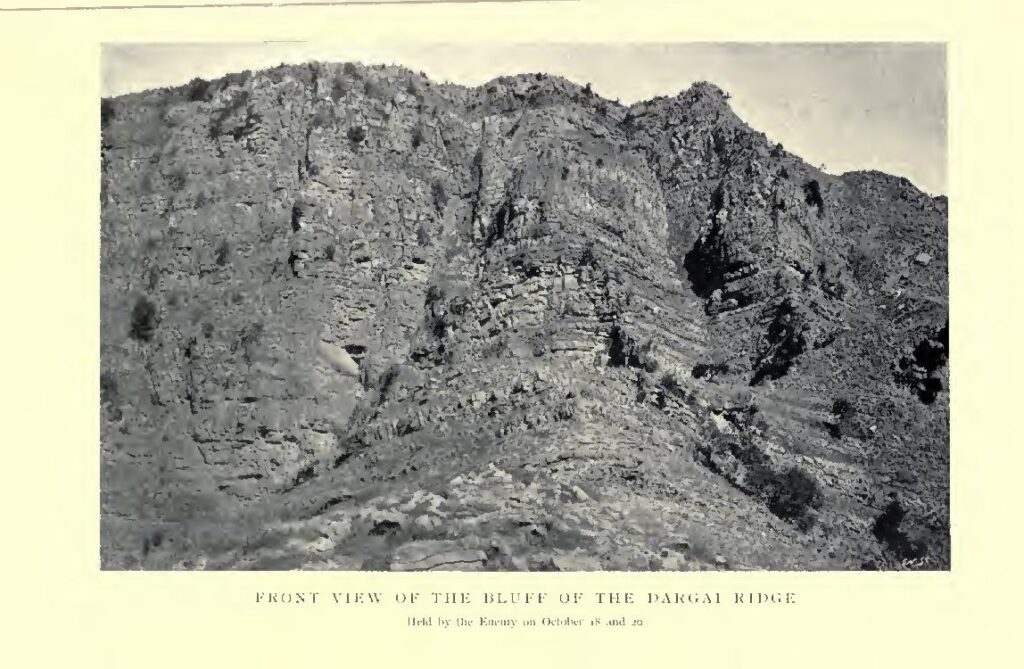
Eventually the Gurkhas were collected at the western end of the lower ridge where the connecting spur joins it. Four companies of the Dorsets ‘A’, ‘B’, ‘C’ and ‘D’ took position on their right to give covering fire, though they had little to shoot at, at about 1000 the Gurkhas tried a rush. About 300 yards had to be crossed to reach dead ground at the foot of the heights, with two outcrops of rocks as the only cover on the way. A terrific fire greeted the Gurkhas, and of their first two companies only a handful got across, including the C.O. Colonel Travers. Many were hit, including one British officer, and others came back most of them wounded. A second effort was no more successful, as the Gurkhas emerged into the open over the crest of the lower ridge and started to cross the connecting spur they were bowled over, the Mountain Batteries on the Chagru Kotal and the covering fire of the Dorset half Battalion being equally impotent to keep down the fire of the well sheltered Afridis.
It was now the Dorsets turn and ‘E’ Company under Captain Arnold, having pushed along the reverse slope to the end of the ridge, dashed forward. They made a gallant attempt, Captain Arnold setting a splendid example, but the fire was deadly. Captain Arnold was hit in several places and nearly all the leading section fell. The other sections following behind under Lieutenant Mercer were no more successful, and after a further attempt at advancing the rest of the Company fell back to cover. Private Vickery of ‘E’ Company who had retreated to cover saw a wounded man lying in the open exposed to fire. He ran out and carried him back to safety. He was awarded the Victoria Cross. The heights were eventually carried by a massed attack by the Gordon Highlanders with more effective artillery support, many Afridis having left the heights, their ammunition exhausted.
The Dorsets suffered ten other ranks killed with two officers and 39 other ranks wounded.‘
Fred was one of those severely wounded at the Battle of Dargai (originally known as the Battle at Chagru Kotal) receiving a gun shot wound to the left elbow. His wound was washed and dressed antiseptically at the No 24 Field Hospital (serving with the Dorsets et al in the First Brigade of the Second Division). Fred was transferred to a line of Communication Hospital the following day (21st) before being sent on to the 500 bed, No. 1 British General Hospital in Rawal Pindi nearly 100 miles away. He reached the hospital on the 29th.
[The Field Hospitals were closest to the front line. They were lightly-equipped to enable them to move forward with the troops; further back from the front line were Stationary Hospitals, which were more heavily equipped and located on the lines of communication. At the base of operations there would be a fully-equipped General Hospital.]
A Detailed Medical History for Invaliding was prepared on 24th Jan 1898 at the hospital in Rawal Pindi. Fred’s wound was described as follows:
“The bullet entered the posterior aspect of the left forearm, two inches below the head of the radius. Taking an upward course, it smashed the neck of this bone and, skirting the elbow joint, emerged on the other aspect of the arm, one inch above the external condyle of the humerus. Several pieces of dead bone have been removed. Since an incision was made in the anterior aspect of the forearm the drainage – in the supine position the part has been in – has been by this opening, and, the original wounds are now granulating ones. There is considerable loss of function of the elbow joint, and, some periarthritic thickening. The injury was received in action and, is the result of military service. It has not been aggravated by intemperance, other vice or misconduct.
The disability is permanent. It will to a very great extent prevent his earning a livelihood in civic occupation.”
Medical treatment received for the wound included splints, antiseptic dressings, incision. Removal of detached bone.
(Periarthritis is a type of arthritis that causes pain and stiffness in a single joint. Symptoms occur when calcium crystals build up around the joint, resulting in inflammation. This type of arthritis is temporary and normally resolves in about 3 years.)
The following day a Medical Board concurred with the report and recommended Fred for change to England. The Board was of the opinion that “Injury has been very severe but in its permanent effects not nearly equivalent to the loss of a limb.”
Fred was discharged from the hospital in Rawal Pindi on 20 Feb 1898. He then travelled the 1,150 miles to Bombay to board a ship back to Blighty.

On 6 March 1898 Fred embarked on the Hospital Transport Ship S.S. Nubia for England. The ship arrived in Netley 28 Mar 1898. The Medical Officer on board, Surgeon Lt. Col. J. Armstrong, reported that the condition of the limb was unchanged. Frederick was admitted to the Royal Victoria Hospital, Netley the following day. On his medical record it was noted: “Left elbow joint, radius and humerus. Impaired extension and rotation. Wound healed. No further treatment indicated.” and “Proposed for discharge. Permanently impaired movement of the left elbow joint and the fingers of the left hand the result of gunshot wound occurred in action. Will affect his earning capacity to the extent of 1/2.“. Fred appeared before a final medical board on 5 Apr 1898 and was Discharged as an Invalid on 17 Apr.
“The worst aspect of the climb was an open space that had to be crossed. This was a killing ground for the sharp-shooting tribesmen 200 yards above them… Every man who attempted that dreadful dash faced almost certain death, making them all potential VC winners.” Stephen Luscombe, britishempire.co.uk.
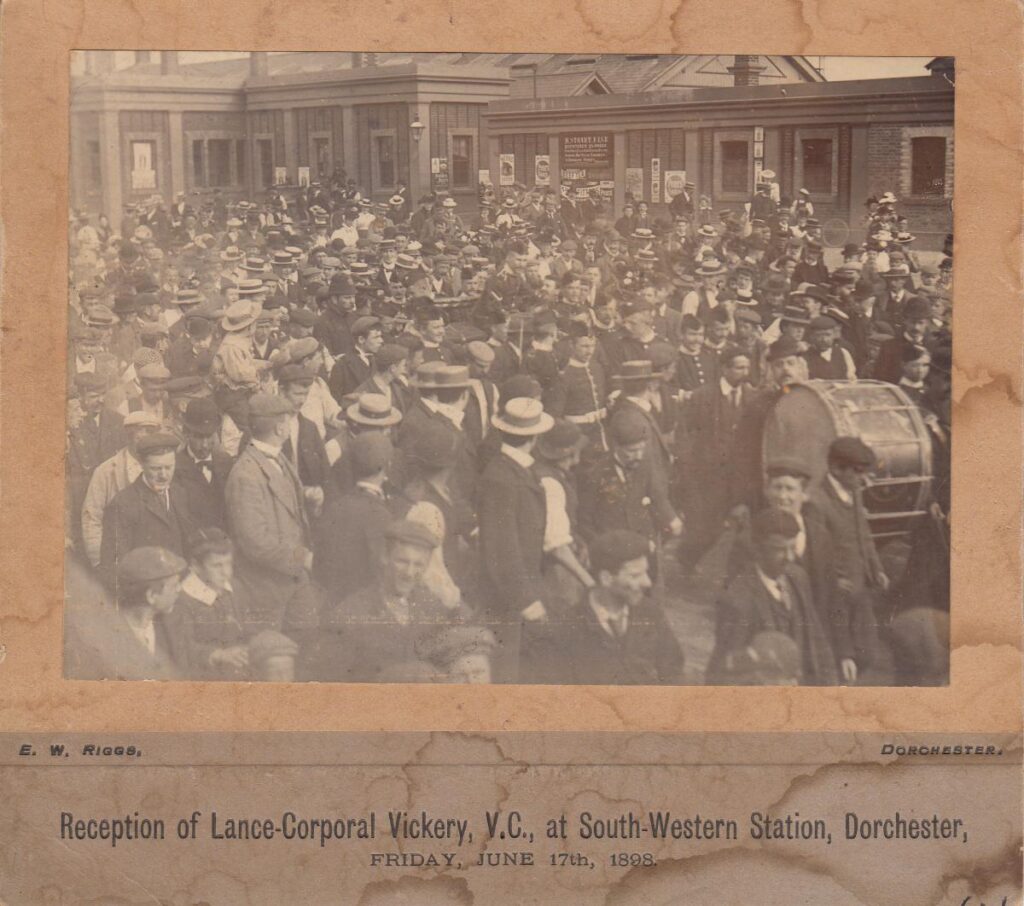
Victoria Crosses were awarded to Piper George Findlater and Private Edward Lawson of the Gordon Highlanders, Henry Singleton Pennell of the Derbyshire Regiment and Private Samuel Vickery of the Dorsetshire Regiment for valour shown at Dargai. The action was commemorated in verse by William McGonagall, the pipe march The Heights of Dargai by J. Wallace and the fiddle tune Dargai by James Scott Skinner.
Fred was awarded the Indian Frontier Medal with the clasps “Punjab” and “Tirah”.
Frederick joined The Corps of Commissionaires on 4th June 1898 (succession number 10444 of the 39th Regiment (Dorsetshire), Corps No. 1111). The Corps had been founded in 1859 by Edward Walter, a retired British army officer, and was devoted to securing employment for ex-servicemen. Still in existence it is the oldest security company in the world. Fred was living “in barracks” at 7 New Exchange Court, St Martin-in-the-Fields, Strand, London at the time of the census taken on 31 March 1901. Fred resigned from the Corps on 24th August 1901 and on 6 November the Civil Service Commission appointed Fred to the position of Post Office Porter in London.
Fred married Beatrice Bertha Bessant, the daughter of a publican and step-daughter of an innkeeper, on 29 October 1903 in Selborne, Hampshire. Frederick was still working for the London Postal Service at the time. The marriage was witnessed by Beatrice’s sister Florence Elise and an Arthur George Palmer. Fred and Beatrice returned the favour by witnessing Florence and Arthur’s marriage in April of the following year.
After their marriage the couple moved to Wallisdown, Kinson where, at the time of his death, Fred was innkeeper at the The King’s Arms, in Wallisdown. The King’s Arms had been built in 1870s for Poole Brewery and the Pike family had been the innkeepers there for many years. Census returns reveal that Mary Pike was the innkeeper in 1881 and 1891 and her son Albert, a former water and gas fitter, was the innkeeper in 1901. Albert, a widower, married Beatrice’s cousin Alice Mary Elton on 10th Jun 1902. The 1911 census records Albert and Alice living in an 8 room property in Bristol with Albert listing his occupation as a licensee in the beer trade. Although resident in Bristol the electoral roll shows that Albert owned a freehold house on the High Road at Wallisdown which qualified him to vote as an Owner Elector. He died in Poole in 1911/2. The Bowring family moved to the King’s Arms from Winton around 1906 and in 1911 Albert Bowring described himself as a Hotel Keeper. (The current pub building dates from 1920’s)

A diabetic, Fred who had suffered from pulmonary phthisis (tuberculosis) for 9 months, developed acute lobar pneumonia at the end of March 1905 and died at home two days later on 1 April. Fred is buried in St Andrew’s Church burial ground, Kinson. The memorial on his grave stone reads “In loving memory of my dear husband Fred Troke who peacefully passed away April 1st 1905 age 36” His estate was probated on 4 May in Blandford-Forum. ‘TROKE Fred of the “Laurels” Wallis Down Dorsetshire army-pensioner died 1 April 1905 Administration Blandford 4 May to Beatrice Bertha Troke widow Effects £864 17s.‘
Beatrice Bertha Bessant was born in 1877 in Farringdon, Alton. After Fred’s death she married William Henry Palmer, brother-in-law of her sister Florence, in Q3 1906 in Sussex. Beatrice died in Portsmouth aged 94.
On 24 May 1900 a pink granite obelisk memorial to the NCOs and men of the 1st Battalion, Dorsetshire Regiment who were killed in action or died of wounds in the Indian North West Frontier (Tirah) Campaign, 1897-98 was unveiled in Borough Gardens, Dorchester. The obelisk stands on a square step set on a stone circular base. A memorial service is held in late October each year.
View The memorial listing on IWM War Memorials Register.