
(Grand uncle of the author).
William George Troke Medley, son of William Medley (1851-1881) and Mary Troke (1853-1886), was born on 27th May 1880 in Poole, Dorset. The inclusion of his mother’s maiden name (Troke) distinguished him from a cousin, also named William George, born 4 years earlier. William was baptised on 16 June 1880 in Poole.
In the UK Census of 1881 taken on 3 April 1881 a 10 month old William is recorded as the son of the head of the household living at the Heart and Hand Inn, Quay, Poole. The Electoral Roll shows that his parents had moved to the inn sometime during the previous year. His father William’s occupation is given as Beer House Keeper but prior to the move he had been a fisherman. Mary was a cook before her marriage.
The Heart and Hand stood off the quay, next door to The Lord Nelson, at the rear of the fish shambles. Inns were open to the public and provided food, lodging and entertainment. They had a special obligation to provide billeting for soldiers. Inns required a licence to sell alcohol. William had a licence to sell Beer.
William senior died on 26th July 1881. Mary remained at the Inn and married John Thomas Coakes, another fisherman, in the 3Q 1883. William’s half sister, Florence, was born in February 1885. Mary died on 14th May 1886. She was buried with her first husband in Poole Cemetery. William went to live with his grandparents Charles and Fanny Troke. Florence was raised by her mother’s sister Harriet and her husband John Warren. The Troke family believed that John Coakes had pushed Mary down the stairs and held him responsible for her death. Florence had no further contact with her father who remarried a young, unmarried mother with indecent haste just a few weeks after Mary’s death.
In the UK Census of 1891 taken on 5 April 1891 the 10 year old William is shown living with his grandparents in Kinson, Dorset.
William attested into the 3rd Battalion (Special Reserve) Dorset Regiment on 10 Aug 1896. He claimed to be 17 years and 10 months old but his true age was 16 years and 2 months. His Militia Attestation Record states that he had been living in St James, Poole for the previous 12 months and working as a labourer for Messrs Carter & Co. (Poole Pottery). William signed up for 6 years but on 25th September 1896, now supposedly aged “18”, he enlisted for a Short Service of 7 years with the Colours and 5 years in the Reserve (Service No. 5059). William was 5 feet 7 ¼ inches tall and weighed 118 lbs. He had a fresh complexion, blue eyes and fair hair. Interestingly he named his grandmother, Fanny Troke, as his next of kin rather than his grandfather. Possibly this was because Fanny was 13 years younger than her husband although ironically she died before him.
William was posted to the 2nd Battalion on 14th October 1896. The 2nd was stationed in Ireland at the time. From Ireland the 2nd Battalion went to Malta, via Southampton, arriving on the 26th January 1897. William was granted 1st Good Conduct Pay on 25th September 1898. A few days later on 4th November he transferred to the 1st Battalion which was in Nowshera, North West Frontier. Nowshera (now in northern Pakistan) is 20 miles east of Peshawar and 40 miles south of Dargai where William’s uncle, Frederick Troke, had been severely wounded a year earlier.
Whilst in India William improved his education gaining his 3rd class certificate on 4th April 1900 and 2nd class certificate on 27th November 1900. 3rd Class was the standard required for promotion to Corporal and 2nd Class that required for promotion to Sergeant. On 22nd January 1901 William was appointed Lance Corporal but he was deprived of his stripe on 18th January a year later. However he seems to have retained his good conduct pay because on 25th September 1902 he was awarded 2nd Good Conduct Pay.
In 1902 the Battalion moved south to Ferozepore in the Punjab where William served out his remaining time with the Colours. On 1st February 1904 William was transferred into the 3rd Battalion (Reserves) in England. He was discharged from the reserve on 24th September 1908.
A few days after his return from India William was back in Poole. In Poole he met up with his friend George Matthews. George was broke and William paid for shared lodgings. George repaid his kindness by stealing about £9 from William’s belt while he was asleep and going on a spending spree. The subsequent prosecution was reported in the Western Gazette of 12th February (for the full story see Robbing a Friend). The Gazette reported that the men became acquainted in India whilst serving in the same regiment. However they probably knew each other previous to that. Both men were from Poole fishing families. In 1881 when the Medleys were at the Inn on East Quay the Matthews were living in East Quay Road and although William was raised by his maternal grandparents he still had family among the fishing fraternity in Poole. He had also been working in Poole at the pottery on the quay prior to joining the army. George Matthews was sentenced to four months hard labour. Money and goods to the value of £5 6s 7d were recovered and ordered to be handed over to William.
William married Ethel Kate Robins on 3 September 1904 in Kinson, Poole. On 1 May 1906 he was appointed by The Civil Service Commission to the position of Postman in Bournemouth C.B., Hampshire. The 1911 census shows William working as a Postman in town and living on High Road (now called Wallisdown Road), Wallisdown near to his and Ethel’s families
William, Ethel and their two sons travelled to Australia in the autumn of 1912. They sailed on the Paparoa from London, England for Melbourne, Victoria on 15 October. William gave his occupation as a labourer.
When the Great War broke out William was living in Somerville, Victoria and working for J. Brunning as an orchardist. He volunteered to serve overseas with the Australian Imperial Force enlisting into ‘H’ Company, 5th Infantry Battalion, 2nd Brigade with Service Number 1082 on 16 September 1914 at the Frankston recruitment office. The Battalion embarked the troopship HMAT Orvieto on 21st October in Melbourne bound for England where they were to train. The Orvieto joined the convoy of 38 Australian transports and 10 New Zealand transports which departed from King George Sound on 1st November. Also on board the Orvieto was Major General Bridges, Commander of the AIF, his staff and the official war correspondent C.E.W. Bean. En route to England they were redirected to Egypt for their training. The convoy stopped at Colombo to re-fuel before proceeding to Egypt via Aden.
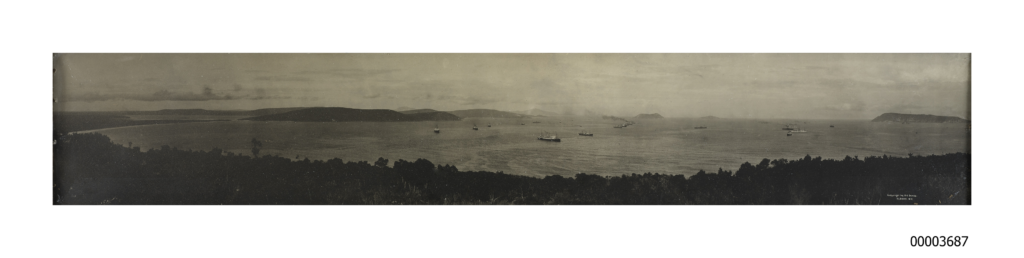
“On-board, Officers organised rigorous training drills and exercise sessions for the men. They were expected to do their own washing, sweep the decks and carry out other chores. Three hearty meals a day were served; breakfast usually consisted of porridge, stew and tea. Lunch included soup, meat, vegetables and pudding. Meat, bread with jam and tea was served for dinner. Many of the troops experienced bouts of seasickness on the voyage. To alleviate boredom, sports carnivals were held with boxing matches, pillow fights and wheelbarrow races. The crossing the Equator ceremony, ‘Neptune’s Journey,’ was played-out on each troopship.”
Extract from Australian War Stories https://memories.net/timeline/williamgeorge-medley-29862.

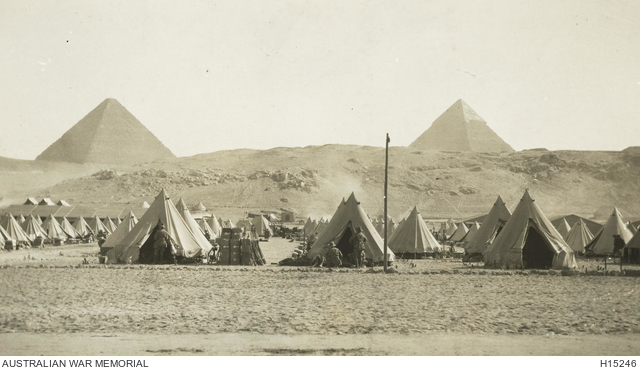
The Orvieto arrived in Egypt on 2nd December and disembarked in Alexandria the following day. From Alexandria the 5th Battalion travelled to Mena camp where they were to train. Mena was situated near the pyramids of Giza, about 10 miles from Cairo. The troops trained for eight hours a day, six days a week. Their training included marching through sand, digging and attacking trenches.
On 1st March William was promoted to Lance Corporal and he transferred to the 1st Division Head Quarters Postal Service on 4th (Service Number 85). The Australian force was ordered to the front on 1st April and began to arrive in Lemnos on 12th. The landing at Gallipoli was made on 25th April.
The Divisional HQ was established on the beach at Anzac Cove. It was shelled out in mid-May and moved a few hundred yards inland to the south side of Anzac Gully. There was a Post Office at the cove. The cove was one of the most dangerous places on Anzac and the casualty rate was high among those who worked there. William Medley was wounded by shrapnel burst when unloading mail on the beach at Anzac on 13th July. The lightly wounded were treated in the field ambulances on the peninsula, the 7 to 14 day cases were sent to the hospitals on Lemnos while those more seriously wounded were taken to Malta. Described as slightly wounded William was evacuated to Mudros, Lemnos by Fleet Sweeper on 14th.

The Hospital Ship Gascon, carrying severely wounded from Gallipoli, arrived in Lemnos at 8pm the same evening. The following day (15th) it boarded around 75 of the slightly wounded who were on Lemnos, William among them, and sailed for Malta at 6.30pm. There was no exit wound and the foreign body that hit him was still in his chest. It must have been decided that his recovery would take longer than 14 days. The Gascon arrived in Malta at 6am on the 18th and was directed to the Quarantine Harbour. The patients, including William, were taken off the ship by Lighter as there was no place to dock. William was admitted to the Military Hospital Tignè. A few weeks later, on 25th August, he embarked for England on the Hospital Ship Geleka.

In England William spent 2 months at the 2nd London General Hospital, St Mark’s College, Chelsea followed by 3 weeks furlough. He was then admitted to the 1st Australian Hospital at Harefield Park where it was recorded that he had a “Bullet in thoracic cavity left side about level with the 10th rib. Shortness of breath on exertion. Pain in region of bullet.” He remained at Harefield for 3 weeks. On 2nd December a Medical Board there found him unfit for Active Service but fit for light duties. William was sent to the Monte Video Australian Camp near Weymouth, Dorset to await transportation back to Australia.
While in England William would have had ample opportunity to visit or be visited by friends and family. Weymouth was close to Poole, where he had family, and Dorchester which was home to the Dorset Regiment.
William embarked the Star of Victoria at Portland for Melbourne on 19th January 1916. He arrived back in Melbourne on 27th February 1916.
On the 16th March William was admitted to the No. 5 Australian General Hospital complaining of pain in the chest, shortness of breath and difficulty walking. A medical Board on 14th April found him unfit for service. He was given leave of absence and ordered to report to the Staff Officer for Invalids, Victoria Barracks. He was discharged from the hospital on 17th April. William received his army discharge (W) 3rd Medical District [Victoria] on 12th July 1916.
Before his discharge the board found William’s capacity for work was ½ and predicted that in 12 months it would be ¼. On 20/6/16 he was granted a pension of 75%. This was reduced over the coming years to 66.6% (1/3/17); 50% (27/9/17); 33.3% (9/3/22) and finally 25% (10/3/24). William’s repatriation file runs to 246 pages! William repeatedly tried to claim that various health problems and inability to work were the result of being wounded at ANZAC and that he should be granted a full pension. Medical opinion over the years was consistent that the G.S.W. to the chest with a penetrating foreign body in situ and Associated Effort Syndrome were due to his war service but that other problems (spondylitis, defective vision, arteric sclerosis with cardio-renal changes, glycosuria) were not.
When William enlisted his employer in Somerville, J. Brunning, had promised William that his position would be kept for him. William returned to Somerville and Mr Brunning was true to his word but William was only able to do light work and only turned up when he felt fit to do anything.
In 1918 William became a soldier settler. He acquired 12 acres (Allotment 6, Section E, Wallan Wallan) under the Discharged Soldier’s Settlement Act (1917) from the Closer Settlement Board. The block of land he was allocated would not have included a house. William would have had to build his own. He was also responsible for clearing the land, fencing it, building stock yards and getting rid of pests and weeds. He would have taken out an interest bearing loan to buy the land. The allotment was for a small dairy farm but the dairying failed (in 1921 the price of butterfat fell 70% and in 1925 butterfat that cost 40 cents/Kg to produce was selling for 28 cents/Kg. In 1924 potatoes were selling for ½ the cost of production). After the dairy farm failed William planted an orchard. Given William’s poor health life for the family would have been very hard and a lot of the responsibility for working the orchard was placed on his two young sons. In 1925 it was reported that his 2 sons (then aged 17 and 20) did most of the work.
A Royal Commission of 1925 outlined the major defects in the Discharged Soldiers Settlement scheme. One of these was the selection of inappropriate settlers. Williams’s medical review of 1917 should have made it obvious that his inability to undertake manual labour made him totally unsuited to farming.
At a medical in January 1922 the physician wrote that William “appears to have the idea of the ‘bullet in heart’ as chief disability.”
An X-ray taken in September 1928 showed a shrapnel ball in the left chest close under the ribs between 11th and 12th level with the front of spine in lateral view.
Having obtained permission to sell his allotment from the Closer Settlement Board on the grounds of ill-health William sold his land on 1st July 1932. He remained as caretaker of the orchard with one of his sons attending the orchard.
In March of 1935 William was said to be mentally depressed but the medical opinion was that his symptoms were largely independent of the gun shot wound. His incapacity was assessed at 50% comprising 33.3% the result of the gun shot wound and 16.6% post-war causes. In the September of that year the scar on the posterior aspect of his left chest was removed. This was done to relieve pain caused by the inclusion of the 7th intercostal nerve in the scar of the gun shot wound. By the end of the year he was diagnosed as suffering with Neurasthenia said to be the result of not accepting that the arteric sclerosis was not wound related. William claimed that he had not received any treatment since his discharge outside that received from the Repatriation Medical Officers. This suggests William was unable to meet the costs of treatment for his various medical problems which may have been a contributing factor to his continued efforts to have them recognised as war related. If they were accepted as such then the cost of treatment would be born by the Repatriation Committee. In his statement made on 23/12/35 in support of his claim William stated that he was discharged with a full pension which was incorrect. In his statement he also said: “My nerves gave out on the Peninsula and my condition has been gradually getting worse ever since.”
The Report of the Closer Settlement Commission, which had been requested by the Repatriation Commission, dated 13/1/36 stated:
Period of occupation: 22/8/1918 to 1/7/1932
Nature of farming: Fruit growing after dairying failed.
Capacity for work: Poor worker, lazy in Inspector’s opinion.
Health during occupation. Military pension but no reports re ill health on file.
Inspector’s reports indicate that lessee depended mainly on his son’s assistance rather than his own efforts.
William requested admission to Caulfield Repatriation Hospital several times but the hospital refused to accept him for non war related problems. He was admitted to R.G.H. Caulfield in Glen Eira City on 12th July 1943 and he died there at 11.35 on the 29th July 1943. The immediate cause of death was given as Myocarditis and Arterio-sclerosis.
William was buried on 31st July 1943 in Plot C8-07-038 Yan Yean Cemetery, Whittlesea, Whittlesea City, Victoria. His memorial has the badge of the Australian Imperial Force and is inscribed
85 Lance Corporal W.G. Medley
1 Divisional HQ, Australian Imperial Force
Dearly loved & sadly missed by
Loving wife and sons Will & Harry
After her husband’s death Ethel applied to have his war pension increased claiming her husband died of internal war injuries. This was rejected and her subsequent appeal was disallowed.
On 14th June 1944 Ethel lodged an appeal to the War Pensions Entitlement Appeal Tribunal. The grounds for the appeal being: “I am not satisfied with the decision of the Repatriation Commission’s rejection of my appeal regarding War Widow’s Pension. My late husband was admitted to C.M. Hospital with gunshot wound in left chest the bullet still being near heart at time of death. Therefore I consider that war injuries was the cause of his death.”
On 20th October 1944 the Tribunal ruled that Williams’s cause of death ( Myocarditis and Arterio-sclerosis) was allowed under Section 24 of the Australian Soldiers’ Repatriation Act 1920-1943 which stated: “The Special Rate of Pension may be granted to members of the Forces who have been blinded as the result of War Service, and to members who are totally and permanently incapacitated (i.e. incapacitated for life to such an extent as to be precluded from earning other than a negligible percentage of a living wage)”
The decision was back-dated to 14th December 1943. A pyrrhic victory but one that ensured Ethel would receive an income for the rest of her life.
Ethel died on 7 July 1966 in Victoria and was laid to rest with her husband in Yan Yean Cemetery.