
My great grandfather, Christopher Rock, divorced my great grandmother Charlotte in 1914. The court documents, preserved at The National Archives, record that Charlotte was at fault but that is not the full story.
This is Christopher’s Petition for Dissolution of Marriage and his signed affidavit which were filed on 28th March 1913 by Oswald Hanson & Smith.
IN THE HIGH COURT OF JUSTICE
PROBATE DIVORCE & ADMIRALTY DIVISION
(DIVORCE)
To the Right Honourable President of the said Division
Dated the 20th day of March 1913.
The Petition of Christopher Rock of 85, Chippenham Road, Paddington in the county of London Painters Labourer
SHOWETH
- That your Petitioner Christopher Rock of 85, Chippenham Road, Paddington in the County of London Painters Labourer was on the 4th day of July 1906 lawfully married to Charlotte Rock then Charlotte Welch Spinster at the Register Office Paddington in the County of London.
- That after his said marriage your petitioner lived and co-habited with his said wife at 6 Windsor Street Paddington, 398 Portobello Road, Notting Hill and 17 Lionel Mews Notting Hill all in the County of London and there had been issue of the said marriage to wit two children namely Doris Amy Rock now aged six years and Catherine Helen Rock now aged four years.
- That the said Charlotte Rock has at various times and places during the year 1912 committed adultery with Sydney Tucker.
- That on the 2nd day of March 1912 the said Charlotte Rock committed adultery with Sydney Tucker at 17, Lionel Mews Portobello Road North Kensington in the County of London.
- That during the month of March 1912 the said Charlotte Rock and Sydney Tucker lived and cohabited as husband and wife at 36, Treverton Street, North Kensington and frequently committed adultery.
- That your petitioner resides at 85, Chippenham Road, Paddington in the County of London and is a Painters Labourer and the said Charlotte Rock resides at 63, Cambridge Terrace Paddington in the County of London and both are domiciled in England.
- That no previous proceedings in reference to the said marriage have taken place in the Divorce Court of the High Court of Justice by or on behalf of either party to the said marriage Your Petitioner therefore Humbly Prays
That your Lordship will be pleased to decree that the marriage of your Petitioner with the said Charlotte Rock be dissolved
That your Petitioner have the custody of the children of the said marriage
That the said Sydney Tucker may be condemned in the costs of these proceedings
And that your Petitioner may have such other and further relief as to your Lordship may seem meet.
[signed] C. Rock
Christopher Rock
And this is Christopher’s Affadavit Verifying his Petition:
IN THE HIGH COURT OF JUSTICE
PROBATE DIVORCE & ADMIRALTY DIVISION
(DIVORCE)
In the Matter of the Petition of Christopher Rock of 85, Chippenham Road, Paddington in the County of London Painters Labourer
I CHRISTOPHER ROCK of 85, Chippenham Road, Paddington in the County of London Painters Labourer the Petitioner herein make oath and say as follows:-
- That the statements set forth in Paragraphs 1, 2, 6 & & of the said Petition dated the 20th day of March 1913 are true.
- That the statement set forth in Paragraphs 3, 4, & 5 of the said Petition are true to the best of my knowledge information and belief.
- That there is not any collision [collusion] or connivance between me and my wife in any way whatever.
| SWORN at 10 Vernon Street West Kensington in the County of London this 22nd day of March 1913 Before me | [signed] Christopher Rock |
| [signed] H. Pierron | |
| A Commissioner for oaths |
The following images, from the London Picture Archive, show 19 and 20 Lionel Mews in 1953 just prior to their demolition (Note that the Archives mistakenly gives the number as 2. Enlarging the pictures the numbers 19 and 20 can clearly be seen on the doors.) Number 17 would have been similar to number 19.
A year before the alleged adultery the Petty’s were residing at 17 Lionel Mews. The head of the family, 67 year-old Abraham Petty, was a coal merchant employing 4 people. Their accommodation consisted of 3 rooms above a stables where they would have kept their horse(s) and cart. The family had a lodger, Fredrick Gentry, who was a coal porter. Coincidentally the brother of Marie Lenharth (Christopher’s mistress and second wife), who had anglicized his name to William Leonard, was also a coal carman!
Sydney Tucker, a coal carman, was residing at 403 Portobello Road in 1911. As the fragment from map TQ2481NW – A shows the rear of 403 faced the front of 17 Lionel Mews. It seems reasonable to assume that Sydney worked Abraham Petty.
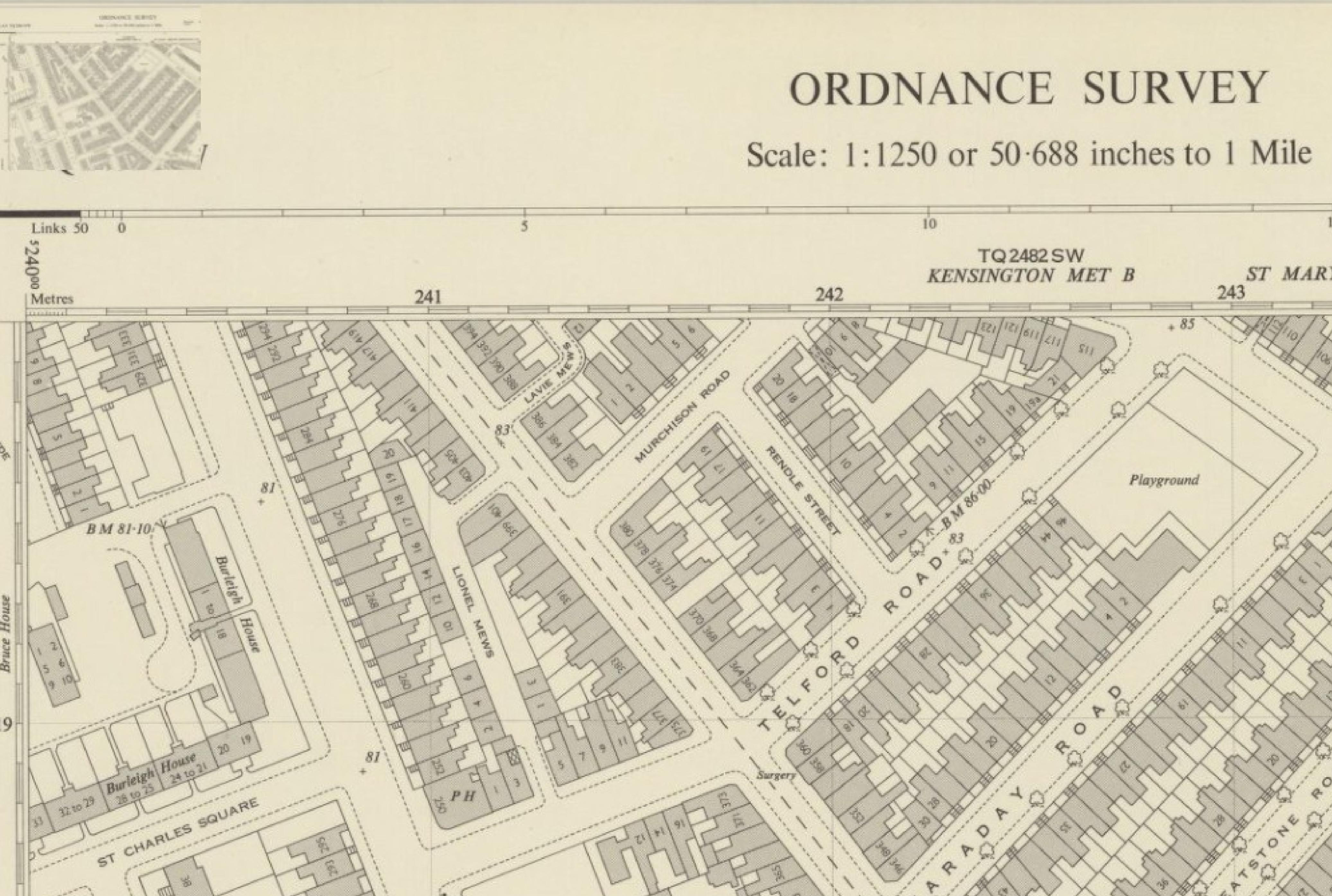
As a suffragist Charlotte boycotted the 1911 census and there was no census return made for 398 Portobello Road. 398 was on the opposite side of the road and a little to the north of 403. Sometime between 2nd April 1911 and March 1912 the Rock family moved to Lionel Mews. The Rock’s were close neighbours of Sydney and lived above his place of work.
Life for Charlotte was hard. Christopher seems to have been unable to keep any job for very long. During the course of their marriage there is evidence of him being employed as a railway porter, a carriage cleaner, a doorman at a picture house and a platform conductor. At the time of the divorce Christopher was working as a Painter’s labourer. This was casual employment and he was paid by the day and the work was seasonal. Christopher would have been earning around £1 (20 shillings) a week when in work. Their rent would have been circa 7 shillings a week leaving 13 shillings for everything else. This meagre amount would have also to have had to support Christopher’s drinking habits. Charlotte would have taken on any casual employment she could obtain to supplement their finances. Christopher was often out drinking until late at night. He was a cruel man with a violent temper especially when drunk. They also moved home a number of times. In addition to the three addresses given in Christopher’s petition they are also known to have lived at 45 Alfred Road (marriage certificate) and 1 Windsor Street (birth registration of Doris).
When he came home on 2nd March Christopher’s violent reaction forced Charlotte to flee. Having fled her only option would be to go to the workhouse where she would have had to demonstrate that her husband’s actions made it impossible for her to continue living with him. On 16th March Charlotte summoned Christopher to the West London Police court to seek a separation order for constructive desertion (meaning that she had not left of her own volition but had been forced out by Christopher’s behaviour). The magistrate dismissed the summons after she admitted being found with a young man at 10pm at night.
Charlotte, in dire circumstances and unable to access the workhouse, found immediate sanctuary in Treverton Street, possibly with Sydney or some of his friend’s (the 1911 census records three men at that address employed as coal porters). How long she stayed there is not known. Christopher’s petition states she and Sydney lived there as man and wife during March. Charlotte’s failure to obtain a separation order would also have prevented her from obtaining a divorce later on. To obtain a divorce a man only had to prove his wife’s adultery whereas a woman had to prove that her husband had committed adultery and also either treated her with cruelty, deserted her, or committed incest or bigamy.
On April 18th 1913 Charlotte, who by now was residing at 17 Swinbrook Road, entered an appearance at court. No address is recorded in the documentation for Sydney and he did not make an appearance.
On May 29th 1913 Christopher filed 2 citations with affidavits of service and search then on August 19th he filed Notice and certificate and Set Down Cause.
The case was heard by the Honourable Sir Henry Bargrave Deane on 17th November 1913 at the Royal Courts of Justice, Strand. He took oral evidence from Christopher and his Witnesses (not documented in the archives). Neither Charlotte or Sydney defended the Suit at the hearing. Sir Henry pronounced that Christopher had sufficiently proved the contents of the petition and that the marriage be dissolved because the Respondent (Charlotte) had been guilty of adultery with the Co-Respondent (Sydney) unless sufficient cause be shown why the Decree should not be made absolute within six months. Sydney was condemned for the costs and the children Doris Amy Rock and Catherine Helen Rock were to remain in the custody of the Petitioner (Christopher) but they were not to be removed from the jurisdiction of the Court without its sanction.
There is no information as to what happened to Christopher and Charlotte’s daughters or to Charlotte’s son, Percy, in the immediate aftermath of the events of 2nd March. The divorce judge granted Christopher custody of Doris and Catherine. It was standard practice for the father to be awarded custody of the children at that time. No mention is made in the divorce papers as to whether Charlotte was allowed access to them or not (typically not) but the girls were not to be taken out of the court’s jurisdiction. This prevented Christopher from taking them to Ireland. The two girls had unhappy childhoods and both were thrown out after they finished school.
On May 19th 1914 Christopher filed for Notice and Affidavit for Decree Absolute and on May 25th 1914 no cause having been shown as to why the Decree should not be made absolute Sir Henry Bargrave Deane pronounced and declared the said Marriage to be dissolved.
Divorce in 1914 was rare and expensive. In 1913 there were 577 divorces and in 1914 856. That is roughly 1 in every 450 marriages. A divorce at this time typically cost in the region of £50 to £60 – well beyond the means of a casual labourer like Christopher. So how was the divorce financed? There is a clue in the paperwork at The National Archives. Two stamps to the value of 15 shillings, representing Judicature Fees, were stamped “cancelled” on 28th March 1913. It seems he brought the case “in forma pauperis”. To sue “in forma pauperis” Christopher would have proved that he was worth less than £25. He would then have been exempt from court fees and received free legal representation in court. He would have still been responsible for the cost of out-of-court work such as deposition transcription, witness fees, postage etc. It is these out-of-court costs that were condemned to Sydney. Neither Charlotte or Sydney contested the divorce so keeping their costs down to the minimum. It would seem that Christopher Rock obtained his divorce as cheaply as was possible although the costs he received from Sydney would have been taxed!
There certainly was collusion between Christopher and Charlotte. Charlotte did not defend the suit and made no mention of Christopher’s adultery which, if known, would have prevented the dissolution of the marriage. If one spouse had committed adultery, they could be divorced, but if both had, they couldn’t! Christopher’s adultery would have been easy to prove as his mistress, Marie Lenharth, was pregnant when the Decree Nisi was granted and their daughter Ivy was born a week before the Decree Absolute.
It is possible that more of the story may have been concocted. Christopher’s claim of adultery was “true to the best of his knowledge” suggesting that Charlotte and Sydney had not been caught in flagrante on Saturday 2nd March. I am not entirely convinced that they were having an affair. Sydney was several years younger than Charlotte and he does not appear to have been her “type”. Reginald and Christopher, Charlotte’s second husband Charles and long term partner George were all guardsmen or former guardsmen and all were older than her. Also it seems odd that Charlotte and Sydney would have been committing adultery that late at night if Christopher had been expected home. Perhaps Sydney was no more than a friend. Then, given that the Rocks were living in a bedsit, there is the question of where Charlotte’s three young children were at the time of the supposed assignation on 2nd March.
What became of Sydney? Well – at the start of the war he enlisted in the 1st Reserve Regiment Cavalry (3441). He transferred to the King’s Own Yorkshire Light Infantry (24412) in May 1915 and left for France sometime in 1916. At the Somme in October of that year Sydney was wounded in the leg and taken prisoner. He remained in captivity until late December 1918. On release he probably was suffering from malnutrition, disease, and/or psychological trauma. Sydney was demobilised to Class Z on the 28th March 1919 but it seems he re-enlisted as he deserted from Neyland, Wales on 30th October 1919. The Police Gazette of 25th November describes him as 5 ft 6 inches tall with a tattoo of a woman on his left forearm. He had a fair complexion, auburn hair and light blue eyes. Sydney was awarded the British War and Victory medals but his medal card shows that the Victory Medal was returned as undelivered, unsurprising considering he was on the run, and it was never re-issued.