
George Gardiner, an “Old Contemptible”, was my great grandmother’s partner for over 30 years and a much loved “grandfather” to my mother.
He was born on 17th November to George and Susannah Gardiner in Newmarket St Mary, Cambridgeshire where his father was a blacksmith in Market Street.
On 11th August 1898 George enlisted into the Corps of Hussars of the Line for 7 years with the Colours and 5 in the Reserves. He was described as being a shade under 5 feet 9 inches tall with a fresh complexion, grey eyes and light brown hair. Four days later George transferred into the 3rd Battalion Grenadier Guards with service number 7584 (renumbered to 2604077 in August 1920).
George obtained his 3rd class Certificate of Education the following month.
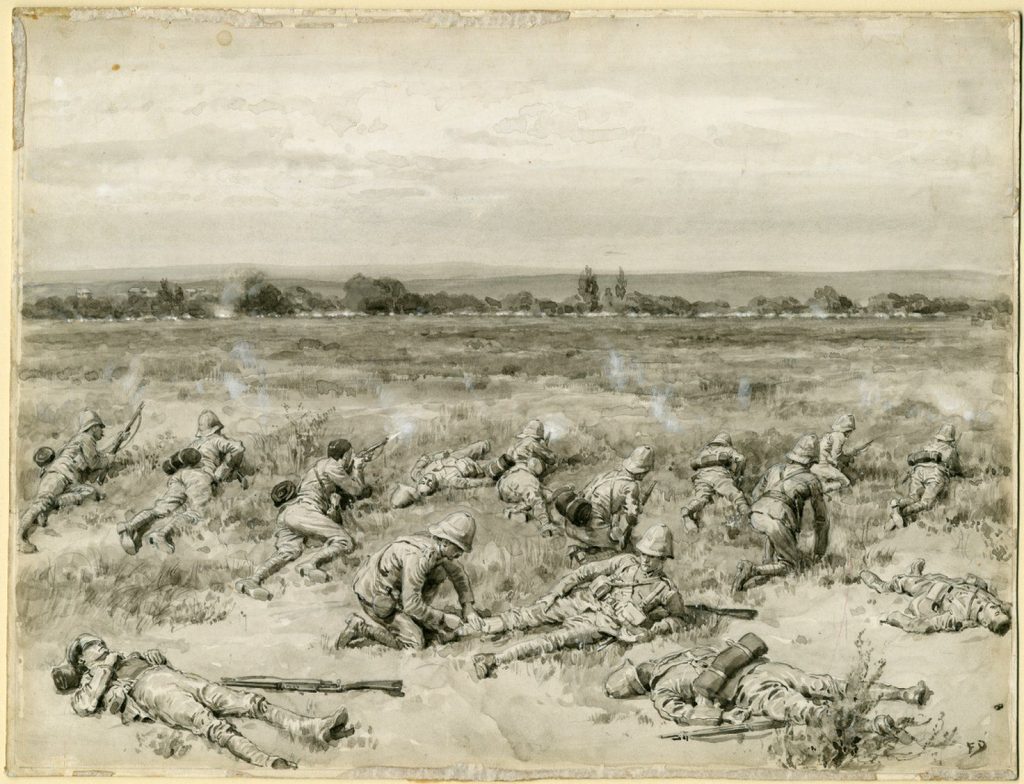
On the 23rd September 1899 the Battalion left Pirbright and travelled by train to Woolwich where it embarked S.S. Nubia for Gibraltar arriving on 27th. On 25th October reservists arrived on S.S. Goorkha to make the Battalion up to war strength and the following day the whole Battalion departed on S.S. Goorkha for South Africa. It arrived in Table Bay on 15th November. In South Africa George served in No. 6 Company.

A letter he wrote to his father at the end of December 1899 was published in The Newmarket Journal on 6th January 1900.
A NEWMARKET MAN WITH THE GRENADIER GUARDS
Private George Gardiner, 3rd Grenadier Guards, who is a son of Mr. G. Gardiner, Market Street, says in a letter which his parents have just received:- “I daresay you have been looking in the papers ever since the war has begun, and I can only say that all of us are thankful to think that we are alive. We have had a great deal to put up with. Our first battle was at Belmont, and we were under fire from the enemy the whole of the time, until we gained the crest of the first hill, which they expected to hold safe for three weeks; but we got them out of it in about three hours and a half. By that time we were very nearly all tired out. Then we had a day’s rest. On the 24th of November we were at it again, and also on the 25th, but we drove the Boers from the positions they held, so that it was safe for us to camp for the night, which rest was much needed. On the 26th and 27th we were marching, but on the 28th we had a longer battle than the first two. We were under fire for the whole of the day, about fourteen hours, and were almost afraid to move hand or foot, for the bullets came whizzing round us just like a hailstorm, and not one of us wanted to experience another day’s fighting like that one. After dusk we had to retire back to camp. We started on the 29th to where the enemy had been lying, and to our great relief found they had gone, so our division had got a week’s rest, which I think we have honourably earned. We are now awaiting orders as to what else is going to take place. I expect you have read or heard of the gallant charge the battalion made, and we are still receiving messages of praise from Her Majesty the Queen, the Duke of Cambridge, and officers of regiments at home, where there is no fighting going on. Our last battle was one of the hardest that has been known in annals of war. The Boers are not worthy of the name civilised people, they are more like cannibals, and some use a bullet which is not to be used by any civilised power, so our General has told them that if any more are used our big guns will fire a worse shell than used at present, which will kill for 50 yards round where it bursts. Kindly remember me to all who may inquire.
In a letter to Mr. A. Cooper, Private Gardiner gives further details of the fighting at Belmont, &c. In speaking of the fight on November 28th, he says “You talk about water being pumped from a fire engine – you would have thought, had you been here, they were pumping lead at us instead of firing it from rifles.”


At Belmont (23rd November) the Battalion suffered 22 killed and 115 wounded and at Modder River (28th November) 10 killed and 46 wounded.
George was awarded Good Conduct pay of 1d two years after enlisting. The Grenadier Guards remained in South Africa until the end of the war. It departed Cape Town on 13 September 1902 aboard S.S. Lake Michigan and arrived in Southampton on 6th October.
George was awarded the Queen’s South African Medal with Clasps for Belmont, Modder River, Dreifontein, Johannesburg, Diamond Hill, and Belfast and the King’s South African Medal with clasps for 1901 and 1902.
The Battalion had a strict headcount cap known as its Establishment. Prior to October 1913 there were 8 companies in the Battalion and each had 3 Officers, 1 Colour Sergeant, 4 Sergeants and 5 Corporals. A commanding Officer could appoint more but if all the paid slots for that rank were occupied then the appointment was strictly unpaid. A man would not receive the corresponding pay for the rank until another soldier of that rank left the Battalion or was promoted. Lance-Corporal was an appointment, a temporary command distinction, and not a substantive rank.
George was appointed Lance-Corporal on 27th May 1903 and received pay (which was more than a private but less than a full Corporal) for the appointment on 1st July. He qualified for Corporal on the 28th August but it appears that there was no vacancy for a paid Corporal. George received instruction in Transport Duties on 3rd January 1904 and on 24th March obtained his 2nd class Certificate of Education.
On the 1st April 1904 George was granted Service Pay at 7d day. This was for having served 5 years with the Colours and was in addition to his basic pay.


He was finally promoted to Corporal on the 26th May 1905 and two months later extended his service with the Colours to 8 years. On the 12th May 1906 George was appointed Lance-Sergeant but it would be two years before he received Lance-Sergeant pay. He extended his service twice more (in 1906 and 1910) to complete 21 years with the Colours. He was promoted to full Sergeant on 21st December 1909 and received instruction in musketry in Hythe in July 1910.

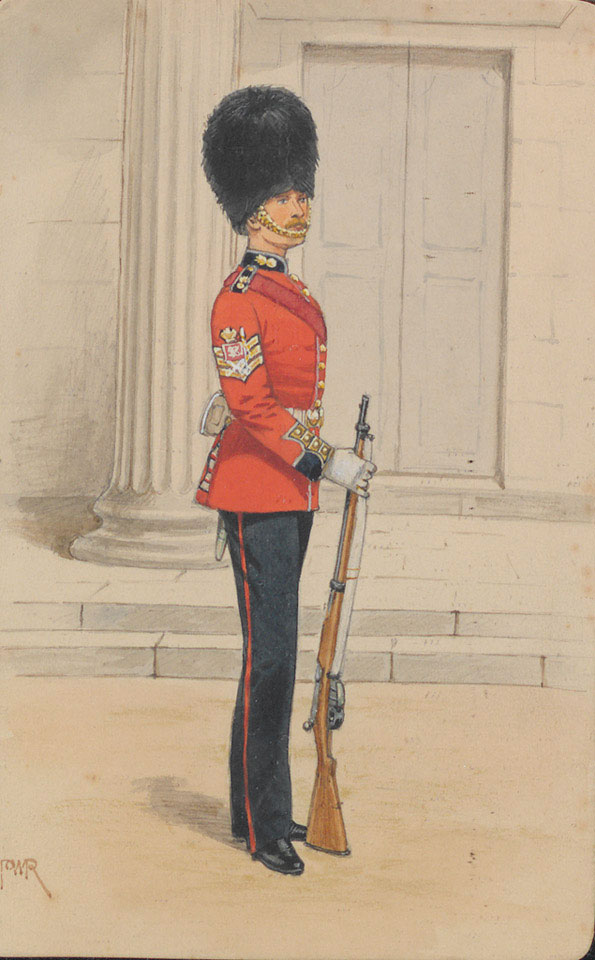
At the beginning of the Great War George was promoted to Colour Sergeant, a senior non-commissioned officer (NCO) responsible for maintaining discipline, training, and guarding the regiment’s sacred ceremonial flags but reverted (at his own request) to Sergeant and was transferred to 4th (Reserve) Battalion the following month. He joined the Expeditionary Force and disembarked in France on 11th November 1914 whereupon he was posted to the 1st Battalion which was near Fleurbaix, west of Lille. In November and December the weather was very bad with a lot of rain followed by snow. The men were issued with Goats’ skins against the cold and there were many cases of trench foot and frostbite. George returned home in early January 1915 and did not return to France until August 1916. There is nothing to suggest that he had been wounded. He probably was posted back to Blighty either to undertake training of recruits or because he was unfit for frontline duty (he had received 21 days furlough in January 1914 when he was suffering from gout) or perhaps a bit of both. Back in England he was posted back to the 4th (Reserve) Battalion.
The Reserve Battalion was redesignated the 5th in July 1915 and a new Battalion was created and designated the 4th. At the end of July 1916 George was in arrest awaiting trial for 9 days. He was tried by D.C.M. on 31st; convicted of conduct to the prejudice of good order and military discipline (S.40) and sentenced to be reduced to Full Corporal. Section 40 of The Army Act 1881 was a catch-all for any offence not covered specifically by the Act. Loss of rank and pay was deemed punishment enough, without jail time or being reduced to the ranks, for whatever offence it was he committed. Two weeks later George joined the 4th Battalion in France.

The 4th Battalion was fighting in the Somme region. It sustained 458 casualties, (killed, wounded, or missing), during its time at the front in September – around 50% of its Establishment. The majority of these occurred on 25th when the battalion participated in the capture of Lesboeufs, north-east of Ginchy. George was appointed Lance-Sergeant on 27th September and received Lance-Sergeant pay from 23rd November. After the taking of Lesboeuf the Battalion spent several weeks at Epaumesil which was nearly 50 miles away before returning to the trenches at Lesboeuf and Gueudecort in mid-November.
George remained in France until mid-January 1917. He relinquished the pay of his appointment on return to England and was transferred to the 5th Battalion.
In the 5th Battalion George was appointed a paid Acting Sergeant on 22nd March. In late November his pay was reduced to Lance-Sergeant rate although he kept the acting rank of Sergeant. He relinquished this acting rank when he transferred overseas as a Lance-Sergeant on 17th March 1918.

In France George was posted to the 3rd Battalion. During May 1918 the Battalion was in the Adinfer area (S.W. of Arras and W. of Cambrai). The diary of the 3rd Battalion records the following casualties and woundings that month:
3rd to 4th Other Ranks (O.R.) 11 killed and 5 wounded.
9th to 10th 1 O.R. killed. 1 Officer and 14 O.R. wounded
20th to 24th O.R. 2 killed and 25 wounded
26th (while the Battalion was in Reserve) 6 O.R. wounded
George was among the wounded. He received a gunshot wound to his leg which had to be amputated. He returned to England on 30th May and was posted as Lance-Sergeant to the 5th Battalion (Reserve).
It was over two and a half years between George’s wounding and his discharge. A career veteran, George was sent to Queen Mary’s Hospital, Roehampton for an artificial leg to be fitted and to receive training in how to use it. This required months of intensive physical rehabilitation, gait training and adjustments to the prosthetic. The stump had to be completely healed, shrunk and stable before a prosthetic leg could be fitted and George would not have been discharged until he could safely use his new limb. By late 1918 there was a waiting list of over 4,000 patients for Queen Mary’s explaining the delay to George’s discharge. George would have had to wait in a military hospital, auxiliary hospital or convalescent facilities until a place became available. It is unknown where he was cared for while he waited but one possibility is Paddington Military Hospital which was a 300 bed specialist hospital for limbless men.

Paddington Military Hospital was a converted workhouse and totally unsuitable for limbless men. The issue was raised in parliament on 17th July 1919 by William Wedgewood Benn, father of Tony and grandfather of Hilary:
Captain W. Benn asked the Secretary of State for War whether he is aware that upwards of 500 wounded men, the majority of whom are cases that have lost one or more limbs, have recently been-transferred from various military hospitals, in particular from the King George Hospital, to the Paddington Military Hospital, in the Harrow Road; whether he is aware that the Paddington Military Hospital, being a converted workhouse is quite unsuited for the reception of such cases, there being no lift, with the consequence that these men have to clamber up and down narrow and inconvenient stone staircases; whether there have been accidents and men injured from this cause; whether, owing to the large number of outdoor patients who take lodgings close to the Lock Hospital in this neighbourhood, the Harrow Road district is more infected with venereal disease than any other district in London; whether this is a suitable district for the convalescent treatment of a large number of partly disabled men; and, if not, whether he will give immediate instructions that all military cases be removed from the Paddington Military Hospital, and no further military cases sent there?
Mr. Churchill replied: Complaint has been made, especially regarding the situation of this hospital, and for some time past endeavours have been made to obtain another suitable building, but I regret to say, so far without success. I hope, however, that arrangements may be made to enable the hospital to be vacated within the next few weeks. I am not in a position at the moment to answer the detailed matters referred to in the question, but inquiry is being made.
A second Army Form B 200 was created for George when he was allocated a new service number in August 1920. A number of errors were made when data was transcribed from his original form. The record of his wounding and leg amputation only appears on the second form. It states that he was wounded in the left leg however a post war photograph of George shows that it is the right leg of his trousers that has been modified to accommodate the prosthetic rather than the left. (The lower part of the right leg of the trousers had been cut off and attached to the prosthetic itself to allow easier dressing, access, greater freedom of movement and more comfort).

On 10th December 1920 George was discharged as no longer physically fit for War Service (Para 392 (XVI) K.R.) . His total Service with the Colours was 22 years and 122 days. He was awarded the 1914 Star with clasp, the British War and Victory Medals.
George had married Annie Lee Hodges at Holy Trinity, Upper Tooting on 3rd July 1904. They had three children Ivy Matilda born October 1904, George Stephen born 8th April 1907 and Sybil Vera Mary born 27 August 1910. Sadly both Ivy and George only lived for a few months. Ivy died at the end of March 1905 and George on the 13th August 1907. Curiously neither child was recorded on George’s army record. Annie also had an illegitimate son, Stewart Lee Hodges, born in Hackney on 23rd February 1901. Stewart, known as Stanley, was raised by his grandparents in Charmouth, Dorset.
George and Annie had separated by the time of his discharge. The 1921 census reveals George visiting Charlotte Carson in Paddington whilst a “cousin” was staying with Annie. Charlotte may have met George in Paddington, Paddington Military Hospital being just a stones throw from Charlotte Carson’s home. Charlotte also had connections with the Regiment. Her husband Charles served in the 3rd Battalion of the Grenadier Guards during the war. She may well have known George’s wife Annie through events organised by the Regiment’s Ladies’ Welfare Committee for the wives of men serving with the regiment. Charles and Charlotte had separated too. They had only actually spent a few weeks together during their married life and Charles re-enlisted after the war. Another couple whose marriage had failed during this time were Frank and Rosa Hanks. Annie Gardiner lived with Frank as Annie Hanks from the early 1920s until his death in 1938. Rosa divorced Frank in 1927. Annie continued to use the surname Hanks until after George’s death in 1953 when she reverted to Gardiner. There are no records of Annie and George or Charlotte and Charles ever divorcing.
In 1921 George was a ward master employed by the Ministry of Pensions at Roehampton House in Roehampton (Queen Mary’s Hospital). Queen Mary’s was a centre of excellence in the treatment of amputation cases. By 1921 the hospital was treating other categories of limbless patients and not just War Pensioners. As a ward master George would have been responsible for supplies and equipment for the ward, patient property and order and discipline among the convalescent soldiers.
George remained living with Charlotte at 10 Woodfield Crescent, Paddington until his death in 1953. They never married. The Ministry of Pensions took over Queen Mary’s Hospital in April 1925. By the beginning of the second World War the hospital’s capacity had been increased to 900. The 1939 register reveals that George was now employed as a hospital orderly.
George died at home on the 5th August 1953 of a ruptured specific aortic aneurysm. He was 75. His death was registered the following day by his grandson (in reality Charlotte’s grandson) Reggie Lambert. On the death certificate George’s occupation was given as Instructor – Hospital for disabled. George was cremated on the 10th.