
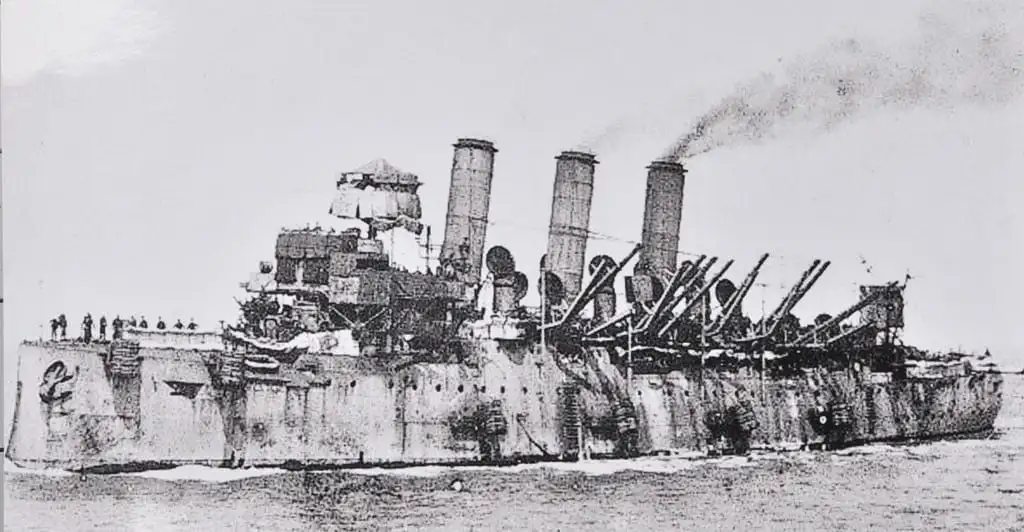
Reginald was my father’s cousin. My father was only a little boy when Reginald died and would not have known him. The name of Reginald’s ship, H.M.S. Vindictive, on his headstone would have told a person much about the man who laid below. A hundred years later and the Zeebrugge Raid is little known and there is not even a complete list of the men who took part. Here is Reginald’s story.
Reginald was the third son of George and Eliza Vincent. He was born in Branksome, Poole on 7th December 1897 and baptised at St Aldhelm’s Church on 20th March the following year. After finishing school Reginald worked as a Grocer’s boy before joining the Navy on 14th January 1914. With his parents permission he engaged for a period of 12 years to commence on his 18th birthday until which time he served as a Boy. Reginald spent six months as a Boy Second Class on the training ship H.M.S. Impregnable in Devonport. On completion of his training he was promoted to Boy First Class and, along with 209 other Boys, joined the Boys Mess on H.M.S. Endymion, an Edgar-class cruiser in the 10th Cruiser Squadron. Endymion was paid off at Devonport on 28th November and Reginald transferred, briefly, to H.M.S. Vivid I before joining H.M.S. Hilary on 6th December. Hilary, an armoured merchant cruiser in the 10th Cruiser Squadron, was commissioned in Liverpool on 6th December. She formed part of the Northern Patrol blockading trade to Germany and was employed patrolling the area south of Faroe Islands. Hilary’s ship’s log records the Lead Signalman and one boy [Reginald] left the ship on 24th November for RN Depot, Plymouth. Reginald remained at the Depot (Victory I) until 23rd February 1916. On his 18th birthday, 7th December 1915, he was promoted to Ordinary Seaman and his 12 years service period began.
Reginald was described as being 5 feet 4 ¾ inches tall with a 34 ½ inch chest, brown hair, grey eyes and a fair complexion.
On 24th February 1916 Reginald transferred to H.M.S. Princess Royal. Whilst serving on Princess Royal he was present at the Battle of Jutland. On 1st Feb 1917 Reginald was promoted to Able Seaman and at the end of May he spent 5 days in the cells!
In early 1918 The Admiralty asked for volunteers from The Grand Fleet for special service on a perilous and secret mission. No secret was made of the fact that they were unlikely to return alive. The men had to be single, under 23, physically fit and able to use a revolver and oars. Reginald was one of the volunteers. While still on Princess Royal he began intense physical training and revolver exercise. Reginald transferred to H.M.S. Hindustan, stationed in Chatham, on 1st March. Hindustan acted as depot ship and provided accommodation for the bluejackets whilst they were training. Training was given in trench warfare, assault tactics, bomb throwing, bayonet drill, and in the use of mortars and the Lewis machine gun.
At the beginning of April the Hindustan moved to the West Swin anchorage just off Sheerness after which all communication with shore ceased. At the Swin Anchorage Reginald finally learnt what the mission was.
The secret mission was to storm the Mole at Zeebrugge and block the Bruges ship-canal. The mission was postponed twice due to unfavourable weather conditions after which Dominion joined the Hindustan to relieve the pressure on accommodation. The attack finally took place on 22nd and 23rd April.
The Royal Navy seamen were organised into four companies – “A”, “B”, “C” and “D” – with 50 men in each. Reginald was in “A” Company under the command of Lieutenant-Commander Bryan F. Adams of Princess Royal. Also in “A” Company were some of his shipmates from Princess Royal including Able Seamen Walter Taylor (J/35414) and Charles Guenigault (J/38286). The company was subdivided into 4 sections of 12 men. Walter and Charles were in Section 1 and it is probable that Reginald was in this section also as men from the same squadron were placed in the same section. Another man from Princess Royal who participated in the raid, as a stretcher-bearer, was Stoker Petty Officer Thomas Haw. Within each section one man was armed with a hand flammenwerfer (flamethrower) and a 1 ½ inch Very pistol with parachute flares (the Very pistol fired a coloured light high into the air. The light provided illumination as it fell and the parachute slowed its descent to provide longer-lasting illumination); three men were designated as bombers and the other 8 men had rifles and bayonets. All men carried loaded sticks and four of them also had wire cutters, gloves and electric torches
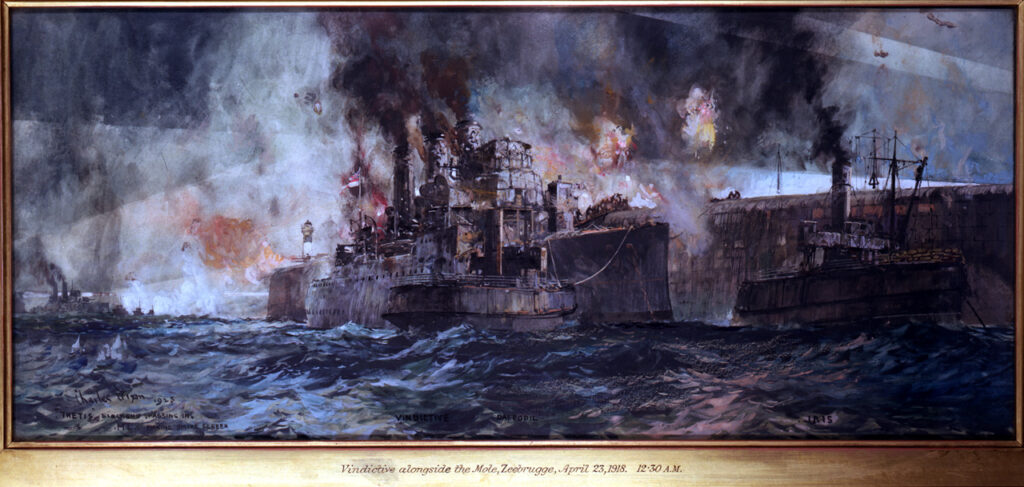
The men in “A” and “B” Companies embarked on H.M.S. Vindictive and formed the first wave of the assaulting force. The plan was for Vindictive to be laid alongside the Mole just to the west of the mole-head battery. Section 1’s duties were to wheel left on landing and make to the far side of the Mole, capture three 4-inch guns and place a red Bengal light as near the end of the Mole as possible.
H.M.S. Vindictive actually came alongside the Mole three ships-lengths beyond this position. There were heavy German machine guns and coils of barbed wire between her position and the main batteries and the Seaman Storming Parties were unable to get through, so their mission became one of holding their ground and drawing much of the enemy fire as a diversion.
Lieutenant-Commander Adams, an Australian by birth, had joined Princess Royal in September 1916. In January of 1918 he had been given special permission to visit Armies in France while on leave. He transferred from Princess Royal to Hindustan on 10th March. The following extract from the report of Vice-Admiral, Dover Patrol (Sir Roger J. B. Keyes ) describes the time Lieutenant-Commander Adams and the survivors of “A” and “B” Companies spent on the Mole:
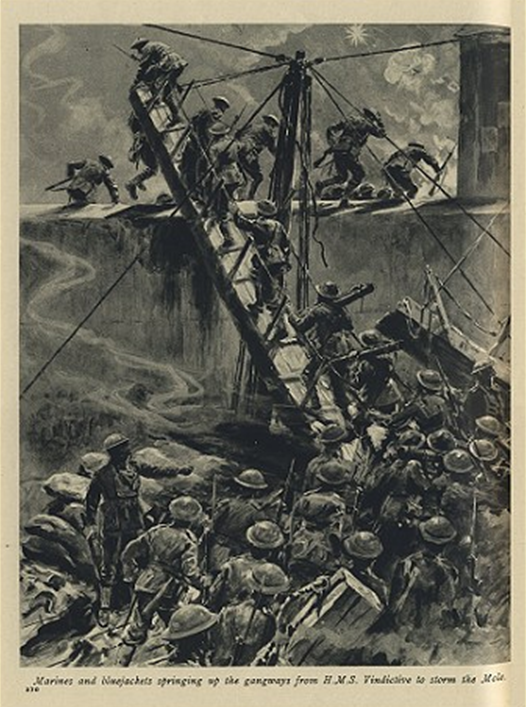
“Lieutenant-Commander Adams, followed by the survivors of “A” and “B” Companies, were the first to land, no enemy being then seen on the Mole. These two companies had suffered severely before landing, especially “B,” both of whose officers were casualties. They found themselves on a pathway on the Mole parapet about 8 feet wide, with a wall 4 feet high on the seaward side, and an iron railing on the Mole side. From this pathway there was a drop of 15 feet on to the Mole proper. This raised portion of the Mole will in future be referred to as the parapet. Followed by his men, Mr. Adams went along the parapet to the left (towards the lighthouse extension), where he found a look-out station or control, with a range-finder behind and above it. A bomb was put into this station, which was found clear of men. Wing Commander Frank A. Brock here joined the party, and went inside to investigate. He was not seen again by Mr. Adams, but from other accounts it is believed he was seen alive later.
Near this look-out station an iron ladder led down to the Mole, and three of Mr. Adams’ party descended it and prevented a few of the enemy from reaching the harbour side of the Mole. Two destroyers alongside the Mole showed no activity up to this time, nor did Mr. Adams see the three-gun battery at the Mole end fire at any time whilst he was on the parapet, but a machine gun about 100 yards to the westward of these guns was firing on his party. It appeared at this time that the enemy were firing at the “Vindictive” from the shore end of the Mole, but no gun flashes were seen, as everything was so well illuminated by enemy star shell and the rockets fired by “Vindictive.” After capturing the look-out station Mr. Adams advanced to the eastward about 40 yards, where he left his party in position and himself returned to collect more men.
Returning, to the look-out station, Mr. Adams found only some wounded, but later collected two Lewis gunners and a small party under Petty Officer George E. Antell, O.N. 232634 (“Lion”). These he sent to the eastward and the Petty Officer inboard, as he had been wounded in the hand and arm before landing, and although in great pain had carried on most gallantly.
The situation now was that Mr. Adams’ few men and the two Lewis gunners were beyond the look-out station protected from the machine-gun fire from the direction of the Mole Head, but exposed to that from the destroyers alongside the Mole, and the men were being hit apparently by machine guns and pom-poms. Lieutenant-Commander Harrison arrived at this time; this gallant officer was severely wounded in the head on board “Vindictive” before coming alongside, but directly he recovered consciousness he joined his section on the Mole; on receiving Mr. Adams’ report he directed him to try and get more men. Major Weller, Commanding the Royal Marines, on receiving Mr. Adams’ report, despatched Lieutenant G. Underhill with reinforcements to assist Mr. Harrison. Whilst this party was being collected, Mr. Adams returned to the look-out station, where he was informed that Mr. Harrison had led a rush along the parapet and that he and several of his men had been killed by machine-gun fire. Able Seaman McKenzie, one of B Company’s machine gunners with Mr. Harrison, did good execution with his gun, though wounded in several places, and Able Seaman Eaves was killed in attempting to bring in Mr. Harrison’s body. (NOTE. Able Seaman Eaves, it appears, was not killed, but was very severely wounded and taken prisoner.)
About this time the recall was sounded, and Mr. Adams therefore withdrew his men from the parapet and Mole, collected the wounded, and sent them to the “Vindictive.” He himself went along the parapet in search of Mr. Harrison, but not finding him, returned to assist in the re-embarkation. As originally planned, Mr. Harrison’s bluejacket storming parties were to deal with the battery on the Mole head and Mole extension only, but for the reasons given, in paragraph 71 they started 400 yards further from their objectives than was intended with the intervening ground fully exposed to machine-gun fire. Mr. Adams and his men, and later Mr. Harrison, pressed their attack most gallantly, and, though denied a full measure of success, it appears probable their fire prevented the 4.1 inch battery at the Mole head coming into action, as these guns did not open fire at the blockships…
… Lieut.-Cdr. Bryan F. Adams was amongst the first to land on the mole, and remained there the whole time, behaving with great coolness and bravery. He was the senior surviving officer of the Grand Fleet contingent at Zeebrugge, consisting of 10 officers of whom 5 were killed and 2 wounded.”
The British losses were 214 dead and 383 wounded with one officer and 15 men taken prisoner. The German losses were 10 dead and 16 wounded.
Charles Guenigault was killed on the ramps of Vindictive. Initially he had been reported missing and enquiry forms were sent to his comrades from Princess Royal to confirm what they knew about his whereabouts during the raid. Walter Taylor had been with Charles on the ramp of Vindictive when a shell burst nearby and Charles fell. A second later Walter was knocked unconscious and so he was unable to say whether Charles was killed or injured. Reginald reported seeing Charles dead on the ramp. Charles’ body was brought back to Dover after the raid but errors resulted in him being buried in an unmarked grave.
A record number of medals were awarded for the raid including eight V.C.s. All the men who participated in the raid were deserving of a V.C. To determine who should receive the award a ballot was held according to Rule 13 of the Royal Warrant dated 29th January, 1856.
Rule 13:
“It is ordained, that in the event of a gallant and daring act having been performed by a squadron, ship’s company, a detached body of seamen and marines, not under fifty in number, or by a brigade, regiment, troop, or company, in which the admiral, general, or other officer commanding such forces, may deem that all are equally brave and distinguished, and that no special selection can be made by them, then in such case the admiral, general, or other officer commanding may direct that for any such body of seamen and marines, or for every troop or company of soldiers, one officer shall be selected by the officers engaged for the decoration; and in like manner one petty officer or non-commissioned officer shall be selected by the petty officers or non-commissioned officers engaged; and two seamen or private soldiers or marines shall be selected by the seamen, or private soldiers, or marines engaged respectively for the decoration; and the names of those selected shall be transmitted by the senior officer in command of the naval forces, brigade, regiment, troop, or company, to the admiral or general officer commanding, who shall in due manner confer the decoration as if the acts were done under his own eye.”
The seaman selected to receive the V.C. was Able Seaman Albert Edward McKenzie of H.M.S. Neptune. The investiture was held in the quadrangle of Buckingham Palace on 31st July 1918. Albert attended, on crutches. Subsequently his wounded foot developed septic poisoning; he fell victim to the influenza pandemic and developed pneumonia from which he died on 3rd November.
After the raid Reginald was on the books of H.M.S. Victory I which was an accounting and administrative centre for men serving ashore in Portsmouth or elsewhere or serving on small ships.
On 1st October 1918 Reginald was transferred to H.M.S. Vindictive. This was not the same Vindictive that had taken part in the raid on Zeebrugge. That ship had been used as a blockship in Ostend in May. This Vindictive was an aircraft carrier which had been laid down in 1916 with the name Cavendish. She was renamed Vindictive in June 1918 and commissioned on 1st October 1918. In 1919 Vindictive participated in the British Campaign against the Bolsheviks in the Baltic during which 107 RN and five RAF members of her crew were killed. Vindictive returned to Portsmouth on 22nd December.
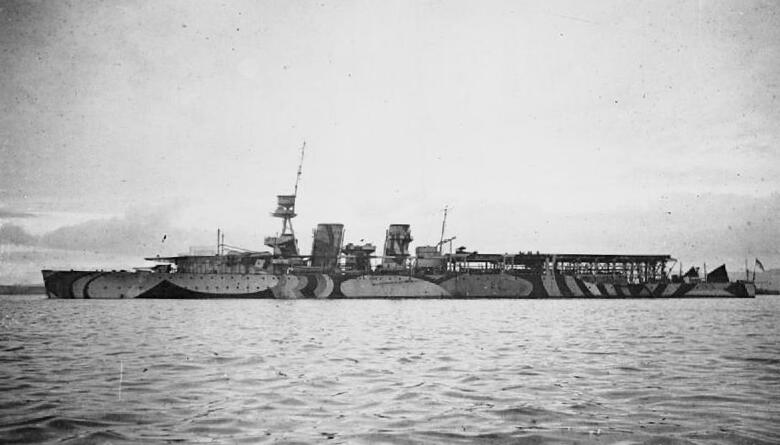
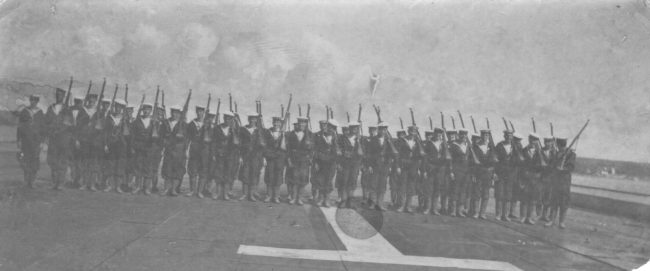
Reginald caught influenza and developed pneumonia. He was one of three ratings discharged to Haslar Hospital on 2nd March. Vindictive was paid off into the reserve in 4th March 1920.
Reginald died of pneumonia on 16th March and was buried in All Saints Churchyard in Branksome on the 23rd. His was not a war grave but because he died in service and within the qualifying period of 4th August 1914 to 31st August 1921 he is commemorated by the Commonwealth War Graves Commission.
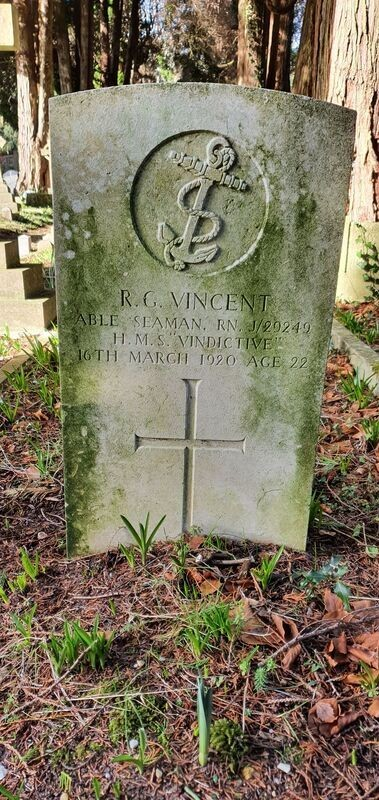
Source: Commonwealth War Graves Commission
Reginald was awarded the 1914 – 1915 Star; the British War Medal (1914 – 1920); and the Allied Victory Medal (1914 – 1919). These medals were sent to his father after his death.