
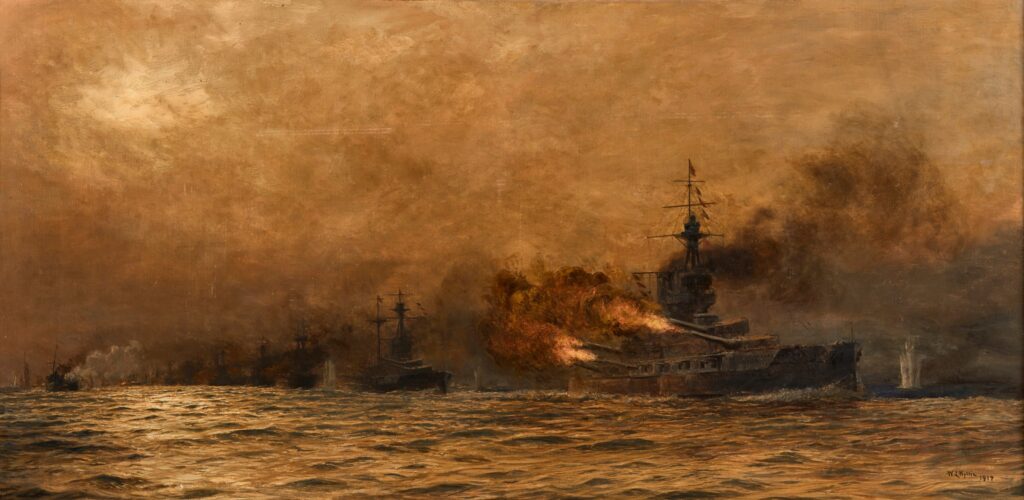
H.M.S. Acasta’s story caught the imagination of many including the maritime artist William Lionel Wyllie. She can be spotted in a number of his works. Wyllie included Acasta and her cheering crew in the painting he made of the Iron Duke for Admiral Jellicoe. Acasta is the ship pouring out steam on the far left as you look at the picture.
Here is a pencil study of the same scene.

And another version which appeared as an illustration in “More sea fights of the great war, including the battle of Jutland” by W.L. Wyllie, C. Owen and W.D. Kirkpatrick.
This version was described in the text as follows:
“An illustration of another incident which shows the indomitable spirit of the British sailor faces p. 146. Acasta, as was told in our last chapter, was very badly mauled in her encounter with German light cruisers, and was finally so damaged that she lay drifting close to the course of the British battleships. She had a list to starboard, two large holes just abaft the third funnel, one large hole forward on the port side, and sat very low in the water, her guns and torpedo tubes still trained abeam as they had been during the action. As the fleet flagship Iron Duke came rushing by, firing her guns and leading her division, the men of the plucky little destroyer rushed out, forming a line from the forecastle head to right aft, and gave their Commander-in-Chief three hearty cheers. Acasta was afterwards taken in tow by Nonsuch and brought safe to port.”

The following picture, which appeared in the same book,…
“… is a picture of the rival fleets seen from farther west. On the extreme left our destroyers are seen driving off a torpedo attack launched by the Germans at 7.10. Beyond are the battleships of the High Seas Fleet. The wash of the Iron Duke is seen upon the water, and Royal Oak is following, firing her 15-inch guns at the distant Germans. Superb and the handsome Elswick ship Canada are in her wake, All are in hot actrion. Benbow is seen beyond, leading her division to starboard, and in the smoky distance are Marlborough and the ships of the First Battle Squadron.”
Acasta can be seen in the background between Royal Oak and the very large water plume in the foreground of the picture.

Wyllie received letters from Lt Commander Barron containing details of the damage that Acasta sustained during the battle. The letters have been sold by Abe Books but their whereabouts are unknown.
