
Charles Finley was born in St. James, Westminster (Piccadilly) circa 1813. No baptismal record has been found for him so the names of his parents and his relationship to other family members in Westminster are unknown.
Records concerning the Finleys in Westminster become easier to find with the introduction of the census even though the surname is spelt in every conceivable way – Finley, Finlay, Fenley, Finly, Findley, Findlay… When the 1841 census was taken Charles’s relations were living in the area known as the Devil’s Acre. James Finley [born bet. 1786 and 1790], his brother Thomas [born c1793] and Thomas’ wife Elizabeth [born in Lambeth] were living in Duck Court off Duck Lane. It is probable that either James or Thomas was Charles’s father. James was described as a labourer and Thomas a porter. George, the bricklayer son of Thomas, was living with his wife Martha and children George and Thomas just a stone’s throw away in Pump Court, Perkin’s Rents. Young Thomas died shortly after the census was taken and was buried on 22nd June.
The Devil’s Acre was a notorious slum area in Westminster. Charles Dickens described it as “The most deplorable manifestation of human wretchedness and depravity.” The word slum was originally a slang word for room especially a back room. By the 1820s slum or back slum was used to describe a dirty back alley populated by poor people. Places like Duck Yard and Pump Court.
Charles and his family were in Portsmouth in 1841 but by 1847 they too were in the Devil’s Acre. Son Nicholas was born at 41 Orchard Street on 17th January. The family were at the same address when Mary Ann was born on 26th November 1848. By the time daughter Ellen was born on 1st October 1850 the family were residing at 20 Old Pye Street.
In the mid-1840s the authorities decided to ‘improve’ this part of Westminster by demolishing and rebuilding it. As the ‘improvements’ took place over the following years the poor and destitute were forced into an ever decreasing number of cheap properties or into other areas. The result was horrendous overcrowding in the home of the poor in Westminster. By January 1849 the Commissioners had acquired all the buildings that needed to go to make way for the planned Victoria Street, which included Orchard Street, and were ready to begin demolition. This accounts for Charles and his family moving to Old Pye Street. The changes that occurred between 1851 and 1869 can be seen in the following two maps:
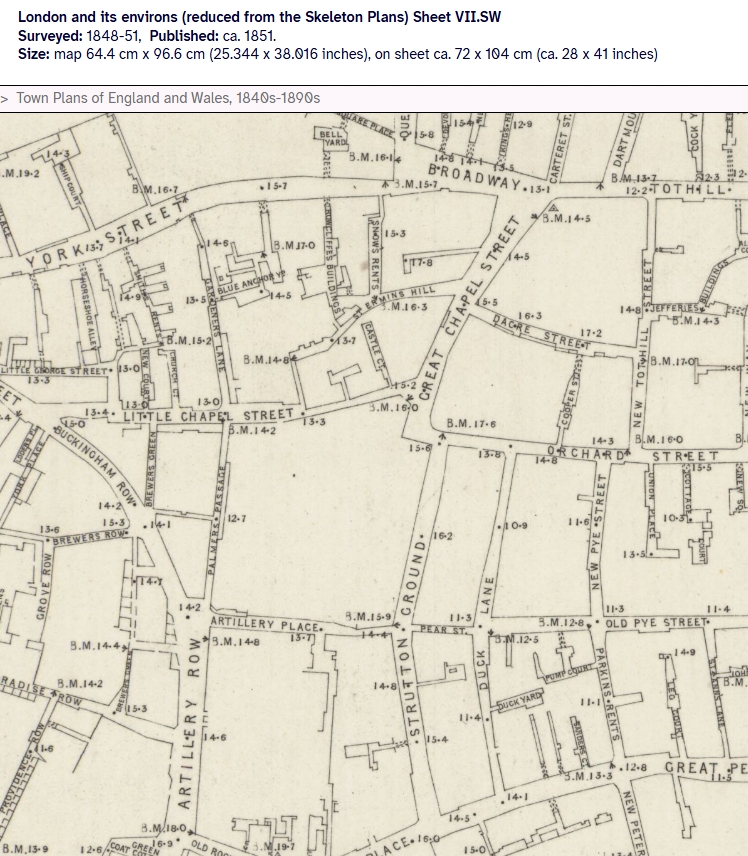
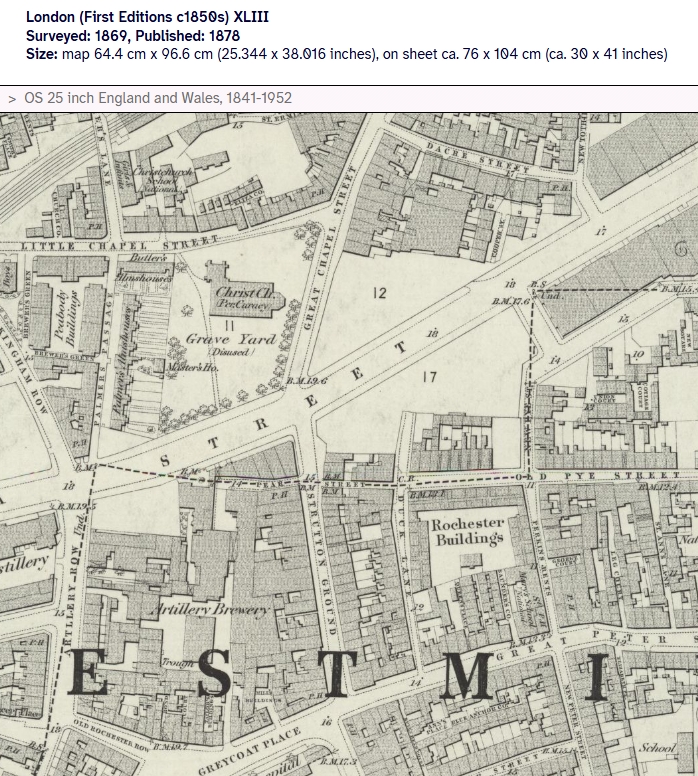
Reproduced with the permission of the National Library of Scotland
Andrew Walker, the London City Mission Missionary to Westminster, had started working in the area in 1838 and in April 1839 he established what would later be known as a Ragged School in a stable in New Pye Street. By 1850 there were 7 Ragged Schools and 1 dormitory in Westminster. The school that had begun in the stable in New Pye Street had moved into premises which had previously housed the Green Man beer house on the corner of Pear Street and Duck Lane.
It seems that Thomas’s family took advantage of the educational opportunities on offer at the Ragged Schools. Going forward they wrote their surname “Findley” even if not everyone else did! In contrast Charles’s family do not seem to have received much, if any, education. Although Charles could sign his name none of his children was able to write their name at the time of their marriage.
The Catholic Mission Chapel of St Mary had opened in Horseferry Road on 16 July 1814. Behind the chapel (in Medway Street) were 3 cottages which were used as a Minister’s house and school. There is no baptismal record for Nicholas but both Mary Ann and Ellen were baptised in the Chapel of St Mary.
In 1850 the Catholic Hierarchy was restored to England; the Jesuits took over the Mission in Westminster and Cardinal Nicholas Wiseman was appointed the first Archbishop of Westminster. Cardinal Wiseman wrote wrote:
“Close under the Abbey of Westminster there lie concealed labyrinths of lanes and courts, and alleys and slums, nests of ignorance, vice, depravity, and crime, as well as of squalor, retchedness, and disease; whose atmosphere is typhus, whose ventilation is cholera; in which swarms of huge and almost countless population, nominally at least, Catholic; haunts of filth, which no sewage committee can reach – dark corners, which no lighting board can brighten.”
By the time the 1851 census was taken James was dead. Thomas and Elizabeth were at number 8 Duck Lane. With them were 20 year-old Caroline and 13 year-old Emma Finley who were recorded as being their daughters. There is a problem with this as neither girl was with them in 1841. I have been unable to find out how they were related. George, now a costermonger, and Martha were living in 2 Perkin’s Rents with their son George and daughter Mary (born in 1846). Charles Finley was away in Brighton on census night but wife Ann and children John, Nicholas, Mary Ann and Ellen were all at 20 Old Pye Street.
Martha gave birth to a son named Thomas Frederick in 1852. Charles’s family had left Westminster and were in Plymouth by late 1853 when daughter Julia was born.
George the younger married Sarah Anne Robinson Q2 1859. Their son Thomas George was born soon after and baptised at St Stephen, Rochester Row on 24th August. In 1860 Emma Finley married John Sullivan. They already had two children. John the younger had been baptised [as Finley] in the Roman Catholic chapel of St Mary. There were no Roman Catholic baptisms among the Westminster Finley’s until those of Charles’s children so it is unlikely that they were a Catholic family. Rather it appears that some members of the Finley family converted to Catholicism when they married a Roman Catholic.
The Old Tun pub at number 3 Perkin’s Rents had once been a notorious thieves’ den. As a result of the efforts of Adeline Cooper money was raised to convert the building into a ragged school. The school opened in 1858. During the conversion nearly a bushel of counterfeit gold and silver coins were discovered behind one of the walls!
When the 1861 census was taken Thomas and Elizabeth were next door to the school in Gibben’s Lodging House, 4 Perkin’s Rents. With them were their grandchildren John and Caroline Sullivan. Thomas was recorded as a labourer while Elizabeth was working as a char woman.

Sarah Ann died after the birth of her son Thomas George in 1859 and George and baby Thomas were with George and Martha on census night. Also with George and Martha were daughter Mary and son Thomas. Both Georges are recorded as being general dealers.
Charles and his family have not been found in the 1861 census.
Martha died in 1865. By 1864 George the younger was co-habiting with Sarah Sandfield. Over the next few years George and Sarah had 4 children: George born in 1865; John born in 1867; Martha born in 1870 and Charles born 1871. Martha was baptised on 11th March but died at the beginning of April. Martha’s body was still at home when her mother was stabbed by a drunken stranger on 4th April. The attack was reported by The Sun (London) the following day.

Mary Kennedy, who had previous convictions for assault, was tried and found guilty of wounding on 12th April. She was sentenced to 6 months at the Westminster House of Correction.
In 1871 Thomas and Elizabeth were at 96 Great Peter Street. Their son George the elder was living in 1 Perkin’s Rents adjacent to the ‘One Tun’ ragged school. Living with him were daughter Mary, a laundress, son Thomas and grandson Thomas. All three men (Thomas the younger was only 9) were working as woodcutters.
None of Charles’s family were in Westminster when the 1871 census was taken. Charles himself has not been found in the census.
Thomas Finley died in 1872 at 4 New Court Orchard Place and his wife Elizabeth died in 1876.
George the younger and Sarah had 3 more children: Frederick born 1875; Mary Ann born 1877 and James born 1879. Their son Charles had died.
The slum clearances continued apace throughout the 1870s and into the 1880s. The ‘One Tun’ Ragged School moved in 1879 and the Finleys/Findleys moved to the outer edges of the Acre.
Charles’s daughter Julia had married John Williams in 1874. The Williams family travelled a lot but they were frequently back in Westminster and most of their children were baptised in St Mary’s Chapel. They were lodging at 82 Great Peter Street when their daughter Julia was baptised 1879.
On Boxing Day later that same year Julia and her sister Ellen assaulted Emily (or Emma) Stephens, landlady of the Star and Garter pub at 19 Great Peter Street. Only by being contrite and apologising did they avoid a prison sentence. Both women were bound to keep the peace for 12 months.
Thomas Frederick married Caroline Hodges in 1880. They already had two children Francis, born 1877, and James, born 1879. In 1881 Thomas was a coal dealer living in 83 Great Peter Street.
In 1881 George the elder was living at 5 Artillery Square with wife Sarah and children John, Frederick, James and Mary Ann. George was a general dealer with a shop, John and Frederick were both road sweeper scavengers and Mary Ann was a domestic servant. George the younger was a general dealer hawker living at number 1 Artillery Square with his wife Sarah and children Sarah, Ellen, George and Elizabeth.
John was attacked by a Grenadier Guard on 12th May 1882. The assault was witnessed by his uncle Thomas and the trial was reported in the London Evening Standard of 15th May.
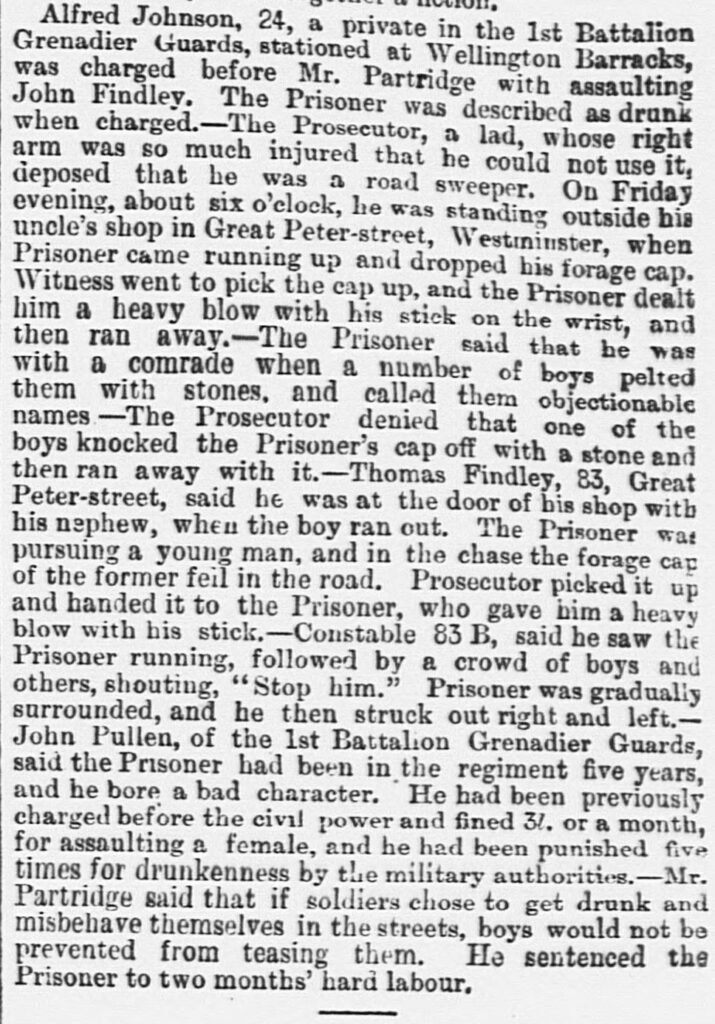
In 1885 Thomas Frederick was residing at Mills Buildings, Great Peter Street and by 1889 he was at 8 Romney Street.
Charles Finley was living at 8 Medway Street when he was admitted to the workhouse prior to his death on 20th September 1886. Over the course of his life he had witnessed tremendous changes in Westminster. By the time of his death the old Devil’s Acre had been swept away. Only the road names remained. The members of his wider family had either moved away from the Westminster or been pushed out to its outskirts.