
Julia Finley was the author’s great-grandmother.
Julia was the youngest child of Charles Finley and his wife Ann (formerly Smith). She was born in Devonport, Plymouth on the last day of November 1853 and baptised in St Mary’s Church, the Roman Catholic Pro-cathedral, a few days later. Her father Charles was born in St James, Westminster and mother Ann in Wicklow, Ireland. Julia’s father was variously described as an engraver, a turner, labourer, hawker, pedlar, general dealer or carpenter. The family spent the winter months in the city, usually in Westminster, and tramped the south of England hawking and doing seasonal work such as fruit and hop-picking.
No one in the family has been found in the 1861 census. In the autumn of 1866 they were hop-picking in East Farleigh, Kent, where Julia’s eldest sister Mary Ann married Charles Henry Randall. Her other sister, Ellen, married Henry Finley in Exeter in March 1871. When the census was taken a couple of weeks later on April 2nd 1871 Julia, mother Ann, sister Ellen and brother-in-law Henry were in Poole, Dorset staying in what was described as the “Upper Strand Lodging House for Tramps etc”. As the crow flies the distance between Exeter and Poole is 67 miles. Charles Finley has not been found in that census.
Julia married comb maker John Williams on 26th Nov 1874 in the Parish Church, St Mary Lambeth (Church of England). It wasn’t that unusual for Roman Catholics to marry in a protestant church. At the time the Catholic Church recognised as valid any lawful marriage. A Church of England marriage was cheaper than a Catholic one – only the vicar had to be paid. A Catholic marriage required payment to the priest and also to the registrar.
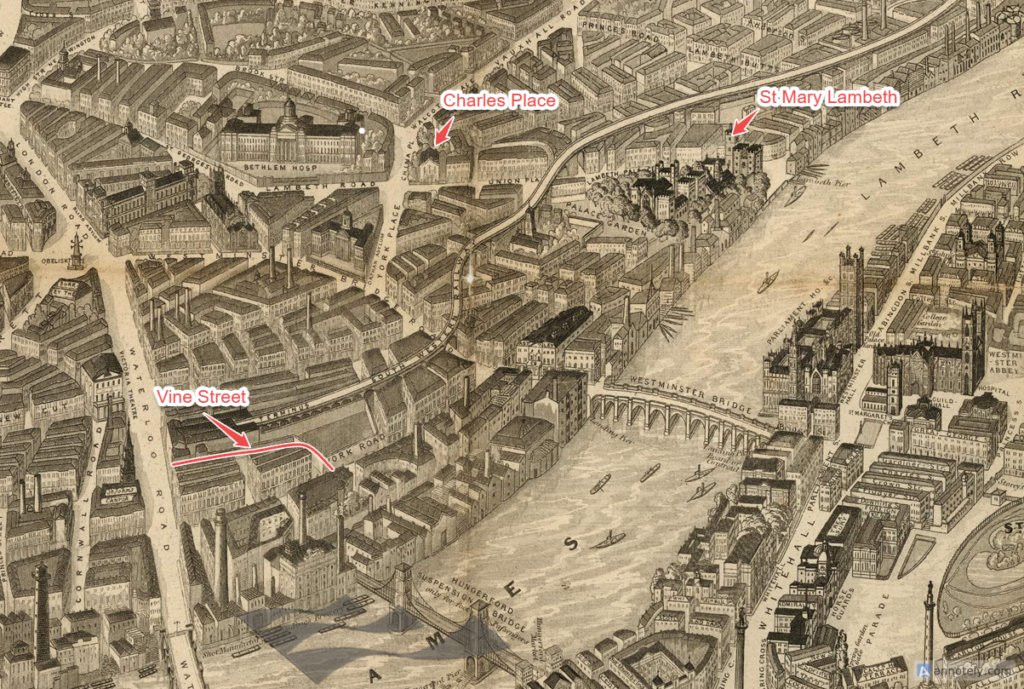
Prior to her marriage Julia was lodging in Vine Street, Lambeth. Vine Street no longer exists. It stood where Waterloo Station is now and was one of the streets worst affected by the annual flooding of the Thames prior to embankments being built following the passing of the Thames River Prevention of Floods Acts in 1879. The witnesses to the marriage were Julia’s brother in law Charles Henry Randall, hawker of brushes, and Thomas Nettlefold, collector of tolls on Lambeth Bridge. John, Charles and Thomas all signed their names. Julia could only make her mark.
As hawkers St Mary’s church was an appropriate place for John and Julia to marry. It is said that in the 1400s a pedlar who had made good gave the church an acre of land, known as Pedlar’s Acre, on the condition that his and his dog’s likenesses were preserved forever in a window in the church. The image to the right shows the Pedlar’s window in St Mary’s church, Lambeth as it appeared at the time of her marriage. This window was destroyed in 1941 and was replaced by another. Pedlar’s Acre was just to the north of Westminster Bridge.

The Williams family had an itinerant life style. The birth places of the children and census records show the range of their tramping. The children were baptised but few of their births have been found in the registers. It may be that some of the births were not registered or that they were registered late or in unexpected places. Registration had to be done within 6 weeks of the birth otherwise a fee was payable. There are documented cases where an incorrect date of birth has been given (i.e. it doesn’t tie up with baptismal information) to avoid having to pay the late registration fee. Given that several of Julia’s children persistently used the wrong date of birth it is possible that this happened too.
John and Julia’s first son, John, was born in August 1876 in London but he survived only a few weeks. Eliza Williams (John’s mother) was his godmother. In September 1877 Julia gave birth to a son, Charles, in Birmingham. The Randall’s were also in Birmingham at the time and were named as the boy’s godparents. John’s occupation was given as hawker on the birth certificate.
Julia gave birth to a daughter, Julia, on 4th June 1879 in the Isle of Wight. The little girl was baptised in St Mary’s Catholic Chapel in Horseferry Road at the end of July when the family were back in Westminster and lodging at 82 Great Peter Street.
Henry Finley, Julia’s brother-in-law, died of alcohol poisoning in Winchester on 25th June 1879 having drunk a pint of whisky in 15 minutes after making a bizarre drinking boast.
On Boxing Day Julia and her sister Ellen assaulted Emily (or Emma) Stephens, landlady of the Star and Garter pub, 19 Great Peter Street. The case was reported in the London Daily Chronicle.
London Daily Chronicle 30 December 1879
WESTMINSTER.
THE HOLIDAYS.- There was a list of 21 charges yesterday at Westminster… one case was of a very flagrant character. Ellen Finlay, a widow, aged 30, was charged before Mr. Partridge with being concerned with another woman in being drunk and disorderly on licensed premises, and assaulting Mrs. Emma Stephens, landlady of the Star and Garter public-house, in Great Peter-street, Westminster.-Mr. W. Doveton Smyth prosecuted, and it appeared that between eight and nine on Boxing Day the prisoner and another woman, generally thought to be her sister, entered the house of the complainant, and asked for a Christmas-box. She refused them, and then they asked for a pot of beer; but, knowing the prisoner, she refused to serve her, whereupon she and the other woman commenced to clear the counter of the glasses and measures, beer and gin being thrown over the prosecutrix, the measures not striking her by reason of the fact that she had to dodge about the bar to avoid the difficulty of the position, and a length took refuge in the bar-parlour, and sent for protection. She at once sent for the police, as the place was in an uproar, but when they arrived the prisoner and the other woman had decamped. The prosecutrix was determined to do all she could to conduct her house in a respectable manner, despite the conduct of the prisoner and others who had annoyed her before, and whom she did not wish to enter her house again.- Prisoner was remanded, without bail, for the apprehension of the other woman.
London Daily Chronicle 1st January 1880
WESTMINSTER
WITHDRAWL OF A PROSECUTION.- Ellen Finlay was charged on remand, and Julia Williams brought up in custody, charged in being concerned together in assaulting Mrs. Emily Stephens, landlady of the Star and Garter, Peter-street, Westminster, on Boxing Night.- Mr W. Doveton Smyth appeared for the prosecution and Mr. B.V. Hutchinson defended. – The prisoners, it appeared, had during the remand, expressed their contrition for what had occurred, and the prosecution was now willing to accept an apology, and bail for their future good conduct.- Mr. Partridge allowed this course to be adopted, bound Finlay over her own recognisances in £20 to keep the peace for twelve months, and accepted the husband of Williams for a like sum and term.
Ellen and Julia were from a local family. Their father Charles had been born in St James circa 1812. The newspaper report tells that Ellen was not the only person who had annoyed Mrs Stephens and been refused service. This would not have endeared Mrs Stephens to the locals and by the time the 1881 census was taken she was no longer at the pub.
£20 in 1880 was the equivalent of £3000 today (2024) and an enormous amount for people like the Williams’. If the Julia had got into trouble in the following 12 months John would have been sent to prison if they were unable to pay the £20. Having the prosecution withdrawn and being bound over meant that Julia avoided a criminal record.
Charles Williams died in Chorlton, Lancashire later that year aged just three.
The 1881 census shows John, Julia and daughter Julia in Cheetham, Prestwich, Lancashire. John was a cutler working on his own account.
Three more daughters were born over the next decade: Mary born Brighton 1883; Anna (Annie) born Westminster 25 June 1885 and baptised 23rd August when the family were living at 71 Tufton Street; and Ellen, born London 7th July 1887 and baptised 31st July 1887 when the family were at 9 Carey Street. (Not THE Carey Street which has been home of the London Bankruptcy Court from 1883 but another Carey Street which was off Vincent Square.)
Charles Finley, Julia’s father, died of bronchitis in St George’s Union infirmary on 20th September 1886.
A destitute Julia together with her daughters Annie and Ellen were admitted to St George’s Union Workhouse in Fulham Road on 4th November 1889. Her sister Mary Randall’s name was given as a contact. They were discharged on 13th at Julia’s own request. John was probably away on tramp at the time and Julia must have run out of money. With no money not only would she be unable to pay for lodgings and food but she would also have been out of stake money with which to buy stock to sell. It is not known where daughters Julia and Mary were at this time. Possibly they were being looked after by Mary Randall or maybe since they were school age, Julia, who was a devout Catholic, left them with the Sisters of Nazareth in Fulham. The second option would have required her to find the entrance fee which was charged to defray the cost of bedding.
In 1891 the census shows John and Julia and their daughters Julia, Anna and Ellen in Cheltenham, Gloucestershire lodging in a single room in the home of bootmaker Richard Mills at 10 St George’s Street. Young Mary was not with them. Mary was an inmate in Nazareth House, Fulham, London, a large institution run by Catholic Sisters of Nazareth for the old and infirm of both sexes and orphan, incurable and abandoned children.
On May 31st 1891 Julia’s mother, Ann, died after being badly beaten by Scottish tinker William Crawford. Crawford was tried at the Old Bailey and found guilty of her manslaughter. He was sentenced to 5 years penal servitude.
Julia and John had two more children both of whom were born in Westminster. John Joseph Vincent, born 9th December 1891 and baptised 3rd January 1892 when they were living at 1 Carpenter Street and daughter Florence Katherine, born 17th August 1893 and baptised 10th September when the family were residing at 55 Vincent Street.
In the spring of 1901 Julia and John and five of their children, including Mary, were in Tormoham, Torquay, Devon. They were sharing 26 Church Lane with the labourer John Coyde and his family. Her daughter Julia had married in 1899 and was living in Boscombe, Bournemouth. Young Ellen died in Bournemouth from a burst appendix in 1902 aged just 15.
On 18th November 1905 Julia was fined 7s including costs for exposing articles for sale on the West Cliff. At the time the family were living at 178 Spring Road, Boscombe.
Mary and her baby daughter, also named Mary, died on the Isle of Wight in 1907. Husband John Williams died from epithelial cancer of the tongue in Christchurch Union Workhouse Infirmary at the end of January 1911. Then at the end of 1911 daughter Julia died having been predeceased by 7 of her 8 children (which included a set of boy triplets).

Neither Julia, John junior or Florence have been found in the 1911 census. It is probable that they were heeding the call of the Suffragette movement to boycott it.
After John’s death Julia settled in Boscombe, Bournemouth. She and her family had always lived in rented rooms and she now in turn rented out rooms in their home. When WWI started Julia was living at 42 Roberts Road in Pokesdown. At the end of August a Mrs Lewis from Bitterne in Southampton sent her a postcard (see left) cancelling her booking “on account of the war”.
Troops, including possibly some from New Zealand, may well have been billeted with her in the war years.
At the beginning of 1918 Julia was living at 38 North Road. When the census was taken in June 1921 Julia was still living there with her daughter Florence who was working as a domestic help. John, who had served in the Royal Navy and had been at the Battle of Jutland, was serving in the Canadian Navy. The following year Julia and Florence moved in with daughter Annie and her family who were living at 298 Windham Road.
Sometime around 1922/3 Julia was admitted to Park Prewett Mental Hospital. Park Prewett was the second County Asylum for Hampshire (The first was at Knowle). It had been completed during the war but was requisitioned as a Military Hospital and used by the Canadian Army. The hospital was eventually handed back to Hampshire and opened for its original purpose in August 1921. The hospital catered for long-stay elderly and mentally infirm patients. It was nearly 60 miles away from Julia’s previous home.

“Park Prewett had open wards but with locked doors, no lockers, no privacy, bars at the always-shut windows. Cutlery was ‘shortened’…. there was no medical control, just physical manhandling. Patients were bored and frustrated with only a few allowed to help on the farm or do menial tasks.“ Rosemary Bond June 2019 TADS Newsletter
Julia’s daughter Florence had fallen in love with John Menzies, one of the troops from New Zealand stationed in Boscombe at the end of the war, and in April 1922 Florence sailed to New Zealand to marry him. John had returned to New Zealand in March 1919 so it seems probable that Florence delayed joining him until care for her mother could be arranged.
At the end of August 1939, on the eve of the second World War, all but eighty of the 1400 patients at Park Prewett were evacuated and the hospital was taken over by the Emergency Medical Service to provide beds for civilian and service casualties. Julia was one of the 175 women patients taken to the Somerset and Bath Mental Hospital in Wells. The transfer went without mishap, she arrived at the hospital at 2.40 am on the 28th and was in bed by 4.10 am having had some refreshments! There was a much more enlightened regime at Wells compared to Park Prewett but there was overcrowding and staff shortages because of the war.
Julia died at the hospital on 25th November 1939. The death certificate gave her prime cause of death as Erysipelas with which she had suffered for four days (and which now would be treatable with a course of antibiotics). The secondary cause was senile decay (mentally infirm with age). Her ‘home’ address was given as 298 Windham Road where Annie and Harry Best had not lived until 1926. Julia was not buried in the Hospital Cemetery. The Hospital Register of Females names Park Prewett as the ‘Union to which Chargeable’ and her case notes were returned to them. When Park Prewett closed their patient records were offered to Hampshire Archives. Because of the large quantity it was decided to take a sample 10% and the rest, Julia’s amongst them, were destroyed. It is not known where she was buried.